

PN is supported by paid subscribers. Become one ⬇️
When Democrats running for office saw a poll released by Politico last week finding that “three in five Americans believe gas prices in their area have risen by more than they actually have,” they surely couldn’t help but smile.
Ignorance and misperception about basic facts have always been a fundamental part of American politics, but now it’s working to the advantage of Democrats for a change.

Not that they need to exaggerate on that score, since the national average for regular gas is now over $4 a gallon — not as high as it was in May, but about a dollar more than it was for most of 2025. After prices fell a bit over the last couple of months, they’ve spiked again, just in time for the home stretch of the midterm election campaign.
Even Republican voters are mad, and they’re blaming the president.
The Washington Post interviewed one man who said voting for Trump was “the worst three mistakes I’ve ever made in my life.” Trump hasn’t kept his promise to lower gas prices, which “have been costing his family an extra $300 to $500 every month for their motorcycle and four cars,” the paper reported. While that may be more than most, the increase since the start of the war has meant tens of billions of dollars in increased costs for consumers.
Even if people are justified in being mad, the politics of gas prices don’t exactly bring out the best in America, either its politicians or its voters. The issue is full of misunderstanding, unfair blame-placing, foolish policymaking, and absurd posturing.
Nevertheless, no president has ever deserved to be hoisted on the petard of gas prices more than Donald Trump. That’s not only because of how he weaponized the issue against his opponents before, but because unlike almost every other president, Trump is actually responsible for where the price of gas is right now.
Signs, signs, everywhere a sign
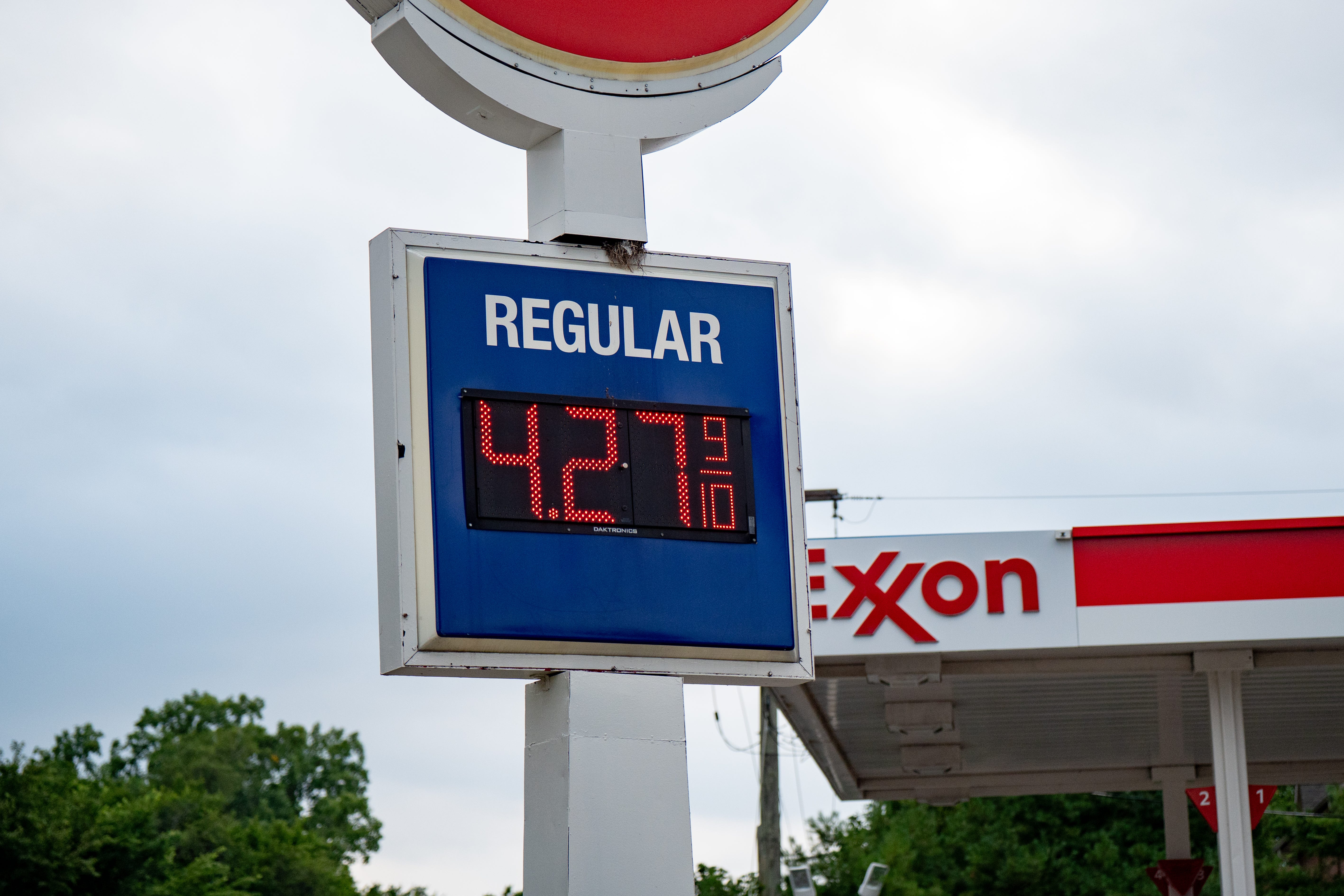
Gas prices are a unique economic indicator because not only do most Americans have direct experience with them, street corners in every city and town feature giant signs telling all who pass by what the price is.
The price of no other product is advertised so heavily and invasively, and as a nation that loves its gas-guzzling SUVs and pickups, we can’t help but notice when the cost of a fillup goes up.
Voters blame the president, even though he usually has little or no control over the what gas costs. Oil is sold on global markets; though the US is the world’s largest producer (and has been since 2018), the decisions of foreign countries, as well as disruptions from war or natural disaster, will affect the price we pay.
But whenever the price goes up, a few things usually happen.
Immediately, the opposition party blames the president. Candidates start airing ads in which they pretend to fill up their pickups, lamenting the high prices. The public demands that politicians do something to bring the price down. The president claims he’s moving boldly to address the problem. And because he has so few tools at his disposal, he often orders the release of millions of barrels from the Strategic Petroleum Reserve, a stockpile that is supposed to be held in reserve should the country face a genuine emergency.

Every president since Ronald Reagan has released oil from the reserve at one time or another in an attempt to bring down prices by increasing supply. Trump released oil from the SPR to counter the supply shock caused by Hurricane Harvey in 2017; then gas prices plunged when the world went into lockdown during covid; then when everyone went back to work, the price spiked again, so Joe Biden released oil from the reserve; and now Trump has been releasing more.
Today, the stockpile is at its lowest level since 1983, and the same lesson goes unlearned at every release: While injecting some supply onto the market can bump gas prices down a bit, the decline is inevitably small, and prices soon return to where they were beforehand.
That’s a story of presidential futility in the face of global market forces. In a better world, the electorate would understand that the president is almost never to blame when gas prices go up, and shouldn’t get credit when the price comes down. But because voter outrage at high prices is so potent — and will inevitably be aimed at the party in power — both parties have an incentive to pretend that gas prices are in the president’s control.
Trump’s chickens are roosting
There is one exception to the general rule that presidents don’t have much control over gas prices: Donald Trump. He can’t bring them down, but he certainly sent them up.
When he ran for president in 2024, Trump relentlessly blamed Biden for the post-covid price spike. Conservatives slapped stickers on gas pumps with a picture of Biden reading “I did that!”, the Republican Party called it “Joe Biden’s gas hike,” and Trump promised that if he were elected, the price would fall to under $2 a gallon.
Prices did stay low during 2025, following the trend they were already on — and the fact that Trump had nothing to do with it didn’t stop him from taking credit (or claiming that prices were even lower than they were).
But then he made a fateful decision: starting a war with Iran.

Despite being warned by his aides that Iran would respond to his attack by making it impossible for tankers to traverse the Strait of Hormuz, he went ahead anyway. The result was a predictable supply disruption that plunged the entire world into an energy crisis.
Even so, it wasn’t quite as bad as many had predicted. While prices jumped in the first months of the war, oil never topped $200 a barrel as the most dire warnings had it, for a number of reasons including China’s decision to slash its oil imports, reducing pressure on world markets. But now, after a dip following the temporary ceasefire, not only have prices gone back up, but some experts are warning that unless the war comes to a complete end soon, we could be headed for a prolonged period of high prices.
But will the war come to an end soon — say, before November 3? We can’t know for sure, but it looks like Trump is still convinced that if he just keeps bombing, the Iranian government will eventually capitulate. Which means the war will go on, the strait will remain mostly closed, and the energy crisis will continue.

[At this point we should acknowledge that there is one group of Americans who doesn’t care about high gas prices: people who drive EVs, an industry Trump has attempted to destroy. It’s also worth remembering that widespread EV adoption would bring down the price of gas for everyone by reducing demand.]
Unlike at prior times of high gas prices, there is little ambiguity about who is to blame. You don’t have to understand global markets or know the difference between Brent Crude and West Texas Intermediate. There’s a simple story to tell about the price at the pump: Gas prices were pretty low, then Trump started a war, and now they’re high.
That story may not be particularly nuanced, but it’s mostly true. Crucially, even Republicans believe it. In a recent Politico poll, 57 percent of self-identified MAGA voters, along with 63 percent of all voters, said the Iran war is responsible for the increase in gas prices.

There aren’t going to be too many voters who call themselves MAGA and will vote for Democrats because Trump made gas prices go up. But Democrats don’t need them to. It’s enough if the persuadable voters who believed Trump when he told them that he’d bring down the price of everything — including gas — are mad that he broke his promise and decide to send him and his party a message.
In fact, if the Iran war drags on and gas prices stay high, this could wind up being as decisive a campaign issue as Trump’s misbegotten tariffs, his parade of idiotic construction projects, his rampaging incompetence, or his boundless corruption.
Of all the ways a president could tank his political standing and sabotage his party’s chances of success in an upcoming election, few are as straightforward as directly causing an increase in the price of gasoline at the pump. Yet Trump has managed it. He truly is a president like no other.
That’s it for today
We’ll be back with more tomorrow. If you appreciate today’s PN, please do your part to keep us free by signing up for a paid subscription.
Thanks for reading, and for your support.
Previously, Trump claimed to have ended eight wars in eight months … amazingly, he has also ended the war in Iran some 34 times! Gotta be a new record.
Political Science is complex. Politics is pretty simple. The news coverage is incomplete. Otherwise, Trump would never have been elected nor even rich. The many talking heads on TV and the overwhelming inanity of the manosphere podcast business have not informed the general public well enough for people to learn that politics shape our lives daily, deeply, and constantly. “I don’t follow politics,” is both incorrect and inane. Every penny spent is a political choice and statement.