

This edition of PN is made possible by paid subscribers. Become one ⬇️
It won’t come as news to Public Notice readers that the Supreme Court, in the hands of the worst chief justice of all time, John Roberts, has been uniquely, unrelentingly malign. But often, the damages wrought are masked, clothed in technical and arcane language, coming across as nothing more than a debate about how many angels can dance on the head of a pin.
Sometimes, though, a decision comes along that’s crystal clear, one where it takes no history degree, no law degree, no STEM degree, no anything, to see how horrifically wrong things are.
It might seem kind of doomer-y to be lamenting the outcome in Trump v Barbara, the birthright citizenship case. After all, per CNN, “the conservative Supreme Court dealt a significant blow” to Trump’s immigration agenda. Per the New York Times, “the justices reaffirmed the long-held principle that nearly all children who are born on US soil are American citizens.”
Why whine when the good guys won 6-3 or 5-4, depending on how you’re counting?
Because it never should have been this close.
Because the Fourteenth Amendment says what it says.
Because our history is what it is.
Because Republicans are already planning their next moves, with Vice President JD Vance bragging that birthright citizenship is “hanging by a thread” and Sen. Rand Paul rushing to introduce a new constitutional amendment.
Manufacturing dissent
Honestly, this shouldn’t have been a case that needed to be addressed in all but the most summary fashion.
The only role for a functional Supreme Court would have been to deny a cert request from the Trump administration by saying, basically, “Did the lower court stutter?” Instead, we came within one vote of letting the very worst people in the country run roughshod over one of America’s sacred compacts, or, as Michael from the 5-4 Podcast put it, “we are one John Roberts heart attack away from the complete dissolution of the reconstruction amendments and instantiation of a formalized caste system.”

Literally the only thing that could be said to be a net good from this opinion is that at least it is bracingly clarifying as to the views of Justices Samuel Alito, Neil Gorsuch, Brett Kavanaugh, and Clarence Thomas. Four of the members of the highest court in the land, the keepers of the constitutional flame, stood ready to adopt an ahistorical reading of the Fourteenth Amendment that flies in the face of its history and plain text and guts the very concept of American citizenship because Trump wants it that way.
You might wonder why it makes sense to lump Kavanaugh in with the rest of the genuinely immoral reprobrates who dissented, given that he concurred in the judgment itself. That’s because Kavanaugh only concurred on technical grounds, since in his reading Trump’s executive order purporting to ban birthright citizenship violated 8 USC 1401(a): “The following shall be nationals and citizens of the United States at birth: (a)a person born in the United States, and subject to the jurisdiction thereof.” He doesn’t see any problem with banning birthright citizenship as such, and doesn’t think Trump’s order violated the Fourteenth Amendment.
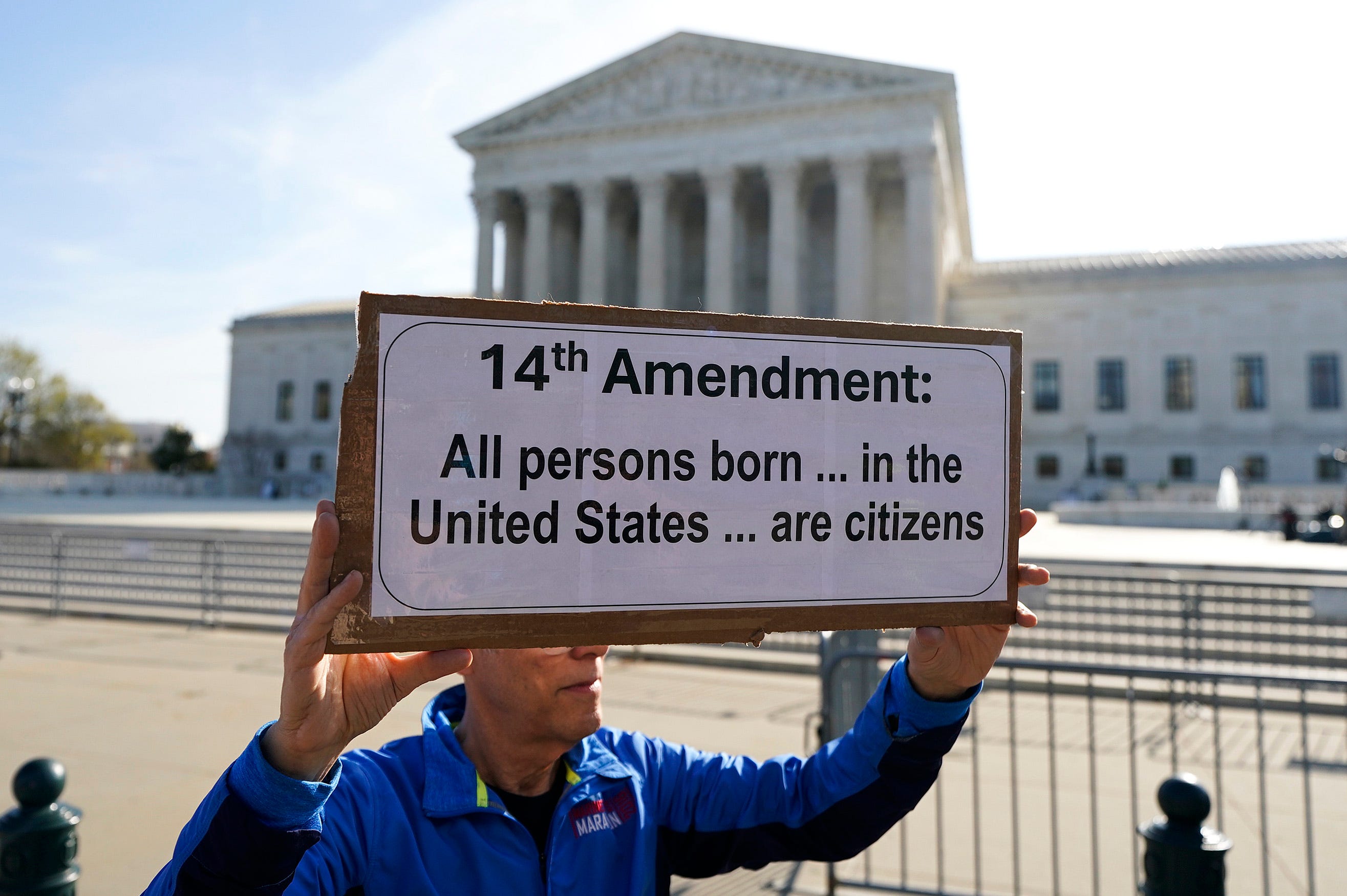
Now to take a little look-see at the relevant language of the Fourteenth Amendment to illuminate the workings of Kavanaugh’s big legal brain: “All persons born or naturalized in the United States, and subject to the jurisdiction thereof, are citizens of the United States and of the State wherein they reside.”
If you’re flicking your eyes between the statute and the amendment and trying to figure out how the language is meaningfully different, you’re not alone.
If you’re casting about trying to remember your 10th-grade civics class and how you learned that the Constitution is the supreme law of the land and Congress can’t pass laws that contradict it, you’re not alone there either.
At root, Kavanaugh’s real beef is just that the executive branch isn’t the proper entity to wipe out birthright citizenship, but if Congress could just scooch on through with a bare majority voting in favor of wiping it out, that’s totally cool.
Kavanaugh even tried to dress this up as if there is some meaningful debate that he’s teetering on the edge of: “The constitutional issue is not straightforward, much as we might want it to be.”
Let’s call this little permission slip “manufacturing dissent.” It’s at the core of what happened here, and it’s why the justice most likely to bring a beer bong to work got taken to task here first.

What Kavanaugh, Alito, Gorsuch, and Thomas all agree upon is the idea that somehow the notion of birthright citizenship is not well-settled constitutional law in the United States, that we’ve somehow been having a robust debate all along, or perhaps that somehow only Donald J. Trump figured out we’ve been Constitution-ing wrong for the last 150 years.
Conservatives — justices and otherwise — got themselves to this point thanks to some very morally pliable law professors who somehow discovered heretofore-unnoticed things in the historical record that undermine the actual text of the Fourteenth Amendment.
This isn’t a new playbook for conservatives. Rather, it’s the playbook they deployed so successfully in getting rid of abortion rights — flood the discourse with bad-faith, scientifically illiterate “information” to shore up the idea that there is some great debate as a way to undermine a core constitutional principle.
It almost worked. And now, just like all the times conservatives got thisclose to banning abortion before they finally pulled it off, they’re going to keep trying.

But here’s where this case feels meaningfully harder to swallow, even for those of us who spent years in the trenches of the abortion fight. The decision in Roe v. Wade required some heavy lifting in terms of the Constitution, which doesn’t explicitly have a right to privacy anywhere in it. The constitutionality of abortion in Roe rested upon the constitutionality of birth control in an earlier case, Griswold v. Connecticut, where the majority held that a right to privacy is found in the “penumbras” emanating from the First, Third, Fourth, Fifth, and Ninth Amendments.
This is the sort of thing we actually want from the nation’s highest court: grappling with the text of our founding documents, of the nation’s history, to maximize the protections of its people. All of its people. We rely on them to see what we don’t, to have the institutional knowledge to translate the sometimes-impenetrable combination of statutes, regulations, and constitutional principles into something comprehensible to guide us forward. We trust that perhaps our plain-language reading of the law is insufficient and that yeah, these folks are probably the experts at figuring out whether an 800-page environmental regulation conforms to congressional intent and the Constitution’s separation-of-powers requirements.
But we need not grant the conservatives on the Roberts court any such grace here.
The Fourteenth Amendment is breathtakingly clear — both its language and the history underpinning it. Its passage was not only compelled by the end of the Civil War but by the need to fundamentally, explicitly repudiate the Supreme Court’s Dred Scott decision from 12 years before. Put another way, we needed to change the Constitution to undo the Supreme Court’s bone-deep racism, a way to prevent the Court — and, for that matter, future Congresses — from doing it all over again.
That should have been the end of it. And, barring a few of the worst types of Lost Cause cranks on the right, it largely was. But then those people found a champion in Trump, and Trump almost managed to find the right court to do something this wrong.
What’s old is new
The Constitution is not a functional document if it can be swept aside so easily at the behest of a fascist sitting atop the executive branch. The Constitution is not a functional document if it can be overruled by a simple majority in Congress. The Constitution is not a functional document if it can be gutted based on a handful of members of the nation’s highest court so eagerly deciding to abdicate their duties.
As constitutional law professor Evan Bernick put it yesterday, “Nothing bad in the United States is ever over, including constitutional things. These were the same arguments rejected over a century ago, and they’ll be back again and we’ll have to kill them again.”
That’s it for today
We’ll be back with more tomorrow. If you appreciate today’s PN, please do your part to keep us free by signing up for a paid subscription.
Thanks for reading, and for your support.
The first priority for the Democrats if they reach a majority in the House this November should be to pass articles of impeachment against Kavanaugh, Gorsuch, Alito and Thomas. That is just how serious the corruption of the Supreme Court has become. We can wait until 2029 to enlarge the Court, but something substantive must be done NOW...
Outstanding. I read Kavanaugh’s concurrence with horror. The fuck is wrong with people like that? And Alito’s dissent left me in shock. That such people walk among us appalled me. And that they would dare write such things terrifies and dismays me beyond words. Thank you.