

This edition of PN is made possible by paid subscribers. Become one ⬇️
President Trump likes to say that thanks to him, the United States is now “the hottest country in the world.”
Were that actually true, the World Cup, which begins this week, would be an extraordinary showcase to attract people from all over the globe, show them the wonder of America, and leave them with even more admiration and affection for us than they had before.
Alas, that’s probably not what will happen. The soccer will surely be exciting and the international rivalries intense, but Trump will hover over the event like a noxious cloud, turning things sour wherever his influence is felt. He may not manage to ruin it completely, but he’ll make it worse in every way he can.

At the heart of the event lies a dispiriting contradiction: The World Cup is supposed to unite the world in a spirit of brotherhood and joy, yet it’s being hosted by a xenophobic, bigoted president who has done everything in his power to shut America’s doors to the world.
For the first time, the tournament is being held across three countries, the US, Mexico, and Canada. But it’s mostly America doing the hosting: 11 of the 16 venues are in the US, and three-quarters of the games — including all those from the quarter-finals on — will be played here. And while some of the less appealing features of the world’s most important sporting event are familiar — including corruption and profiteering — others have a distinctly Trumpian cast.
Everyone cashes in
The Fédération Internationale de Football Association (FIFA), which governs the sport, had been beset by corruption scandals when the current president, Gianni Infantino, took over as president a decade ago. While he stabilized the organization’s finances and the sport is more popular and profitable than ever, critics argue that Infantino rules soccer like a dictator. Which makes him a kindred spirit to our president.
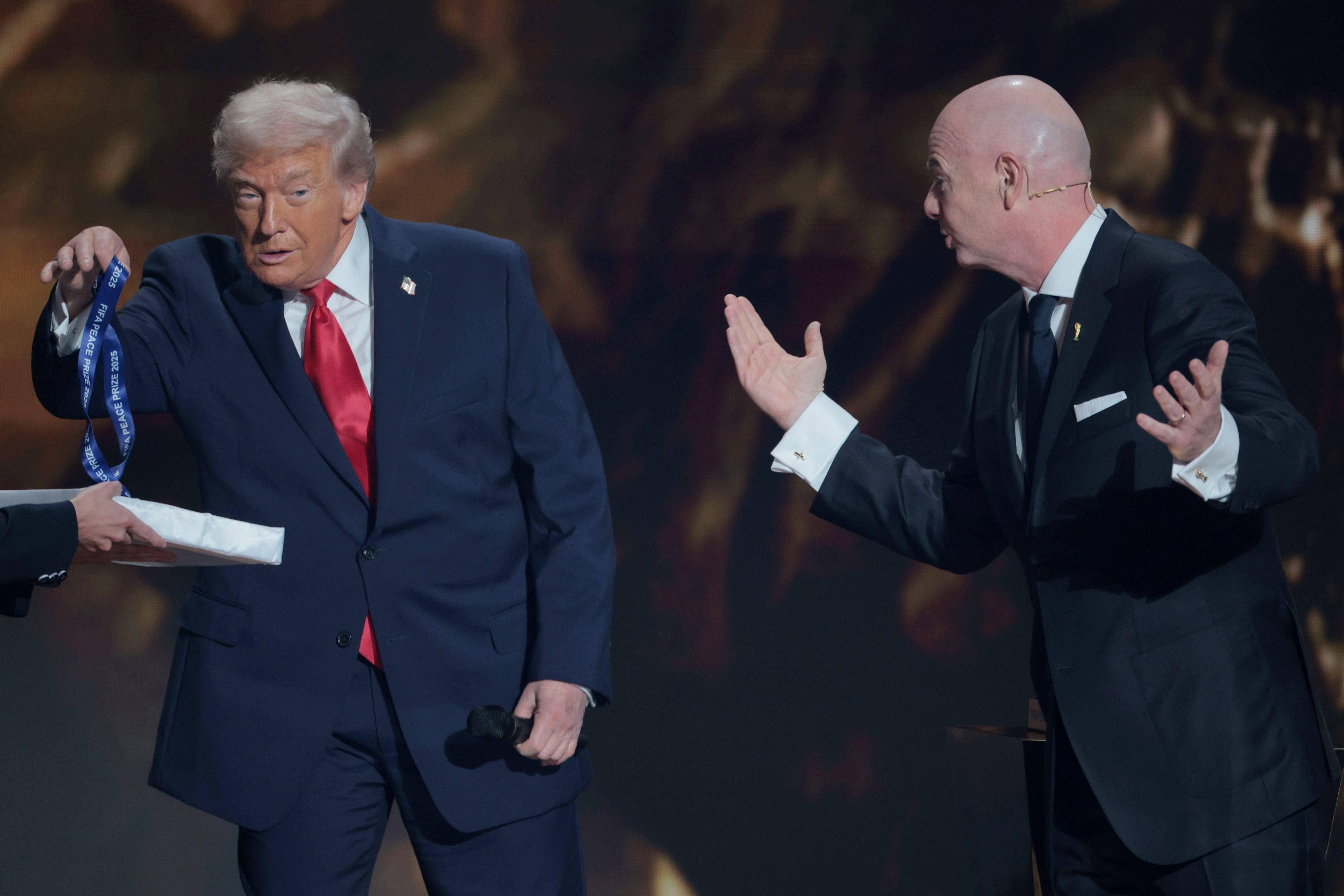
So it wasn’t really a surprise when Infantino came to the World Cup draw event and presented Trump with the “FIFA Peace Prize,” an award they made up to win Trump’s favor. (Watch below.)
Playing off the president’s petulance over not being awarded the Nobel Peace Prize, it was about as subtle as over-indulgent parents presenting their bratty child with “The 2026 Donny Is a Very Special Boy Award.”
In addition to the gold trophy, “there is also a beautiful medal for you that you can wear everywhere you go,” Infantino told Trump, who clearly loved it. Infantino has become a close Trump ally and informal foreign policy advisor; he has traveled with Trump in the Middle East, showed up at the first meeting of Trump’s “Board of Peace” for Gaza (donning a MAGA hat!), and even rented office space for FIFA in Trump Tower.
Meanwhile, those who want to attend the World Cup will be paying through the nose. Ticket prices have been shockingly high; prices for the cheapest nose-bleed ticket at a first-round game now range from the mid-hundreds for a matchup between two small countries up to a couple thousand to see the most popular teams like France or Spain. If you want to see the first US game in Los Angeles, there’s almost no seat available for less than $1,000.
After the group stage, in which four teams play a round-robin and the top two proceed to the knockout rounds, tickets will get substantially more expensive. Attending the final in MetLife stadium in the Meadowlands will cost you anywhere from $8,000 to $57,000.
Fans will have every spare dollar squeezed out of them even after they’ve bought their tickets. Last week, FIFA announced that attendees would be barred from bringing water bottles into stadiums, despite worries about extreme heat that could affect players and spectators alike. Could this benefit the Coca-Cola corporation, sole vendor of drinks at all World Cup events? Perish the thought.
After an immediate backlash (New York Mayor Zohran Mamdani called it “concerning,” and Toronto Mayor Olivia Chow said it was “a pure money grab”), FIFA backtracked slightly, saying fans in the US and Canada (but not Mexico) can bring one soft-sided, sealed water bottle of no more than 20 ounces. Getting to games may also be pricey: NJ Transit is charging $98 to take a train from Penn Station in Manhattan to the Meadowlands for a match, a half-hour ride that usually costs $12.90. You could park at the mall a mile’s walk away — but you’ll have to pay $225 for that privilege.
All that nickel-and-diming can’t be laid at Donald Trump’s feet; it’s familiar to anyone who has attended a large concert or sporting event in the last few years. But he is having an effect on the tournament, largely through the way he has dampened the willingness of people from around the world to come to America, even for this.
A diminished nation
When the Pew Research Center surveyed people in 24 countries last year, it found that in 15, the number of people expressing favorable opinions of the United States had fallen significantly from the year before. There’s little doubt about why; a median of 62 percent of respondents across the nations said they had no confidence in Trump to do the right thing in foreign affairs. And that was before he launched a disastrous war in Iran that has spiked energy prices across the globe.
More relevant to the World Cup is the fact that Trump’s anti-immigrant policies have made news across the world, with the unmistakable message that America doesn’t want people to move here and might even prefer if they didn’t visit (unless you’re a white Afrikaner from South Africa). We’re forbidding travelers from some countries, and telling others we want to scrutinize their social media to see if they’ve expressed opinions the administration doesn’t like (you know the ones). The result is inevitable.
“I’ve never known Europeans — or a world — as anti-American as they are today,” the Financial Times’ Simon Kuper recently wrote.

Unsurprisingly, fewer tourists want to come here. In 2025, we suffered the largest decline in international tourism in over two decades, with four million fewer visitors than 2024 and $8 billion in lost income for American businesses.
Particularly notable was the steep drop in visitors from Canada, who make up a quarter of all tourists to the US. This was a direct result of Trump’s insanely counterproductive hostility to our northern neighbor, expressed in both policy (i.e. tariffs) and rhetoric. It is simply impossible to overstate how offensive all Trump’s talk of making Canada the “51st state” was to Canadians, for whom independence and distinctiveness from the United States is a central part of national identity. Many of them responded by deciding to spend their tourism dollars elsewhere.
Despite the harm to the American economy, the Trump administration doesn’t seem to care; in fact, one sometimes gets the sense they’d be happy if nobody ever came to our shores. Homeland Security Secretary Markwayne Mullin recently threatened to stop customs processing of international flights to all “sanctuary cities,” which could mean no international travel to New York, Los Angeles, San Francisco, Seattle, Chicago, Philadelphia, or Boston.
Think that might put a damper on tourism?
Now there are signs that fewer foreigners are coming to the World Cup than expected. The San Francisco Chronicle reports that Airbnb owners and some ticket buyers hoping to resell their seats aren’t getting the demand they expected around the games taking place just outside San Francisco. A Chronicle review showed “plenty of rooms available for roughly $200 a night within walking distance” of the stadium.
It’s not just San Francisco. A report released in May from the American Hotel & Lodging Association found that most of the members they surveyed in cities with World Cup venues were seeing bookings below what they had forecasted.
“Visa barriers and broader geopolitical concerns are significantly suppressing international demand, cited by close to 70 percent of respondents across most markets,” the report said.
Thanks to dynamic pricing, the astronomical cost of some of those tickets will likely drop as the games approach — since many of the games haven’t sold out. Prices on the resale market are already dropping.

The truth is that once the competition begins, the spirit that makes soccer the world’s most popular sport will kick in; even Trump can’t dampen fans’ enthusiasm for watching their countries compete. The 2022 World Cup in Qatar was sullied by evidence of corruption and exploitation of migrant workers, yet interest was undimmed; the global audience for the final between Argentina and France was estimated at 1.4 billion. But this time, many have already decided to watch at home rather than make the trip.
Late last year, Infantino brought the World Cup trophy to the Oval Office and gave it to Trump to hold.
“Can I keep it?” Trump said. “We’re not giving it back. It goes very well on the wall right over there.”
Everyone laughed, perhaps a little uneasily. We’ll see if the World Cup will be just one more thing Trump manages to spoil.
That’s it for today
We’ll be back with more tomorrow. If you appreciate today’s PN, please do your part to keep us free by signing up for a paid subscription.
Thanks for reading, and for your support.
The title of Rick Wilson's 2018 book sums it up quite succinctly: "Everything That Trump Touches Dies."
I'm struck by the top picture. Dec. 5, 6 months ago. If you look closely, he seems to have a bruise on his left hand. That right hand & especially its fingers are terribly swollen. We see the rightward slant of his mouth, sign of a left hemisphere stoke. The peri oribital edema is also present. But compare it to say a pic from Thur's "Clean Coal" event. He has visibly worsened in those 5, 6 months. By a lot.