

PN is supported by paid subscribers. Become one ⬇️
“Bidenflation.”
Throughout the 2024 campaign, Donald Trump, his supporters, and the national punditry invoked that term to indict President Biden’s economic policies. Although Biden actually reduced covid-induced inflation in the United States from 7.2 percent in 2022 to 2.4 percent by 2024, Trump won a second presidential term by capitalizing on consumer angst about high prices.
Put me, a genius businessman, back into office and I will solve America’s inflation woes, he promised.
Trump’s problem now is all three of his major second-term policies are raising prices across a range of commodities, but especially housing, food, and gas. Reducing the immigrant labor pool, imposing tariffs on imports, and the Iran War are costing consumers billions in higher out-of-pocket costs.
Americans are finally starting to realize the great business “genius” is an economic imbecile.
Clueless
Let’s start with Trump’s signature policy: xenophobic, ICE-led attacks on immigrants.
Nobody believes the United States should have open borders and zero restrictions for immigrants seeking either full citizenship or temporary work visas. But the ineluctable fact is that immigrant workers are good for the economy because their labor lowers domestic production costs and keeps inflation down.
That fact is especially true for the construction and food industries. Almost no commercial or residential work site operates without immigrant labor, and few agriculture products are harvested, picked, shipped, processed, cooked, or served without immigrant labor.

Immigrants comprise roughly 30 percent of the construction trade workers who build America’s commercial and residential properties. The construction industry confirms that 92 percent of member firms report production delays as a result of labor shortages caused by the “chilling effect” of Trump’s brutal ICE policies. An untold number of workers not already removed from the country by the government are no-showing for work. Trump has worsened America’s housing affordability crisis.
As for groceries — a term Trump, who has probably never food-shopped in his life, infamously marveled at — almost every calorie of food Americans consume that is not harvested from private gardens is cooked at home from fresh or processed foods purchased at markets, or are restaurant meals prepared from similar food sources.
According to the United Farm Workers, about 70 percent of farmworkers who process the crops to make those meals are immigrants, 45 percent of them undocumented. In addition to higher food prices, removing these workers creates supply chain and food safety issues. Whether prepared at home, ordered for take-out, or eaten at restaurants, meals are cheaper thanks to immigrant labor.
To complement his inflation-inducing immigration policy for domestic goods, Trump continues to prosecute a moronic, reckless, and unconstitutional tariff policy that effectively imposes a national sales tax on imports.
Based solely on trade imbalance rates, the administration’s original tariff policy was so “fake and incredibly stupid,” as that notoriously left-wing business rag Forbes described it, that Trump’s advisers created a phony mathematical formula with Greek letters to make the tariff rates calculated for each trading nation seem sophisticated.
Worse, Trump imposed or threatened to impose tariffs on specific goods or countries in wildly unpredictable ways. He continues to use tariffs as his primary trade war weapon despite the Supreme Court’s February ruling that his initial tariffs scheme was illegal (he is now citing different authorities to justify them).
But even if his policy was rational, consistent, and legal, Trump’s tariffs failed to bring foreign leaders and producers to their knees and beg him for relief.

Confused, disgruntled nations have responded by either imposing reciprocal tariffs on American exports, as Canada did this week, or by gradually marginalizing the United States within the global marketplace by inking better trade deals with good-faith nations led by sane politicians.
The result? Consumers so far have footed the bill for Trump’s reckless tariffs through higher retail prices for imports. The Tax Foundation estimates that Americans spent an average of $1,000 more in 2025, and will pay another $840 in 2026, in retail spending. Worse, the Foundation estimates that these tariffs reduce America’s long-term GDP growth rates by 0.4 percent.
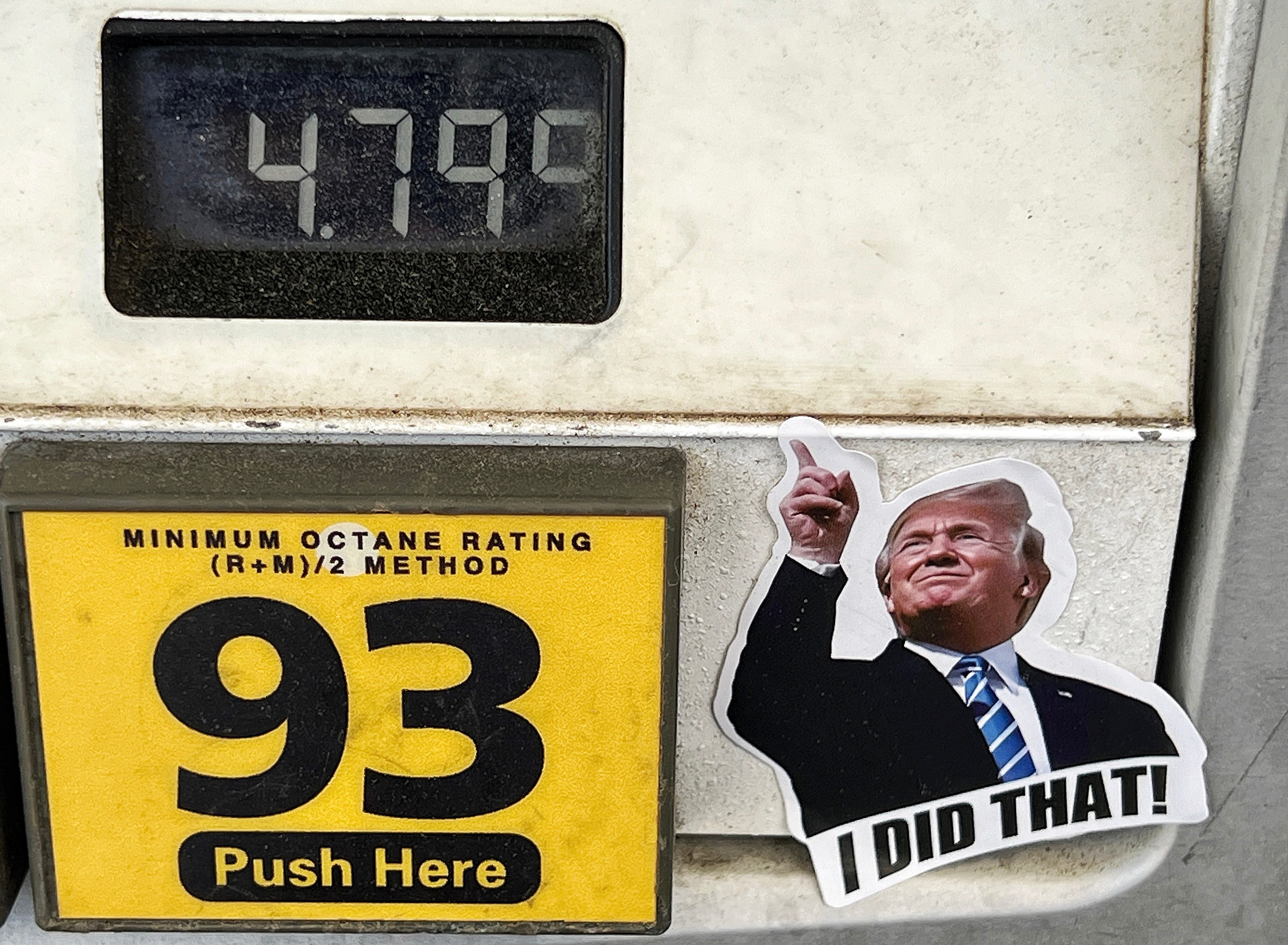
If higher prices on both domestic and imported goods were not enough, Trump found yet another way to raise prices: He started an unnecessary war with Iran, which led to six months (so far) of bottle-necking the Strait of Hormuz, causing oil prices to soar.
Crude oil prices this week reached $100 a barrel, and the price of diesel fuel rose to record highs. Rising fuel costs are uniquely inflationary because, as those in the diesel-dependent trucking industry love to remind consumers, “if you bought it, a truck brought it.” When their fuel costs rise, trucking companies pass those costs along in the former of higher shipping bills for retailers, who promptly pass this added expense along to consumers in the form of higher prices.
B-level students in high school economics courses understand this. But not Trump!

What he and Vice President JD Vance do understand, however, is the practical and economic ignorance of their supporters, which is why they shamelessly lie about the causes of recent price hikes at the pump.
“The reason gas prices are so high now is because the Iranians are shooting at commercial shipping,” Vance said. “Gas, frankly, could have been much, much higher were it not for our efforts.”
Vance’s first claim is technically true, but the latter is a blatant lie; there would be no need for Iranians to shoot at oil tankers had Trump never started this needless war. Not to be outdone by obsequious sidekick, Trump recently told an even bigger fib: “We have the Strait of Hormuz in extremely good shape.”
In short, Trump’s immigration-induced higher prices for domestic goods and his tariff-induced higher prices for imported goods have for the past six months been compounded by higher fuel costs induced by his disastrous Iran war.
Touching the stove (again)
Donald Trump is ruining a US economy he fundamentally misunderstands — beyond, of course, his impressive and insatiable facility for crudely extracting billions of dollars in graft for himself and his family.
Trump’s economic ignorance and history of business failures — which include serial casino bankruptcies and marketing belly-ups like Trump water, Trump jets, Trump steaks, and Trump University — would be funny were he not heading the world’s largest economy, with millions of Americans’ livelihoods at stake.

Why voters expected a self-proclaimed business “genius” who can’t compute basic percentages to understand global macroeconomics shall forever remain the central mystery of Trump’s rise and return to power. With short memories and a loose grip on economic theory, Americans fooled around and elected Trump to solve post-covid inflation that the United States under Biden’s leadership mitigated better than other Western democracies. Now those same voters are finding out the hard way that Trump’s three major policies — immigrant labor purges, tariff-based trade wars, and the Iran war — are inflationary and compounding in their effects.
Matters are getting worse. Food and housing prices continue to rise. Last week, fuel prices, especially for diesel, surged. And this week the price of a 10-year US Treasury note, upon which banks set their rates for car and home loans, is higher than at any point in Trump’s second term. The next 48 hours could be key: Later today the government will release the latest producer price index and tomorrow comes the latest consumer price index data. These indicators will bear significantly on the Federal Reserve’s decision whether to raise interest rates to curb inflation.
Almost as soon as he returned to the Oval Office in January 2025, Trump began moaning about high interest rates. He derided then-Federal Reserve chair Jerome Powell — whom Trump appointed during this first term — as a slow-footed incompetent. When Trump finally got the chance this past May to replace Powell with Kevin Warsh, Trump expected Warsh to obediently cut interest rates.
But Warsh can see the same economic indicators that realtors, mortgage brokers, bond traders, car dealers, construction companies, importer-exporters, and smart American consumers do. Which is why the new Fed chair already hinted that the Fed is likely to raise interest rates this autumn. Warsh knows what his predecessor did: That the American economy is being crippled by the inflationary policies of the very person who appointed him.

In an alternate universe where Republicans were held to the same standard of governing competence as Democrats are, the Trump administration would already be saddled with the term “Trumpflation.” Predictably, Trump is trying to shift blame for inflation elsewhere: on Joe Biden, Canada, the Federal Reserve Board.
But Donald Trump owns this economy now — and he should, because his ignorant, short-sighted economic policies created it.
That’s it for today
We’ll be back with more tomorrow. If you appreciate today’s PN, please do your part to keep us free by signing up for a paid subscription.
Thanks for reading, and for your support.
"Why voters expected a self-proclaimed business “genius” who can’t compute basic percentages to understand global macroeconomics shall forever remain the central mystery of Trump’s rise and return to power."
The solution to this mystery might be the absolute failure of the "Media" to honestly report the truth of who this man is. From Fox to the NYTs emails, emails, emails, old Biden, old Biden, old Biden.....and basically quietude on T's insane unfitness. Genius con sold across the land.
On September 7 2026, US Secretary of Agriculture Brooke Rollins posted on X that certain meat prices were lower than in 2022. (Link)
https://x.com/SecRollins/status/2097049215901831246
I had recently visited the meat department at a local Kroger outlet and was intrigued by the price for beef chuck. Sec Rollins posted, "This Labor Day, enjoy your favorite proteins at some of the lowest prices in 4+years….Beef chuck: $6.02/lb -- lowest since 2022...." This price was very much lower than what I observed at the grocery store.
Online, I searched with the terms "beef chuck price month year". The first reference provided the nationwide average price in July 2026. $9.38 per pound.
There was a reference link to St. Louis Federal Reserve database (FRED). A trend chart. (Link)
https://fred.stlouisfed.org/series/APU0300703213
Sec Brooke says the price of beef chuck was higher in 2022 than today? In 2022, the average price range of chuck was $6.23-$6.45 per pound. Sure, $6.02 is less than $6.45, but WHEN, EXACTLY was the price of beef chuck $6.02 a pound? January-February 2021.
$6.02/lb, provided by Secretary of Agriculture Rollins (who has access to all of this information and more.).....“lowest since 2022” was last observed when Trump was inaugurated in 2021. A result of “The Biden economy”?
Since February 2021, with Trump tariffs, trade and immigration policies, the price of beef chuck has been rising.
Trumpflation. Thank you for your attention to this matter.