

PN is supported by paid subscribers. Become one ⬇️
Donald Trump spent the past week cozying up to North Korea and attacking Canada. Whatever claim the US had to be a beacon of free trade — not to mention moral leadership — has been demolished like the East Wing of the White House.
And so it was probably inevitable the president would dig the prototypical failed economic policy of the 20th century out of history’s dumpster and operationalize it against our closest ally.
Smoot-Hawley tariffs are back, baby! Sure, aggressive levies cutting off trade as a means of stimulating domestic industry never worked for those people. In fact, it effectively crashed the global economy and turned a recession into the Great Depression. But it may work for us!

It will not work for us. But it may make us so roundly despised that it galvanizes other countries to reimagine the world order so as to cut out the one, heretofore indispensable nation.
USMCA? Never heard of it!
Upon returning to office, Trump immediately took a Sharpie to “the most modern, up-to-date, and balanced trade agreement in the history of our country, with the most advanced protections for workers ever developed” — also known as the USMCA, which he himself negotiated in 2018 as a replacement for NAFTA
"We don't need anything that Canada has, we don't need anything that Mexico has, but they need everything that we have,” he blustered in June. “We don't need their cars, we don't need their lumber, we don't need their energy, we don't need anything that they have."
This is self-evidently ridiculous.
Canada supplies roughly 80 percent of the potash American farmers use as fertilizer. Midwest refineries are built to run on heavy Canadian sour crude, and the pipeline infrastructure simply doesn't exist to swap in lighter, American-produced oil from places like Texas. Canadian hydropower fuels a significant share of the electricity supply in New York and New England. And the auto and auto parts trade between the two countries, already strained by Trump's steel and aluminum tariffs, is about as integrated as two countries' economies get.
And yet Trump negotiated as if Canadians could never say no, even as he demanded crippling concessions and lobbed humiliating insults at our stalwart ally. Trade talks were at an impasse after 18 months of threats and taunts about annexing our northern neighbor. But in July the prospect of an additional 50 percent levy on a sprawling list of Canadian goods forced Canadians back to the negotiating table. And last week, with the major principles agreed, Trump congratulated both sides for striking “a very fair deal.”
"Our farmers are going to be thrilled; our manufacturers are going to be thrilled," he gushed. "And basically, we have no tariffs going into Canada anymore."
Instead talks collapsed Friday night, when Prime Minister Mark Carney announced he was suspending negotiations and recalling Canada’s negotiators to Ottawa.
By Saturday morning, the Trump administration had levied tariffs on roughly $20 billion worth of Canadian goods — hockey sticks, building materials, beer, cheese. Carney promises dollar-for-dollar retaliation, hitting US steel, dairy, appliances, agricultural equipment, pulp, paper, and electronics starting September 8.
Art of no deal
The New York Times and Washington Post confirm that the deal fell apart because the Trump administration attempted to extract a fresh round of concessions at the last minute.
After domestic companies aggressively lobbied Commerce Secretary Howard Lutnick, the US backpedaled on reductions in steel and aluminum tariffs. Plus Lutnick insisted on excluding Ontario-built heavy trucks (the Ford F-350, F-450, and GM Silverado) in hopes of forcing carmakers to relocate production to the US.
And if you’ve got a problem, that crank Peter Navarro can make it worse.
“Navarro and Lutnick were both yelling at Greer saying: ‘What are you doing? This is stupid. You know, we’re not giving these things away,’” a source told the Post.
Trade Representative Jamieson Greer said the Canadians would never go for it, and he was right.

America’s last-minute demands included: dropping French language labeling and content requirements, an absolute non-starter for the country’s restive Québécois population; getting rid of “buy Canadian” government initiatives while leaving similar “buy American” measures in place; and restoring US-produced liquor to Canadian shelves. That last decision lies with each province, and Ontario Premier Doug Ford told Carney he wouldn’t go along with it.
Trump responded with a grotesque post comparing Ford to his dead brother, calling Carney “Governor,” and lying about Canada’s unemployment rate. (In reality, Canada has a higher labor force participation rate than the US.)
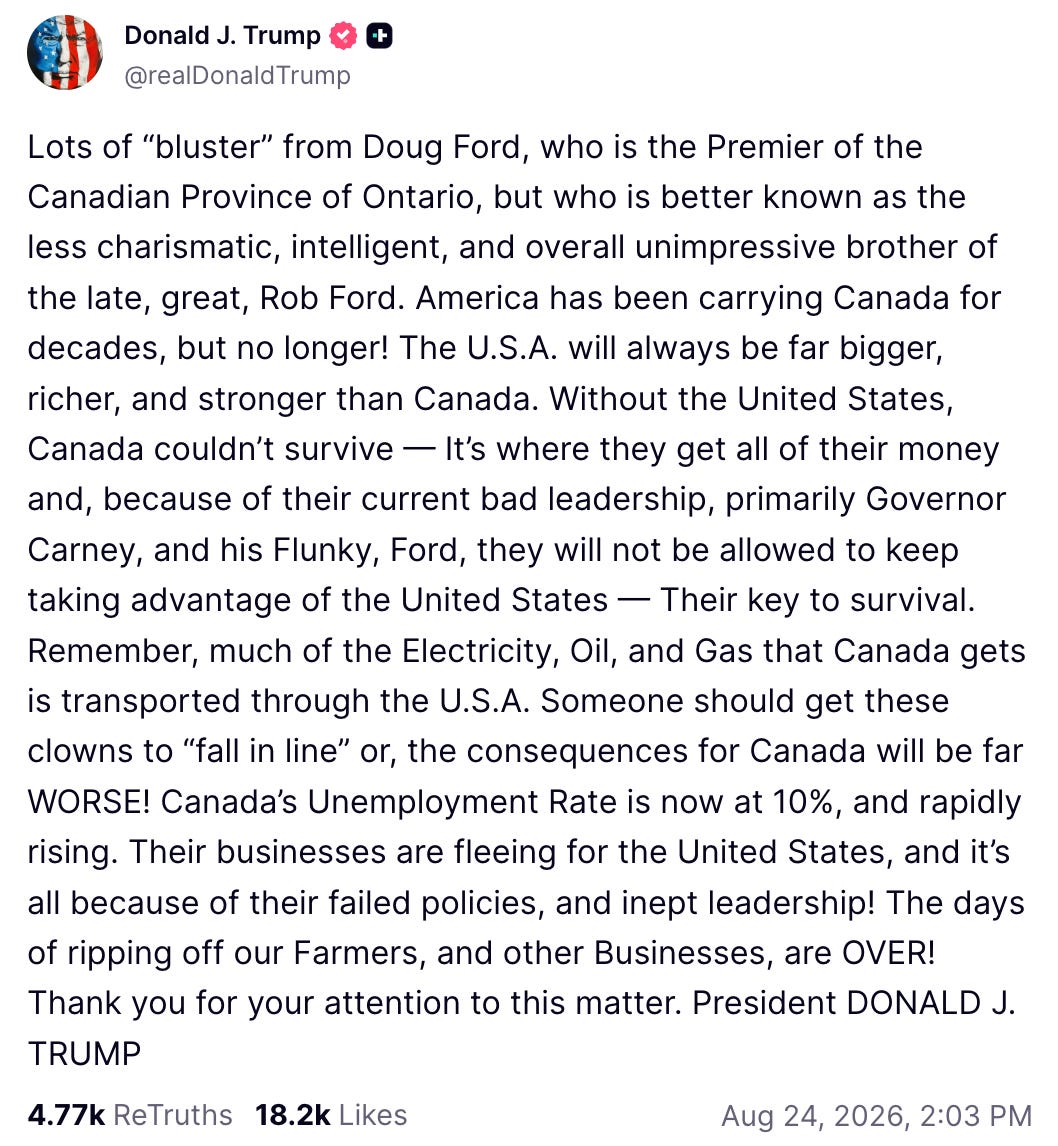
The president is currently shitposting about changing the name of Lake Ontario, “in that we don’t expect to be doing much business with Ontario any longer.”
But what actually killed the deal was a demand that Canada subordinate its independent trade policy to the ever-changing whims of the United States — specifically, that Ottawa agree in advance to match tariffs imposed by Washington, even when it would override Canada’s existing trade agreements.
Per the New York Times:
The United States wanted Canada to apply US tariffs to other countries, particularly when it came to steel, now and in the future: If the United States changed policy and place higher tariffs on certain goods from a third country, Canada would need to do the same, even if it already had a trade agreement in place, a Canadian official said.
American negotiators characterize this as a measure to prevent Canada becoming a passthrough conduit for goods excluded by US tariffs. But no sovereign country could voluntarily surrender its trade policy, much less yoke itself to an erratic neighbor whose maniac leader imposes a new tariff scheme every week.
“Last spring, I warned that America is trying to break us so that they can own us. And I promised: ‘That will never, ever happen,’” Carney said Saturday. “We are keeping that promise. Canada is becoming stronger and less dependent on America. We are already giving ourselves more than they can take away.”
This echoes a major speech Carney gave in January at the World Economic Forum in Davos, in which he exhorted middle powers to band together rather than rely on the United States to ensure their national and financial security.
“You cannot live within the lie of mutual benefit through integration, when integration becomes the source of your subordination,” he warned, adding that “hegemons cannot continually monetize their relationships. Allies will diversify to hedge against uncertainty.”
And Canada is putting its money where its mouth is. Only two nations imposed retaliatory tariffs in response to Trump’s two prior rounds of levies: Canada and China. In fact, that response is now being cited as justification for the latest tariffs.
As America reverts to naked suzerainty, Canada hopes to lead the international resistance movement — yet another reason the Trump administration was so insistent on blocking the country’s power to enter into its own international trade deals.
But a funny thing happens when a world leader actually puts in the effort to explain his policy choices. Carney’s approval rating is at 60 percent, and polls show that 76 percent of Canadians support his decision to walk away from trade talks with the US.
The fallout from these tariffs will absolutely hit Canadians harder than Americans, with potential job losses in the tens of thousands. But Canadians are gearing up for the fight, and a movement to boycott US-made goods is picking up steam. In contrast, Americans feel no patriotic support for Trump’s capricious levies. And as Politico points out, swing state voters really don’t like these tariffs. That may have an impact in November, with the midterms serving as a referendum on Trump’s handling of the economy.
Naturally Susan Collins is concerned. And with Trump’s tariffs about to increase costs for farmers, builders, and autoworkers, she’s got a reason to be — as do her fellow Republicans in Minnesota, Michigan, Wisconsin, Ohio, and Iowa. Because Canada’s leaders have done the work to ensure that their citizens are prepared to absorb the pain from this trade war.
Carney spent the past nine months making the case that Canada must fight back against the United States to ensure its survival. Trump spent that time posting AI slop and pretending that the US has nothing to lose. One of these men has a 30 percent approval rating 70 days before an election.
Looks like it’s time for Tariff Man to test his theories … again.

That’s it for today
We’ll be back with more tomorrow. If you appreciate today’s PN, please do your part to keep us free by signing up for a paid subscription.
Thanks for reading, and for your support.
'When a country (USA) is losing many billions of dollars on trade with virtually every country it does business with, trade wars are good, and easy to win."
No one can cure Trump of his notion that exchanging your money for goods and services you desire means "losing" that money. When exchange is untainted by exploitation, it's advantageous to both parties -- something that whoever took Trump's economics classes at the Wharton School of Business failed to explain to him...
When the movie “Ferris Bueller’s Day Off” is smarter than everyone in the trump administration:
Ben Stein, as the economics teacher:
“In 1930, the Republican-controlled House of Representatives, in an effort to alleviate the effects of the... Anyone? Anyone?... the Great Depression, passed the... Anyone? Anyone? The tariff bill? The Hawley-Smoot Tariff Act? Which, anyone? Raised or lowered?... raised tariffs, in an effort to collect more revenue for the federal government. Did it work? Anyone? Anyone know the effects? It did not work, and the United States sank deeper into the Great Depression. Today we have a similar debate over this. Anyone know what this is? Class? Anyone? Anyone? Anyone seen this before? The Laffer Curve. Anyone know what this says? It says that at this point on the revenue curve, you will get exactly the same amount of revenue as at this point. This is very controversial. Does anyone know what Vice President Bush called this in 1980? Anyone? Something-d-o-o economics. "Voodoo" economics.”