

PN is supported by paid subscribers. Become one ⬇️
MONTREAL: Last week I crossed into Canada from Maine and promptly turned on CBC Television in my Quebec City hotel to watch Conservative Leader Pierre Poilievre’s press conference regarding the ongoing US-Canada trade war.
Standing on the banks of the Detroit River in Windsor, Ontario, with America’s automaking capital in full view behind him, a stern but agitated Poilievre made his fourth public appearance in three days to discuss trade and tariff policy. After complaining about Canadian Prime Minister Mark Carney’s “transparency” during the recent negotiations with President Trump, Poilievre delicately tiptoed between mild criticism of his domestic liberal opponents and measured criticism of Trump, his conservative counterpart across the border.
Poilievre called for the Canadian parliament to hold an emergency session to negotiate the tariff deal that Carney had rejected. Desperately seeking any political opening, Poilievre demanded Carney release all the details — offers and counteroffers from both sides — during the failed negotiations. But Poilievre could do little more than whine about procedure because he knows Canadians, including many of his own Conservative Party supporters, are so furious with Trump that if he dared to praise him or side with the United States in any way he would be committing political suicide.
“Poilievre is screwed,” Dalhousie University political scientist Lori Turnbull told me. “He was anyway. Even in places where Poilievre and conservatives have a stronghold, Carney is eating into their support.”
Everything Canadian Trump touches dies
Privately, Poilievre must despise Trump almost as much as roughly 60 percent of Americans who disapprove of him do.
After all, were it not for Trump’s erratic trade and tariff policies — not to mention his arrogant suggestion that Canada become America’s 51st state — Poilievre would almost certainly now be negotiating US-Canada trade policies as prime minister.
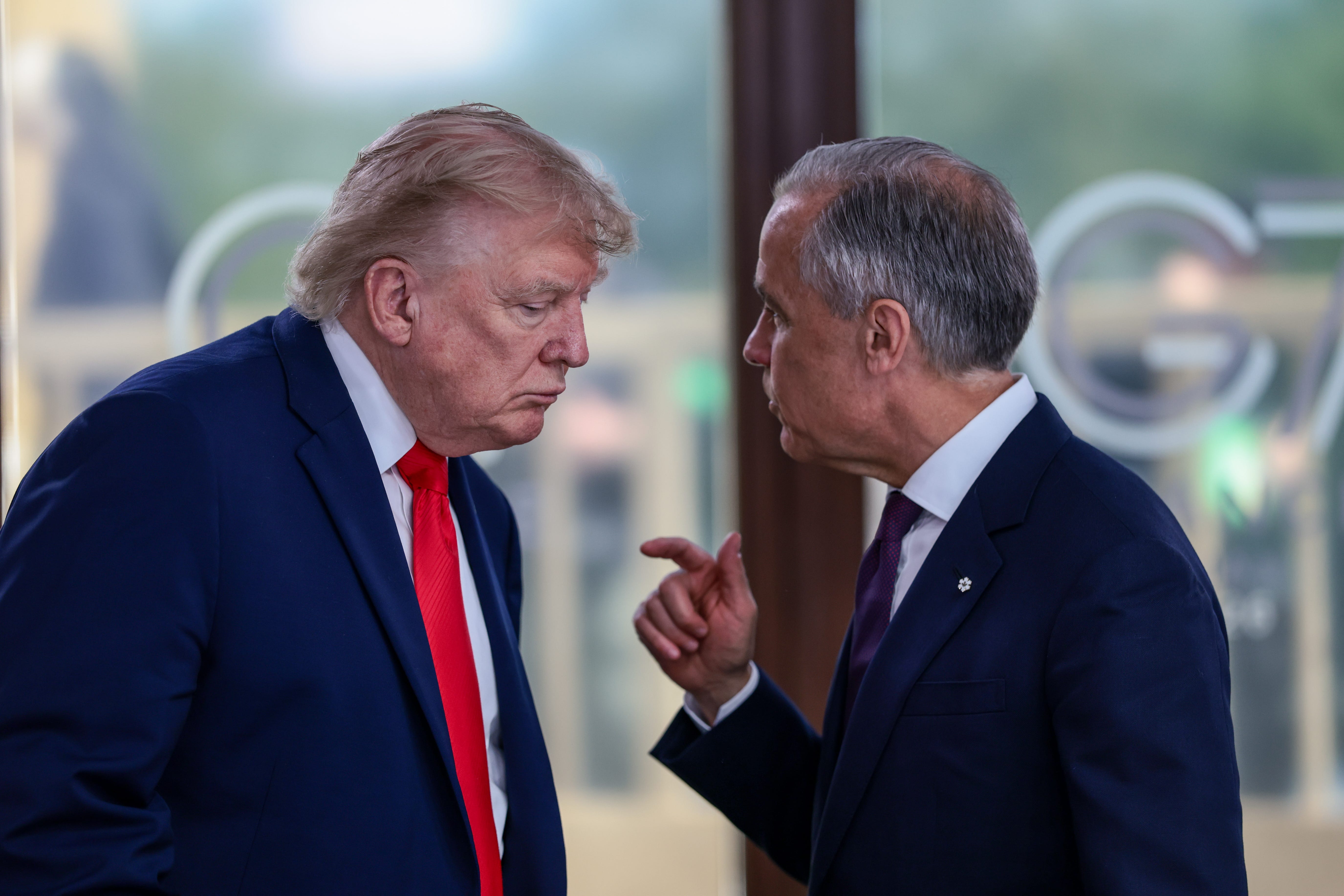
A mere two months before the April 2025 Canadian national elections, Poilievre was riding the same global wave of inflation-driven citizen disgust with incumbent parties; at one point, polls showed him leading Carney and the ruling Liberals by as much as 30 points. But Trump hatred among Canadian voters helped catapult Carney from likely defeat to solid victory.

That pattern of Canadians rejecting Conservative Party office-seekers to rebuke Trump continued this week when Liberals swept all three special elections to fill vacant parliamentary seats. Two of those seats had been occupied by Liberal members of parliament, but in the third contest the Liberal victor in a Quebec-based district replaced a Conservative MP in a seat Conservatives held since 2018.
“The Quebec result was the most dramatic shift,” noted the Associated Press of Toronto. “The region is home to aluminum producers, dairy farms and other industries caught in an escalating trade war with the US.”
Liberal MP Hedy Fry made plain what the results meant, telling the CBC: “The United States is getting a message tonight. [Carney] has the support of the Canadian people.”
The special election results came just days after US Treasury Secretary Scott Bessent doubled down on Trump’s insulting rhetoric toward America’s northern neighbor.
“I don’t think you can be in a tit-for-tat with someone who’s 13 times larger than you are,” a smarmy Bessent said in response to the suggestion that Canada wielded sufficient economic power to win a trade war with the United States.
I asked McGill University political scientist Daniel Béland how much damage Trump has caused for the conservative opposition in Canada.
“Trump is highly unpopular in Canada so it would be very hard for Poilievre to side with him in any significant way. This is especially the case because Poilievre’s polling numbers do not look good, especially compared to Carney’s,” he said. “The Liberals probably want Poilievre to stick around as long as possible as his low favourability numbers benefit to them electorally.”
Béland is not exaggerating. By summer 2025, Canadians’ views of Trump and the United States had already tanked, according to Pew Research. A recent poll shows that Canadians’ hatred for Trump has widened the Liberal Party’s advantage.
Americans are also fed up with Trump’s treatment of Canada. A new Reuters/IPSOS poll this week showed that only 20 percent of Americans support Trump’s tariffs and just 14 percent approve of his spiteful move to rename Lake Ontario as Lake America. (But a new poll from YouGov America shows that Trump’s rhetoric is polarizing Republicans against Canada, with 38 percent of them now viewing our northern neighbor as “unfriendly or an enemy of the US.”)
Carney strikes back
Last week’s breakdown in negotiations is the latest skirmish in the ongoing tariff battle that began when Trump returned to the White House in January 2025.
PM Carney made it very clear that he no longer considers the United States a good faith negotiator and trade partner, and he’s actively encouraging Canadian businesses to search for alternative markets to sell Canadian exports.
“The prime minister was basically built for this type of thing,” says Turnbull, citing the PM’s business chops. (Carney holds master’s and doctoral degrees in business from Oxford University, and as governor of the Bank of Canada helped navigate his country through the 2008 financial crisis.) “He comes at this issue like an emergency, like a wartime PM. Canadians believe he has the skillset and experience to do this kind of work. They really support his decision to walk away from the table.”

So far, Carney’s firm stance and trade pivot seem to be working. Canada is the only nation to boast free trade agreements with all other G7 nations. According to International Trade Minister Maninder Sidhu, in the past year alone Canada has inked 20 new trade agreements with countries other than the United States. In the next decade Canada intends to double, from 1.5 billion to 3 billion, the number of foreign consumers of Canadian products.
These changes put Carney in a strong position to reject the most absurd demand Trump made during the recent negotiations, namely, that the United States have the power to approve any trade agreement Canada entered with other nations. No American president would agree to such a restriction; believing Canada was so dependent on US trade that it would accept this provision was pure Trumpian arrogance.
Unlike the many American institutions that caved to Trump’s threats, from law firms to universities, Carney understands that standing up to bullies is always the best approach.
“Prime Minister Carney’s decision to reject the terms the Trump administration posed during last month’s trade talks between Canada and the United States proved very popular across Canada, with about three quarters of the population approving the decision according to one poll,” Béland wrote to me. “His decision was also celebrated by commentators in many other countries, who saw it as a template to how one should stand up to the Trump administration.”
US Commerce Secretary Howard Lutnick is trying desperately to spin the failed trade negotiations as Canada disrespecting Trump, but until Carney calls for the United States become a new Canadian province those lame complaints will fall flat.
Indeed, two polls taken during the final weeks of August showed Carney’s Canadian public approval rating at 53 percent on August 17, before the tariff war began, then surging to 60 percent by August 31, after Carney rejected Trump’s counteroffers. Those are the kind of eye-popping levels of support that a self-deluding Trump boasts about, when in fact he suffers from his lowest approval ratings to date.
A rift that will take decades to repair
Last weekend, I bellied up at a popular Montreal pub called Nyk’s Bistro Pub and ordered an Old Fashioned. I like my Old Fashioneds sweeter, made with bourbon rather than rye, and asked Max, the bartender, what my bourbon options were.
“We don’t have any American whiskeys,” he told me, citing the US-Canadian trade war. Silly me: I had forgotten about the implications of Trump’s foolish and self-destructive trade policies. (Max promptly recommended Bearface, a triple-oak barreled whisky made in rural Canada; I ordered it on the rocks instead — quite tasty.)
My disappointment is a minor casualty of Trump’s inane trade policies, which continue to cause serious economic pain for Canadians and Americans alike. As we explained here three months ago, the tariffs effectively imposed a retail sales tax on US consumers. We predicted the Supreme Court’s ruling that Trump’s tariffs were unconstitutional and would result in corporations recovering their losses while consumers never receive a dime they paid in higher retail prices. That’s exactly what is now happening.

The conservative Wall Street Journal pilloried Trump for his ruinous tariffs. At the G20 Summit this week, our allies complained about the damage caused by Trump’s economic policies. Even rural Americans — some of Trump’s most devout supporters — have finally realized the self-proclaimed business “genius” they voted for is causing them unnecessary economic pain.
The tariffs are bad, but our long-term relations with Canada are worse. Led by their defiant Prime Minister Mark Carney, whose election Trump effectively sealed, Canadians have seen and heard enough. They’ve turned their back on the United States and their eyes toward new markets and trading partners. The mutually beneficial economic partnership between America and its top trading partner is in tatters and will take years for future administrations to repair.
“I think that there’s an awareness here, which has developed over time, that even if there’s a Democratic president next that this is not a moment that will be reversed,” says Turnbull. “The trust relationship has been blown up so much that Canadians would want to see guarantees that this will not happen again. The irreversibility is in the loss of trust.”
That’s it for now
We’ll be back this afternoon at 2pm Eastern with a special Thursday edition of the PN Pod, then with new editions of Public Notice tomorrow and Saturday.
If you appreciate today’s PN, please do your part to keep us free by signing up for a paid subscription.
Thanks for reading, and for your support.
Truth. The loss of trust will not be reversed because Americans decide to elect a Democrat.
The way things have been going, the US has no allies. Given that Russia (who Trump caters to) is helping Iran, if somebody did invade the USA, nobody would help out. Instead, there would be worldwide Schadenfreude at the misfortune of the USA and other nations saying, "Good riddance!"
And would this nation in the future be regarded in the same way that Sodom and Gomorrah are regarded now?