

PN is supported by paid subscribers. Become one ⬇️
When Donald Trump ran for president in 2016, many voters figured that because he was a business guy, he must understand the economy.
That was certainly what he himself said, insisting that “I understand money better than anybody,” and “I am going to be the greatest jobs president that God ever created.” For good measure, Trump added that “nobody knows more about taxes than I do, maybe in the history of the world.” Despite a spotty record (at best) on that front in his first term, when he ran again in 2024 with memories of 2022’s burst of inflation fresh in people’s minds, voters turned to him again.
So, one year into his second term, how has Trump performed on the economy? The answer is: not good. Not good at all.

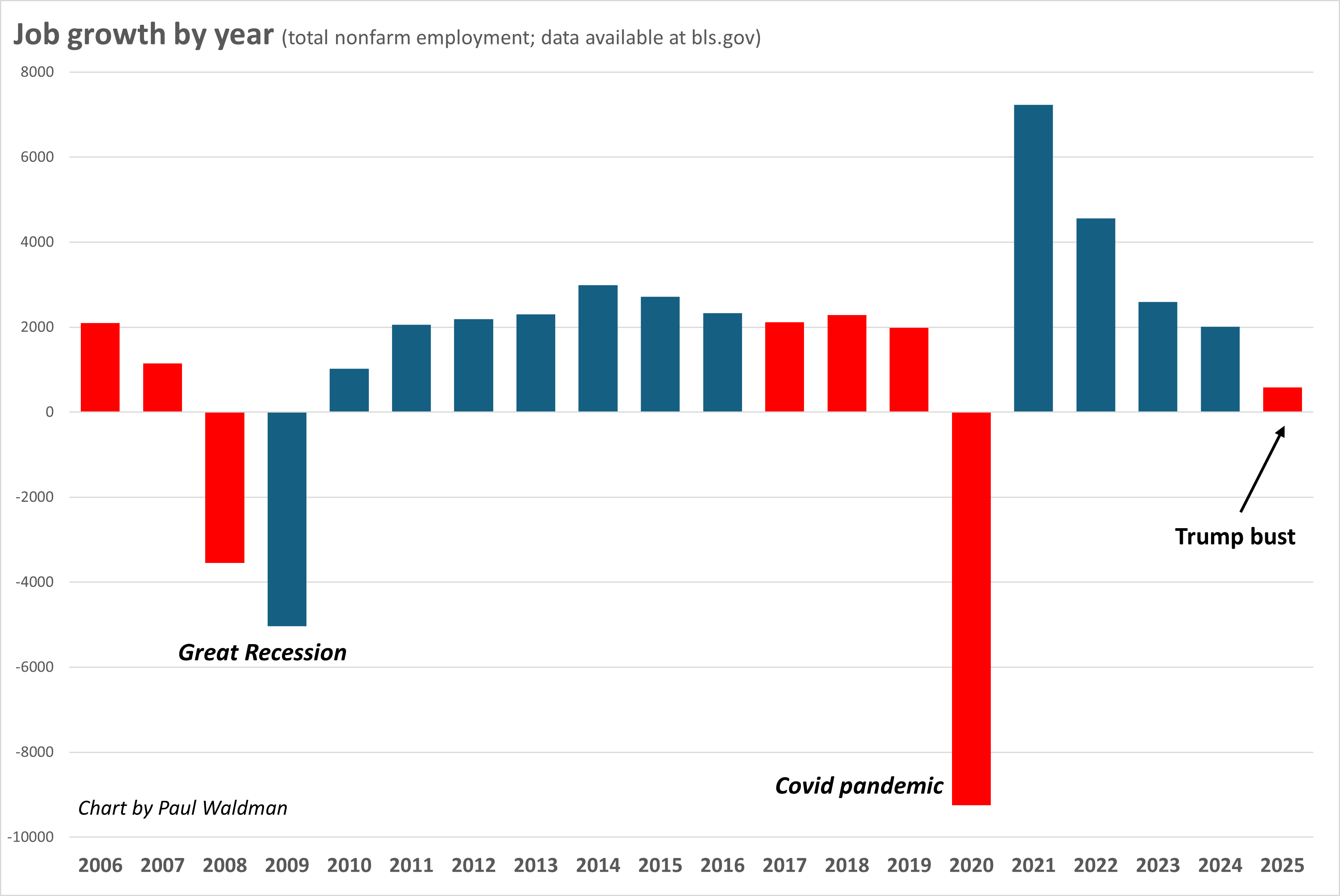
We got the final jobs numbers of 2025 on Friday, and the results were striking. Keep in mind that because the population is always rising, the “breakeven” job creation number of what needs to be added to keep the labor market in the same state is around 150,000 jobs per month. For reference, in 2024, the last year of Joe Biden’s presidency, over two million jobs were created. His four-year total was over 16 million, higher than any other single presidential term in history.
But just 50,000 jobs were added in December, bringing the grand total for 2025 to an abysmal 584,000. Other than the depths of the Great Recession and the covid pandemic, job growth in the first year of Trump’s second term was the worst in over two decades.
While the unemployment rate has not spiked, the job market seems frozen; companies aren’t firing large numbers of workers, but they aren’t hiring large numbers either. Both the number of people working part time who would like to be working full time and the number of people who have been looking for work unsuccessfully for over six months are the highest they have been in a decade. As a result of Trump’s attack on the federal government, 335,000 federal workers were fired or fled. Trump’s immigration crackdown is also holding down job growth.
What else is happening? Consumer confidence continues dropping. In Gallup’s year-end polling, only 21 percent of Americans rated the economy “good” or “excellent.” GDP growth is still healthy, but it’s being propped up by the tech industry’s ungodly spending on data centers. And as Bloomberg recently reported, the share of GDP going to workers in the form of wages and salaries is lower than at any point since data collection began in 1947. Because of Republicans’ unwillingness to extend Affordable Care Act subsidies, healthcare premiums are skyrocketing for millions.

In fairness, it’s not all terrible news; it’s not like we’re in a recession (at least not yet). Growth in the stock market is one positive Trump can point to; the S&P 500 rose by over 16 percent for the year, which is very nice for anyone with substantial stock holdings (though three of the four years of Biden’s term were better). Inflation has been basically unchanged since Trump took office, and stands a bit higher than the Fed’s two percent target — not terrible by any means, but not the kind of success Trump wanted, or that he claims has already occurred (more on his unsuccessful attempts to hoodwink the public on that score in a bit).
The centerpiece of Trump’s economic program is a failure
There is no economic policy Trump believes in more deeply than tariffs for what is likely a chaotic tangle of factual delusions and psychological dysfunction. He has long been convinced that other countries are “ripping us off” when we buy anything from them, and if we can use tariffs to drive imports as low as possible, then limitless prosperity will inevitably follow.
It’s hard to say whether a coherent program of high tariffs would have been better or worse than the chaotic mess of Trump’s program, in which goods from every country are assessed different tariff rates and those rates constantly change based on Trump’s whims. One result is that effective tariff rates are significantly lower than what Trump has said publicly, because he has offered a series of exemptions, delays, and reversals. While the actual tariff rate we pay on foreign goods is still extremely high (around 17 percent, higher than it has been in 90 years), this is an implicit acknowledgment that the tariffs are fundamentally harmful — a parade of companies and industries beg to be excused from the tariffs to limit the damage to their businesses, which Trump grants to those he favors.
One of the main objectives of the tariffs was a reversal of the long decline of American manufacturing. Trump claimed that “jobs and factories will come roaring back into our country” when he announced his enormous “liberation day” tariffs in April. It would be like the 1950s and 1960s again, a time when a man could provide a middle-class life for his stay-at-home wife and kids with what he made down at the plant.
But what that story misses is that the quality of those jobs was made possible by labor unions, which have been almost eliminated from the private sector. Nevertheless, back in April, Secretary of Commerce Howard Lutnick touted a glorious future in which you, your children, and your grandchildren will all spend your working lives in the same factory.
So how is the Trump administration doing at creating manufacturing jobs? Well, the December report showed the eighth consecutive month of job losses in the manufacturing sector, which just happens to be the period since “liberation day.”
While Trump claimed that exporting countries would pick up the cost of the tariffs, that didn’t happen. According to one estimate, 94 percent of the cost has been borne by American companies and consumers. One study this fall projected that the tariffs would cost American companies $1.2 trillion for the year, most of which would be passed on to consumers. The Tax Foundation estimated that the tariffs cost each American household $1,100 in 2025. And among other things, Trump’s trade war produced inevitable retaliation from other countries, especially China, which necessitated yet another taxpayer bailout for farmers whose foreign markets were closed off.

That Trump’s version of tariffs would fail was a surprise to no informed observer, but something else important occurred: Despite near-constant propaganda from the White House and Trump himself about how wonderful tariffs would be, to their credit the public remained unconvinced.
We hadn’t had a real public debate about tariffs in decades, so Americans weren’t working off detailed prior knowledge. But after being exposed to Trump’s claims and a good deal of news coverage explaining what effects tariffs actually have, the weight of public opinion remained against him; throughout the year, polls have shown most Americans disapproving of his tariff policy.
Why Trump’s economic propaganda campaign was doomed
However many people thought “Trump is rich, he must know the economy” in 2016 or 2024, it’s getting harder to find Americans who think that today. His overall approval ended the year in the 30s in some polls, lower than any president in the history of polling at the end of his first year in office. And his approval on the economy is even worse, especially when poll respondents are asked specifically about prices.
As important as people’s daily experience is to whether they arrive at that conclusion, Trump may be feeling backlash from the way he deployed two of his favorite rhetorical strategies. The first is his propensity to predict that he is about to do something spectacular, solving difficult problems with mind-boggling ease and speed.

“Starting on Day 1, we will end inflation and make America affordable again,” he said during the 2024 campaign. “When I win, I will immediately bring prices down.”
This was an impossible promise to keep, because outside of a few products here and there, the nature of inflation is that once prices go up, they may stop rising, but they almost never come down (and if they did, it would be a problem; deflation has all kinds of negative effects). Trump even promised that “under my administration, we will be slashing energy and electricity prices by half within 12 months, at a maximum 18 months.” That has not occurred.
These promises were at the core of Trump’s campaign and one of the most important reasons he won. Then when he took office and failed to do what he had promised, his second ill-suited rhetorical strategy kicked in: telling people everything is great and he’s been fantastically successful.
So not only does Trump tout made-up numbers about how much investment he is supposedly bringing to America and how many jobs are supposedly being created as he claims America is “the ‘hottest’ and most respected Country anywhere in the World,” he can’t help himself but pour contempt on anyone who would say otherwise.
Where Joe Biden was constantly apologizing for inflation (“We know that prices are still too high for too many things, that times are still too tough for too many families,” he’d say), Trump tells you that if you worry about prices you can go to hell. He calls affordability concerns “a hoax” and “a con job by the Democrats.” But no one believes him.
So even relatively inattentive voters know that 1) Trump said he’d bring down prices and make the economy great; 2) prices are not lower and the economy is not great; and 3) now he’s lying in our faces about it.
No one can predict the future with any certainty; the economy could improve dramatically at some point in Trump’s term. But if it does, it will be not because of his policies, but in spite of them. And if anything, the choices he makes over the next three years will likely only make things worse.
That’s it for today
We’ll be back with more tomorrow. If you appreciate today’s PN, please do your part to keep us free by signing up for a paid subscription.
Thanks for reading, and for your support.
Someone should write about Trump’s successes. Oh, OK, I will: None.
The image of TFG at the McDonald’s Summit looks like a spoof from Saturday Night Live or Monty Python. In what universe, other than the one we are trapped in, does a United States president speak at a gathering of fast food restaurant owners? A quid pro quo to him for all the unpaid advertising he gives to McDonald’s.