

PN is supported by paid subscribers. Become one ⬇️
“We are holding Canada responsible for the fact that they are not properly maintaining their Forests, and Brush therein, and the United States is being unnecessarily invaded by filthy, polluted, and unhealthy air, the quality of which is dangerous, and totally unacceptable!” Trump screeched on social media Friday afternoon.
If only Canada knew how to rake the forests like the Finns!
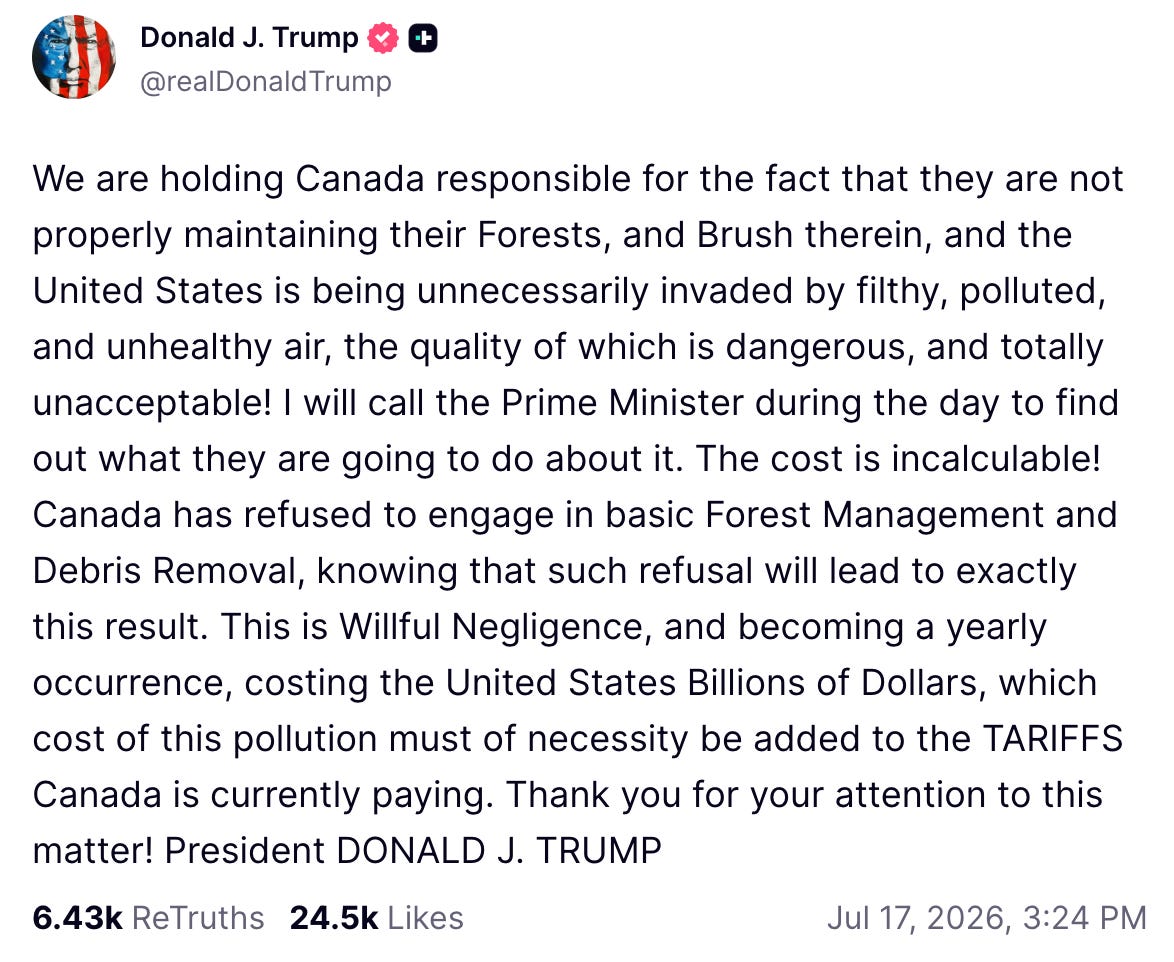
It was a typical Trump post, signifying nothing … or possibly a new trade war.
Two days later, Trump watched the World Cup finals in New Jersey along with his co-hosts, Mexican President Claudia Sheinbaum and Canadian Prime Minister Mark Carney — both of whom managed not to photobomb the winning Spanish team. En route home, Trump stopped to insult the nation that routinely sends firefighters to the US during wildfire season, along with their leader.
“It went good, but I told him, you got to stop these fires from coming in and poisoning our air,” he told reporters at Joint Base Andrews, adding that “maybe they should pay us some damages or something, or we should do some tariffs. But it was terrible. I mean, you had businesses closing.”
On Monday, he announced a new round of tariffs on Canadian exports … but said they had nothing to do with the wildfires.
The White House put out three proclamations imposing an additional 50 percent tariff on a sprawling list of Canadian goods, citing our northern neighbor’s "discrimination" against American cars, alcohol, and cheese.
The legal basis is a hundred-year-old statute most commonly associated with the movie Ferris Bueller’s Day Off and, before that, the Great Depression. And if courts let him use it the way he’s threatening, he’ll be free to wreak havoc on the global economy.
Anyone, anyone …
Last year, Trump careened back into office erratically barking out tariff commands.
The Constitution vests the tariff power in Congress, but the president insisted it had actually been permanently delegated to him by the International Emergency Economic Powers Act, better known as IEEPA. In February, the Supreme Court finally said he didn’t — although not before letting him illegally collect upwards of $100 billion from American businesses.

In dissent, Justice Kavanaugh sniffed that there were plenty of other statutes Trump could use instead of IEEPA, such as Section 232 of the Trade Expansion Act of 1962, Sections 122, 201, and 301 of the Trade Act of 1974, and Section 338 of the Smoot-Hawley Tariff Act of 1930.
“The supreme court (will be using lower case letters for a while based on a complete lack of respect!) of the United States accidentally and unwittingly gave me, as President of the United States, far more powers and strength than I had prior to their ridiculous, dumb, and very internationally divisive ruling,” Trump responded.
That very same day he announced a raft of new tariffs under Section 122, a law which refers to “balance of payment deficits,” something which was only possible in an era when other countries pegged their currencies to the dollar and the dollar was pegged to gold — which ended in 1971.
Trump gamely pretended that “balance of payment deficit” and “trade deficit” were exactly the same thing, but in May the Court of International Trade ruled that his tariff scheme under Section 122 was also illegal. The Federal Circuit Court has once again allowed Trump to keep collecting these tariffs during the appeal process, even as the administration is still working through the backlog to grudgingly refund all the illegal IEEPA levies.
Meanwhile, Trump’s aides have moved down the list to the Smoot-Hawley Tariff Act, the one that bored Ferris Bueller’s classmates and which is widely blamed for turning a bad recession into the Great Depression.
The law was named for Republican Sens. Reed Smoot and Willis Hawley and signed into law by Republican President Herbert Hoover, despite a petition from more than a thousand economists warning that it would damage the US economy. Which it did. But, among the congressional delegations of tariff power, it’s the one that comes with the fewest constraints.
Where Section 301 requires an actual investigation with findings on the record by the US Trade Representative, Section 338 merely requires the president to “find as a fact” that a foreign country is discriminating against US commerce. And, unlike Section 122, which caps out at 15 percent and 150 days, Section 338 has a 50 percent ceiling and no time limit.
Some legal scholars have suggested that Section 338 was effectively superseded by trade legislation Congress passed in 1962 and 1974 and is therefore defunct — which would explain why it hasn’t been touched since 1949. That question was never tested in court, though, because nobody tried to invoke this cursed provision for more than 70 years. Presumably the Supreme Court will weigh in with its signature alacrity, possibly in time for the 2028 election.
What the tariffs actually do
When Trump’s illegal “Liberation Day” tariffs under IEEPA went into effect, only two countries passed retaliatory tariffs of their own: Canada and China. In 2025, US automobile exports to Canada dropped by 22 percent, and provincial governments in Canada yanked American liquor off the shelves.
Ottawa’s defensive maneuvers in the last trade war are now being used to justify the US attack in the current round. The motor vehicles proclamation points to Canada's own retaliatory surtax on US cars as proof of “discrimination” against US exports, and then uses it as justification for levies on a basket of totally unrelated goods.
The new tariff scheme imposes an additional 50 percent import duty on a vast array of Canadian products — everything from whisky and cheddar to cement, hockey sticks and skates, furniture, jewelry, and industrial electronics. And unlike the previous levies, there’s no carve-out for products covered by the United States-Mexico-Canada Agreement (USMCA).
In his first term, Trump tore up the North American Free Trade Agreement (NAFTA), which had the whiff of Bill Clinton on it, and negotiated the USMCA in 2020. The delta between the two treaties wasn’t huge, but Trump called his "the fairest, most balanced, and beneficial trade agreement we have ever signed into law."
Six years later, Trump’s assessment has soured, and earlier this month he declined to renew USMCA, kicking off a decade of rolling annual reviews instead. But, throughout the tariff chaos of the last two years, Trump largely included fine print exempting USMCA-compliant goods from the duty du jour. Not so with the latest levies, which are slated to take effect on August 19.
Talks with Mexico are reportedly going well, but negotiations with Canada were stalled. Most trade watchers view the new tariffs as a cudgel to force Canada to make trade concessions, rather than something that will actually take effect — it seems unlikely that Trump will impose massive levies less than three months before the midterms. And while Small Business Administrator Kelly Loeffler will dutifully pretend to be an idiot in public, you can’t fool Americans at the cash register.
The threat appears to be working, at least nominally. Carney told reporters Tuesday he’d spoken with Trump that morning and the two had agreed to “intensify negotiations in the coming weeks.” But Canadians are furious at the US’s treatment.
"We are an energy powerhouse and we can dismantle the US if we wanted to, if we all work together," Ontario Premier Doug Ford railed Tuesday. "No matter if it's the electricity … the potash, the oil — we're their number one customer in the world. They need to feel the pain rather than us constantly feeling the pain."
“We do sell a lot of energy products to New England. We put gas in their cars, we put jet fuel in their fighter jets and we heat and cool their homes. And so we knew that we have those kinds of tools at our disposal should we need them,” New Brunswick Premier Susan Holt agreed.
Canada’s provincial premiers convened an emergency meeting with Carney this week. Ottawa also pulled out of a ribbon-cutting ceremony for the new Gordie Howe International Bridge, calling a celebratory event “inappropriate” given the tariff threat, although the bridge itself is still opening on schedule.
Credibility gap
Trump has mostly knocked off his “jokes” about Canada as the “51st state.” But his rhetoric about our closest ally remains deeply offensive.
“In all fairness to them, they need us to survive. Without us, there’s no way they can survive,” he said Tuesday.

Carney has been making the opposite case, most forcefully at Davos in January where he gave a landmark speech exhorting the “middle powers” to band together in a world where the US is tearing down the post-war order that lasted for 75 years.
We are in the midst of a rupture, not a transition.
Over the past two decades, a series of crises in finance, health, energy and geopolitics have laid bare the risks of extreme global integration. But more recently, great powers have begun using economic integration as weapons, tariffs as leverage, financial infrastructure as coercion, supply chains as vulnerabilities to be exploited.
You cannot live within the lie of mutual benefit through integration, when integration becomes the source of your subordination.
Pentagon policy chief Elbridge Colby snorted in derision at these upstart nations daring to challenge US hegemony.
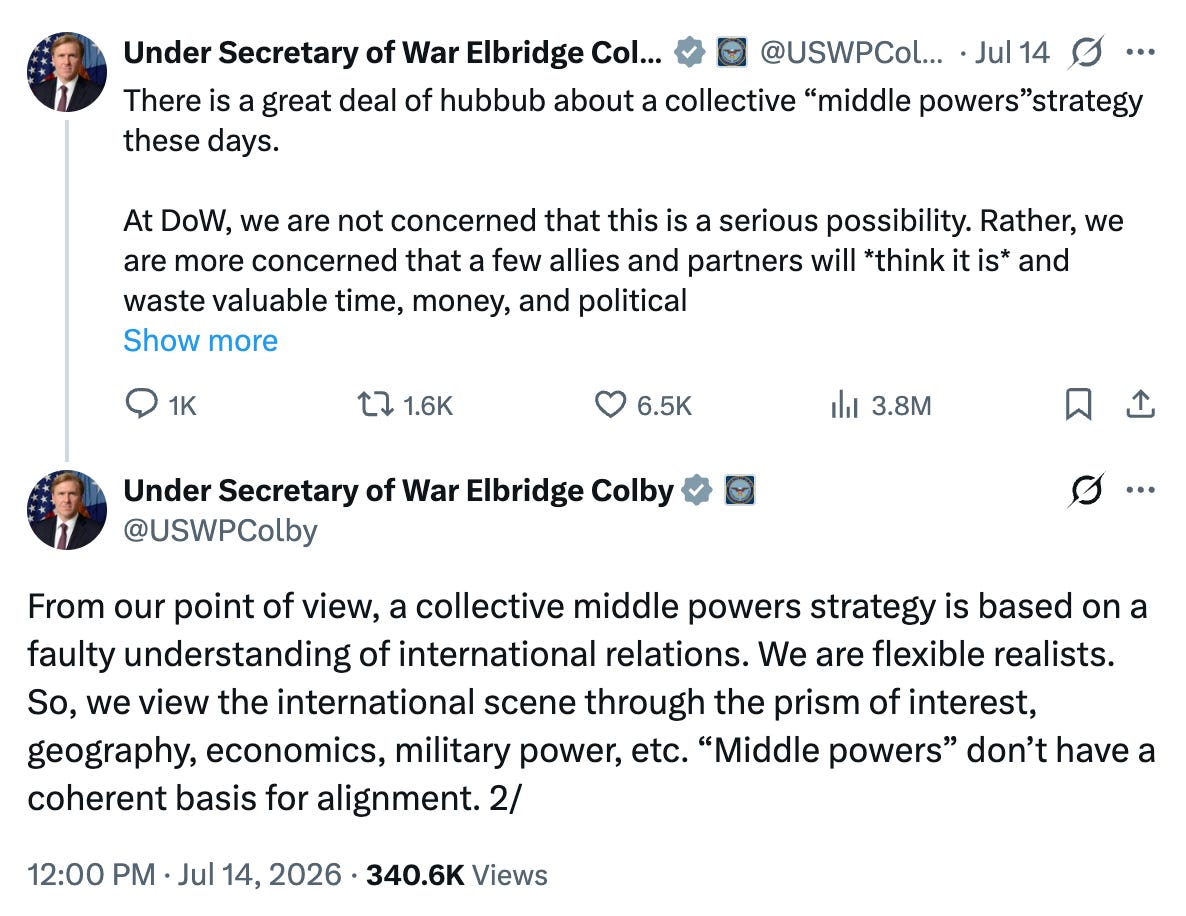
Obviously Trump just freestyles much of the time, but here there’s discernible signal in the noise.
The United States is punching the one “middle power” that had the temerity to fight back war squarely in the nose. This is a warning to other countries that might be considering a challenge to US hegemony in trade or anything else: retaliate, and we will destroy you. Whatever the actual merits of the dairy or alcohol complaints, the audience for these new tariff announcements goes far beyond Ottawa.
But brandishing this cudgel is not without costs for the US. Trump has now blown up or threatened to blow up three trade relationships with major partners inside of six months, and the pattern is the same each time: negotiate a deal, call it the best deal ever made, then treat its existence as a grievance a few years later. That’s not really a trade strategy so much as a demonstration that no American commitment is durable past the next mood swing — which is its own kind of cost, distinct from whatever the tariffs themselves do to the price of Canadian whisky.
That’s it for today
We’ll be back with more tomorrow. If you appreciate today’s PN, please do your part to keep us free by signing up for a paid subscription.
Thanks for reading, and for your support.
This whole tariff tantrum reads like the United States doing community theater. Canada, the geopolitical equivalent of a golden retriever in a scarf, is suddenly our arch‑nemesis because… milk? Lumber? Feelings?
It’s peak American farce: a country that can’t keep its own bridges standing now fantasizing about a trade war with its politest neighbor. The U.S. isn’t being “taken advantage of” by Canada; it’s being taken advantage of by its own political class, who treat tariffs like a mood disorder.
If you ever needed proof that U.S. politics has become performance art, here it is, a dope store goon yelling at Canada like it’s a Bond villain with a maple‑syrup weapons program.
Reality keeps beating satire to the punch, and this piece just documents the latest episode of America’s long-running absurdist show.
Johan 🐌
"And if courts let him use it the way he’s threatening, he’ll be free to wreak havoc on the global economy."
Courts didn't let him use his first tariffs - he lost all the way up to SCOTUS. & has the admin refunded any of those unconstitutional tariffs that his regime collected?