

Public Notice is supported by paid subscribers. Become one ⬇️
One of the silver linings of 2025 was watching Trump do exactly what he set out to do, but having it prove the opposite point.
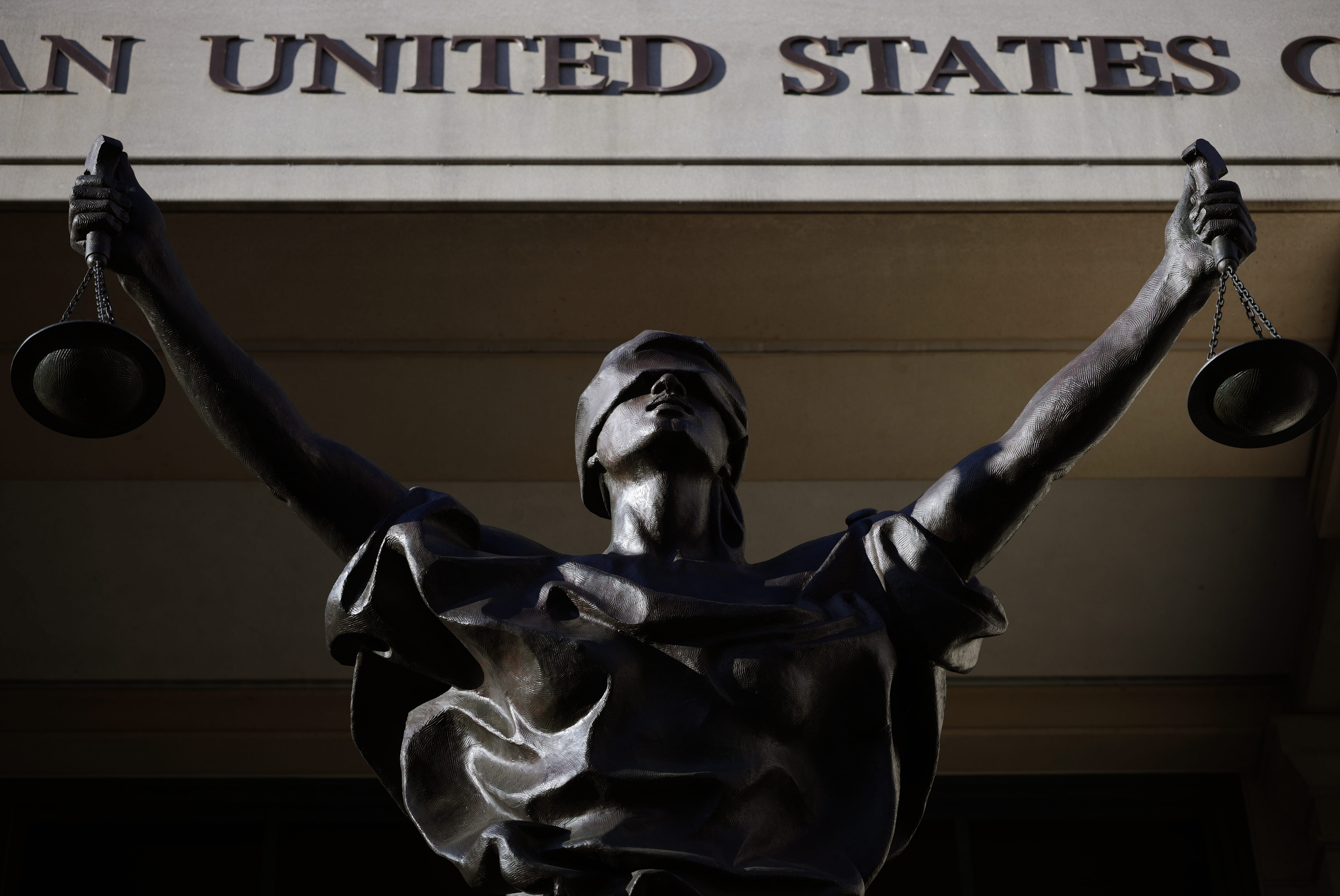
There is perhaps no greater example of this than the US legal system. Trump and his cohort have long lambasted it as the heart of “the swamp” they claim must be drained. And to be fair, the US legal system is far from perfect. It is a cumbersome, sprawling behemoth full of arcane procedural requirements, and it takes an expert lawyer — preferably a whole team of them if you can afford it — to navigate successfully. Even then, it often takes months, if not years, to get the legal system to serve the purpose it’s intended to serve.
In short: the US legal system is hardly a model of efficiency. And thank God for that.
Because what Trump never understood, and what this past year demonstrated quite resoundingly, is that the US legal system was never supposed to prioritize efficiency above every other value.

Rather, what the US legal system is set up to do — what all those finicky legal requirements are doing by making everything so complicated — is to make sure the structure and fundamental rights enshrined in the Constitution endure, even in the face of a direct assault on those values like the one Trump is leading.
In other words: the legal system’s inefficiency is exactly the point. Because it’s that same inefficiency that prevents Trump and company from steamrolling the Constitution entirely.
Revenge of the swamp
When you look at the “bottom” of the legal food chain in the US — that is, the lowest levels of the courts, as well as the administrative officials who are actually charged with executing the nation’s policies and laws — it becomes very clear that this is where the Trump administration’s boundary-pushing policies are likely to encounter the most difficulty.
One excellent example from 2025 was Trump’s assault on the functioning of the Department of Justice itself. The DOJ is effectively the primary legal arm of the federal government, charged with enforcing the laws of the United States. It oversees not only the FBI and other federal law enforcement agencies but numerous divisions of lawyers whose responsibility it is to represent the federal government in day-to-day civil litigation.
Trump has been on a singular mission to reshape the Department in his image, which basically means he put a bunch of incompetent people in charge and fired many of the career lawyers who displeased him. This has unsurprisingly created a terrible work environment, which it turn has prompted many more people to leave, further shifting the DOJ from effectively carrying out its traditional functions.
But the thing that Trump never seemed to understand is that one of those functions is helping him actually carry out his agenda in court. Perhaps the splashiest example of this was the giant flameout that was the appointment of Lindsay Halligan as US attorney for the Eastern District of Virginia.

Very quickly, Halligan demonstrated the consequences of putting a deeply incompetent lawyer in charge. She then went on to demonstrate an even more important legal corollary by immediately losing cases she was overseeing against Letitia James and James Comey: that it is hard to effectively prosecute people. To be fair, those cases were thrown out because Halligan’s appointment was unlawful in the first place (another problem with caring more about grabbing headlines than the details of the law). But even had Halligan been lawfully appointed, Trump’s political prosecutions could have gone farther in court had they been overseen by someone competent.
In brief, the result of all of Trump’s meddling in the day-to-day operations of the DOJ has been to weaken his administration’s ability to represent itself in court. In the case of the prosecutions against James and Comey, the fact Halligan was invalidly appointed led to the court dismissing both indictments solely on that basis. This meant the court never even considered the merits of the cases, which in turn meant the story became all about the legal incompetence of the entire Trump administration. Trump’s original intent of muddying the names of James and Comey was left entirely by the wayside.
More generally, the Trump administration’s oversight of the DOJ has led to the number of attorneys across the Department dropping by more than 50 percent. This has not only led to lawyers withdrawing in dozens of cases, but numerous requests from government lawyers for extensions of time, questioning from the courts at to why the government wasn’t presenting more evidence, and deeply inexperienced lawyers handling a larger swath of cases. Basic staffing needs have become such a problem that the remaining US attorneys have apparently taken to mass-emailing their professional networks asking for people to apply for jobs — hardly the sign of a legal department that is capably handling their workload.
By all accounts, the lawyers who remain there are deeply overwhelmed and demoralized, with the real-world consequences that they are missing deadlines, getting facts wrong, and generally doing a pretty bad job at defending Trump’s actions in court. And Trump has more need of that defense than ever now: this past year saw over 500 actions filed against the administration in court, and that doesn’t even include all the litigation in which the DOJ is charged with representing the administration affirmatively rather than defensively.
Another non-DOJ example of the way the lower levels of the legal system is pushing back stems from how Trump’s attempt to go after private law firms played out.

When Trump issued a series of executive orders targeting major law firms early in 2025 for associating with his political enemies, many of the largest ones caved in an effort to protect their business. But when the leadership from those firms made deals, it then led to an outflux of attorneys from those same firms for other organizations that were willing to take up that fight. Perhaps even more telling: it was the myriad smaller firms that then took a stance against the unconstitutional attack on the legal system’s guarantee of equal representation — accompanied by law students who organized to shame the capitulating firms and deprive them of access to new talent.
The smaller firms that helped to pick up the slack included 504 firms that signed an amicus brief supporting the few big law firms that were fighting back against Trump — a number that is all the more notable because it overwhelmingly consisted of law firms from outside the “Big Law” ecosystem. In addition to the solidarity shown by smaller firms were a wave of brand-new firms created in direct response to the unprecedented attacks on the rule of law by the Trump administration. These new firms, like Lowell & Associates and the Washington Litigation Group, have expressly stated that their mission is to fight back against unconstitutional overreach. They hired many of the attorneys who fled larger firms in protest of their capitulation.
Failure of the elites
In some ways, these examples of resistance to unconstitutional action from the “bottom” of the legal food chain might seem undramatic, because they depend on small day-to-day actions rather than grand pronouncements. But that does not make them any less significant, particularly when contrasted against the milquetoast response demonstrated by elite institutions of the American legal system.
For instance, Congress, which is charged not only with promulgating laws, but with the express responsibility of overseeing certain kinds of legal powers. Those powers include the ability to declare war, which the Constitution declares is Congress’s sole purview in Article I, Section 8, Clause 11. And yet Congress has abdicated this authority almost entirely, despite Trump’s military strikes in Venezuela. It’s an abuse of power Congress is uniquely capable of remedying — and yet they do nearly nothing.

Venezuela is far from the only example of Congress’s reticence to actually carry out its constitutional duties. The newly-rechristened Department of War’s continued killing of people in the Caribbean and Pacific under the aegis of “drug smuggling,” the way Trump has threatened the independence or existence of agencies that were congressional creations — these are actions the Constitution gives Congress near-complete power over. But it obviously has not exercised it, largely because Republicans in Congress seem afraid of crossing their dear leader.
Then there is the Supreme Court, which is charged with having the final say on preserving the meaning of the Constitution as interpreted by the other two branches of government. In this role, the Court should be the final line of defense when it comes to drawing clear boundaries around an executive branch intent on enlarging its power past its constitutional limits — and yet this Court seems eager to allow Trump’s incursions.
There are almost too many examples here to name, but one particularly egregious series came when the Supreme Court repeatedly intervened (often by poorly-explained “shadow docket” decisions that obviated the normal in-court argument procedure) to overturn lower court decisions finding Trump’s firings of federal employees to be unconstitutional, both with respect to mass terminations like those at the Department of Education and high-profile terminations like Federal Trade Commission Chair Rebecca Slaughter. These shady rulings repeatedly seemed to do the opposite of what the highest court should do in the face of blatantly self-aggrandizing executive actions — namely, act as a check on them.
Another excellent example: the Supreme Court’s siding with Trump in Trump v Casa, in which the administration took the position that no federal district court should be able to issue a nationwide injunction, the procedural mechanism that many lower courts had used to halt on some of Trump’s more egregiously unconstitutional actions. This was such a stark example of the Supreme Court abdicating its constitutionally assigned power that it is still astonishing to contemplate today. That’s particularly true when you remember what the case was about in the first place: Trump’s desire to have the power to assign and withhold birthright citizenship. It would be difficult to come up with a starker example of the top of the legal food chain letting Trump run roughshod.

Certainly, the American legal system has been in better shape. Over 2025, Trump relentlessly and effectively consolidated power in the executive branch, to the weakening of the fundamental structure of the US government and the protection of fundamental rights that are enshrined in the Constitution. The highest-profile bulwarks against this encroachment have largely declined to take up the fight, allowing Trump’s power to continue to grow to the point where the White House is beginning to resemble an autocrat’s office more than that of a democratically elected president.
But the American legal system still remains far from a lost cause — and it’s almost entirely thanks to “the swamp.” In other words, it is thanks to the labyrinthine US legal system — with all its irritating procedure and requirements, all those pesky mandates that you actually have to know something and have evidence in order to get anything done — that the fundamental structure and rights of American democracy survive today.
That is the real reason that Trump hates the legal system so much — because it actually does what it’s supposed to. Namely: make democracy really, really hard to get rid of.
In other words, if there’s one lesson to take away from the American legal system in 2025? Thank God for the swamp.
That’s it for this week
We’ll be back with more Monday. If you appreciate Public Notice and aren’t yet a paid subscriber, what are you waiting for? Please click below and sign up to support our work.
Thanks for reading, and have a great weekend.
Matthew, you’re celebrating procedural resistance while missing what those procedures are failing to prevent. The swamp is slowing autocracy, not stopping it.
Yes, incompetent DOJ appointments hurt Trump’s legal effectiveness. Yes, smaller law firms are picking up slack. Yes, procedural complexity makes democracy “hard to get rid of.”
But while you’re thanking God for the swamp, ICE is detaining five-year-olds as bait, running secret detention centers where 32 people died in 2025, and operating under a secret memo that subverts the Fourth Amendment.
This isn’t legal system resilience. This is state terror emerging while lawyers file motions.
The parallels with Argentina’s Dirty War are chilling….
Detention centers operating outside judicial oversight. Forced disappearances (detainees transferred to Texas, families can’t locate them). Paramilitary forces (ICE with masks, no badges, no warrants). Deaths in custody ruled homicides with no accountability. Witnesses being deported to silence them.
Argentina’s dictatorship also had courts. Lawyers filed habeas corpus petitions. Judges occasionally ruled against the regime.
None of it stopped 30,000 people from disappearing.
Because when a regime operates paramilitaries outside legal constraints, procedural resistance becomes performative.
Your “bottom of the legal food chain” resistance matters. But it’s happening while the regime builds capacity to ignore courts entirely. Secret ICE memos. NSPM-7 designating protesters as terrorists. DOJ weaponized against political opponents. The swamp is creating friction while authoritarianism establishes parallel structures that don’t require legal process.
Understand what they’re fighting: not a president who respects courts and loses cases, but a regime building the infrastructure to operate outside judicial reach entirely. Argentina had lawyers too. It didn’t save them.
— Johan
Former foreign service officer
At this point, all testimony before the Oversight Committee should be public. The Jack Smith questioning by the Republicans was delusional. People should be required to watch this 💩 show. They voted for these clowns.😡