

PN is supported by paid subscribers. Become one ⬇️
For a while there, it appeared the great redistricting war of 2025-2026 would be fought to a draw, or even that Democrats could come out slightly ahead. That is no longer the case, and the way this conflict played out has made something distressingly clear: We are facing nothing less than the collapse of American democracy as we have known it.
This is a crisis, and the only thing that can keep us from spiraling even further downward is if Democrats — not always a group known for their courage and determination — confront it in a way that meets the magnitude of the challenge.

For that to happen, the Democratic Party has to become something it has not been in the past. Its collection of careful legislators and cautious campaigners must be reborn as bold, aggressive, creatively ruthless warriors willing to take steps they never contemplated before.
There are signs they might — the fact that they fought back at all against President Trump’s attempts to rig the midterms shows they have begun to understand what they’re up against. But now they have to go much farther — not just this year, and not just if they take back one or both houses of Congress in November, but toward a radical reform of the political system of the kind we haven’t seen in decades.
The map-drawing frenzy
This started last summer when Donald Trump ordered Republicans, first in Texas and then in other states, to redraw their congressional district maps to deliver more GOP seats.
Most of them complied (Indiana was the exception), and Democrats in California and Virginia responded by putting measures on the ballot to get voters’ permission to do the same. This was a temporary response, they argued: We’ll stop Trump and the GOP from rigging the midterms now, then work toward a national system in which gerrymandering has been banished. The voters in both states agreed.

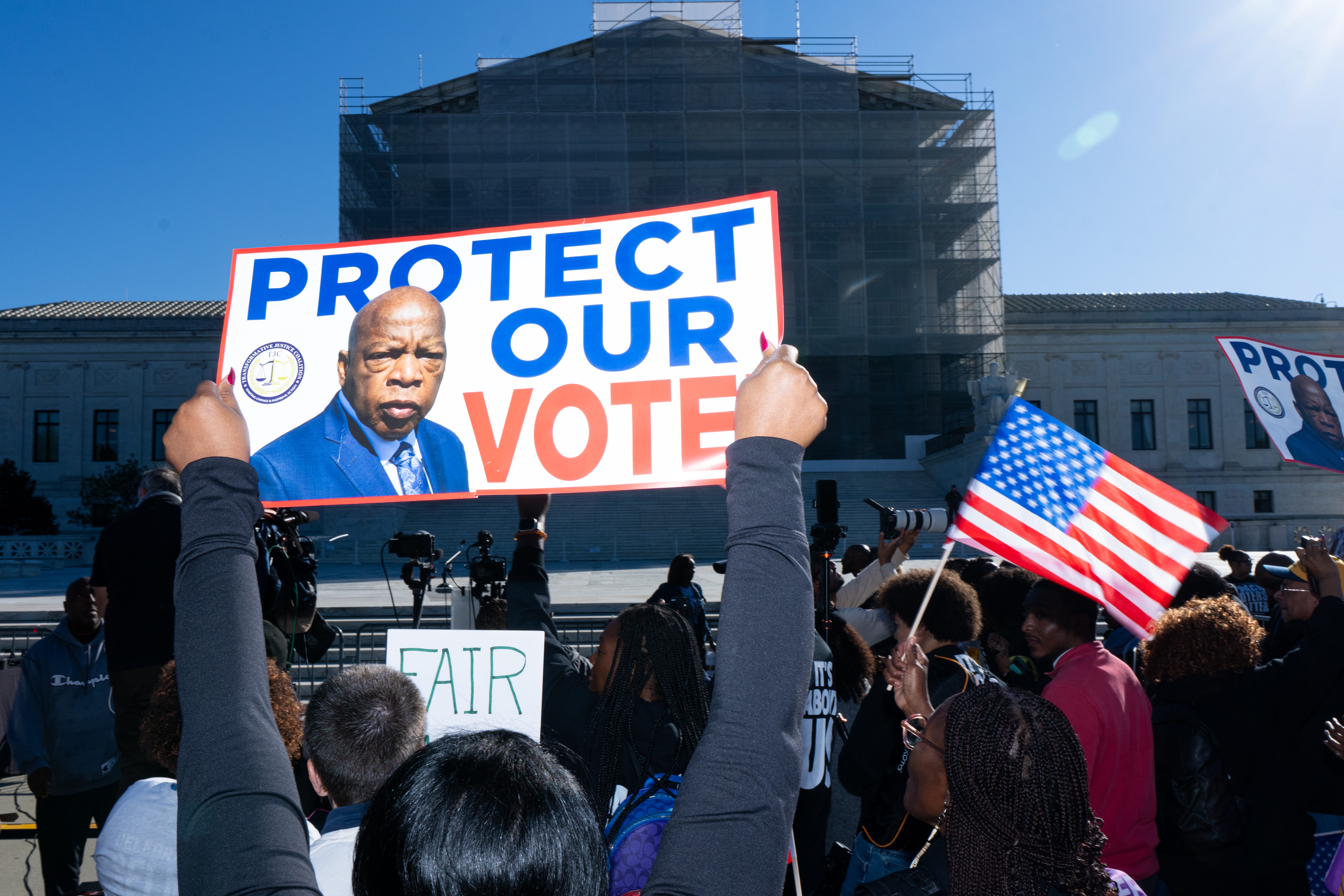
But Republicans weren’t done. First the conservative supermajority on the Supreme Court gutted what remained of the Voting Rights Act, the crown jewel of the civil rights movement’s triumph in defeating Jim Crow. Immediately, multiple southern states moved to wipe away every district represented by a Black member of Congress, to return to the all-white delegations of the past.
Then conservatives on the Virginia Supreme Court nullified that state’s redistricting referendum, despite the fact that multiple times those same judges had rejected challenges to the measure and allowed it to go forward. It was only when the voters made a choice the court’s conservatives didn’t like that they decided they had to step in.

The redrawing isn’t done yet — for instance, Republicans in South Carolina are considering following Louisiana, Alabama, and Tennessee in hastily redrawing their maps to get rid of the state’s sole Black representative. Even so, it probably won’t be enough to keep Republicans from losing the House in November, given the president’s abysmal approval ratings and the electorate’s usual midterm preference for whichever party is in the opposition.
That makes what has occurred in the last two weeks no less alarming. And it comes against the backdrop of the Trump administration’s lawlessness, corruption, and dismantling of the federal government’s ability to perform even the basic functions of effective governance.
These are not separate problems, and if they are to be solved they must be solved together.
Procedural aggression is required
When considering where Democrats go from here, we must begin with the Supreme Court, because it is the keystone of conservative minority rule in America.
The truth is that for almost its entire history, the court has been a fundamentally reactionary force, defending the wealth of the wealthy and the power of the powerful against claims to justice or equality. But because of a brief liberal period in the court’s jurisprudence running roughly from Brown v. Board of Education in 1954 to Roe v. Wade in 1973, many on the left came to see the court as a natural ally, even as it moved further and further to the right.
What conservatives realized, on the other hand, was that if they could capture the court then nothing would be out of their reach. “Checks and balances” notwithstanding, the judiciary has a unique ability to nullify the work of the other two branches. So moneyed conservative interests set out on an effort stretching over decades to create a court that didn’t just lean right, but was in the firm control of movement-bred conservatives who were committed to advancing their ideological and policy objectives and saw no limits on their ability to do so.

The right understood what they could do with a court like that, and now they have it. Principles and precedents have become a joke, while modes of analysis like “originalism” and “textualism” are deployed in radically different ways depending on which party will benefit from the outcome. When a Democrat is president, the court is extraordinarily aggressive in seizing the power to decide policy; when a Republican is president, he can largely do as he likes, even commit all the crimes he wants. They do this while allowing billionaires with interests before the court to shower them with gifts, because in this world, ethics are for suckers.
That’s why Supreme Court reform is the sine qua non of any progressive reform agenda. Without it, nothing else matters, because this court will use its power to strike down anything meaningful Democrats try to do.
There are plenty of Supreme Court reform ideas out there from which to choose. The first is to expand the size of the court, immediately adding new justices to rebalance the body. Keep in mind that the Court’s size has been altered many times over its history, most recently in 2016 when Republicans contracted it by refusing to allow Barack Obama to appoint a member after the death of Antonin Scalia, then expanded it again once Donald Trump took office.
Beyond expanding the court, Congress should enact 18-year term limits, consider stripping the court of jurisdiction over certain kinds of cases, and create strict new ethics standards to prevent the kind of naked corruption we’ve seen in recent years. That is all in Congress’ power to legislate.
Republicans will object vigorously to these reforms, and there’s no guarantee that Democrats would be able to pass them. But they have to try. As long as we live under the tyranny of this court, our democracy will continue to erode.
Beyond the court
Next, Democrats have to commit themselves to a radical program of political and procedural reform to begin the moment they have control of the executive branch and Congress — which could occur as early as January 2029.
It should include the elimination of the Senate filibuster, the circumventing of the Electoral College through the National Popular Vote interstate compact, a national ban on gerrymandering, and the revision of House elections through multimember districts, all guided by the simple principle that every American deserves both genuine representation and, when they are in the majority, to see their preferences at least stand a chance of being turned into policy.
Oh, and if Democrats take the Senate this November? Donald Trump should get no more Supreme Court nominations, not even if eight of the nine justices decide to retire. None.
Finally, the next Democratic administration must undertake a sweeping and aggressive de-Trumpification, in both policy and personnel.

The horrific changes of this administration have to be undone, and those who committed crimes in this president’s service must be prosecuted. Anyone who was tainted by Trumpism should be eliminated; for instance, the next president should immediately fire every last person who joined ICE or Border Patrol after January 20, 2025 — all of them, without exception. Those who believe they are ethical professionals and not violent thugs would be welcome to reapply for their old jobs, and they could be reassessed to see if they deserve the privilege of public service.
Perhaps you’re uncomfortable with one or more of these proposals. That’s fine. At this point, the details are less important than preparing for a new approach to politics, procedures, and governing. Because if Democrats take over in 2029 and try to slowly and carefully improve the federal government’s functioning and pass some progressive legislation, the Supreme Court will cut everything they do to ribbons. Then Republicans will take over again and degrade our democracy even further.
In the meantime, every new crisis has to be confronted with the same aggressiveness Republicans bring to politics and political procedures. For instance, what can Democrats do about what just happened in Virginia? Rather than laying down, they can explore every option open to them, no matter how unusual.
Virginia law allows the legislature to set a mandatory retirement age for justices of the state Supreme Court; since Democrats control the legislature, why not pass a law setting the retirement age a year below that of the youngest justice, to take effect immediately, then appoint a new court that can rehear the redistricting case?
You may say “That would be crazy!” Perhaps. But that’s what people thought about refusing to hear the nomination of a Supreme Court justice, right up until Republicans did it in 2016. That’s what they thought about the kind of mid-decade redistricting Trump ordered. That’s what they thought about the idea of wiping away the Voting Rights Act, but Republicans did that too. The point is that Democrats need to start thinking creatively, and take this cue from Republicans: “That would be very controversial” is not a good enough reason not to take action.
And if that causes a political crisis? Good. We’re already in a political crisis, and we won’t emerge on the other side with something better unless Democrats fight with every tool available to them — including the ones they’ve been too timid to use.
That’s it for today
We’ll be back with more tomorrow. If you appreciate today’s PN, please do your part to keep us free by signing up for a paid subscription.
Thanks for reading, and for your support.
This piece a thousand times over! The old Dems and their mania for the status quo have to go—reform or retire. The opportunity to fight the fascists won’t last for much longer. We need to push back now against the massive grift, the abhorrent pedos, the growing autocracy, and the newly reinstated Jim Crow regime. That fight starts with the sort of reforms in this post.
This version of SCOTUS is a nightmare for democracy, with six ruthless racists who think they're invulnerable.
The first step to reform is brutal hearings. Get experts in to testify about the damage they've done, their utter lawlessness, their corruption, and their lack of accountability.
One or more of them have to appear at at least one budget hearing. They should be interrogated harshly, but not by politicians. Instead, ambush them with talented lawyers who put the nation first. Confront them with the testimony from the hearings.
Ask them if they support the race to gerrymander Black people out of power, Trump's corruption, the war on Iran, the murders in the oceans and the partial destruction of the White House. In public. Make thm squirm.
That sets the stage for reform.