

PN is supported by paid subscribers. Become one ⬇️
When the Supreme Court smashed the last meaningful vestiges of the Voting Rights Act last week, it took literally a matter of hours before the reigning political powers in one state of the old Confederacy after another began moving to eliminate Black representation in Congress.
Louisiana, Alabama, Florida, and Tennessee all look like they’ll get rid of some or all of their substantially Black districts, and other Southern states could follow. There was no hesitation, no deliberation, and no doubt about it: If the Court is going to let them eliminate any chance for Black representatives to get elected from their states, they’re going to do it.
And that’s just Congress; with the VRA effectively overturned, many will likely redraw their state legislative maps to rid themselves of Black political influence as well.

No one who observes the Court was surprised with the decision in Louisiana v. Callais, since destroying the VRA has been John Roberts’s goal since he was a young lawyer in the Reagan administration. But this is more than a tragedy for voting rights. It’s a kind of revival of the Confederacy, in a way that few liberals thought was possible. The Lost Cause doesn’t seem so lost anymore.
There has been a lot of liberal complacency about this in recent years, even as we decried Donald Trump’s promotion of the Confederacy and the ready audience it found on the right. Some of us were too quick to believe in a final cultural/political victory, confident that even as Republicans used their power to preserve emblems of the Confederacy and banish discussion of slavery and racism from schools, they were fighting a doomed rear-guard action. “The right has lost the debate over the Confederacy” read the headline on a piece yours truly wrote in 2021 after a statue of Robert E. Lee was taken down in Richmond.
But the truth is that this fight is far from over. The right never lost their faith that if they were patient and determined enough, the 1960s could be undone — and maybe some of the 1860s as well. They knew that even after a statue of a white supremacist slaveholding traitor is torn down, defeat is not permanent. In fact, that statue may literally be raised back up.
Never underestimate the power of right-wing backlash
The Civil Rights Era of the 1950s and 1960s is sometimes referred to as the Second Reconstruction, a moment when the high-minded promises of democracy written into the founding documents finally had legal force for everyone. And just as the first Reconstruction was followed by an intense and violent backlash that clawed back the political progress Black Americans had made across the South, the Second Reconstruction produced Richard Nixon and his “silent majority,” then the steady sorting of the two parties into a white conservative party and a multiracial liberal one.
But throughout those years and those that followed, it was possible to believe the arc of history was bending in only one direction. Republicans could trot out various race-baiting tactics at election time to great effect — Ronald Reagan’s “welfare queens,” George H.W. Bush and “Willie Horton” — but not only was legal equality reasonably secure, culture kept moving in a more progressive direction. Interracial couples became more common on TV and in movies, using racial slurs became less acceptable, and even conservative politicians had to pledge their commitment to an equal society. The VRA itself was repeatedly reauthorized and strengthened by wide bipartisan majorities in Congress.
Looking back now, it’s clear that the desire to undo the Civil Rights Era — and even restore the Confederacy to a place of honor — never disappeared. It was sometimes set to the side and reshaped, but they kept the fire burning with unwavering attention.
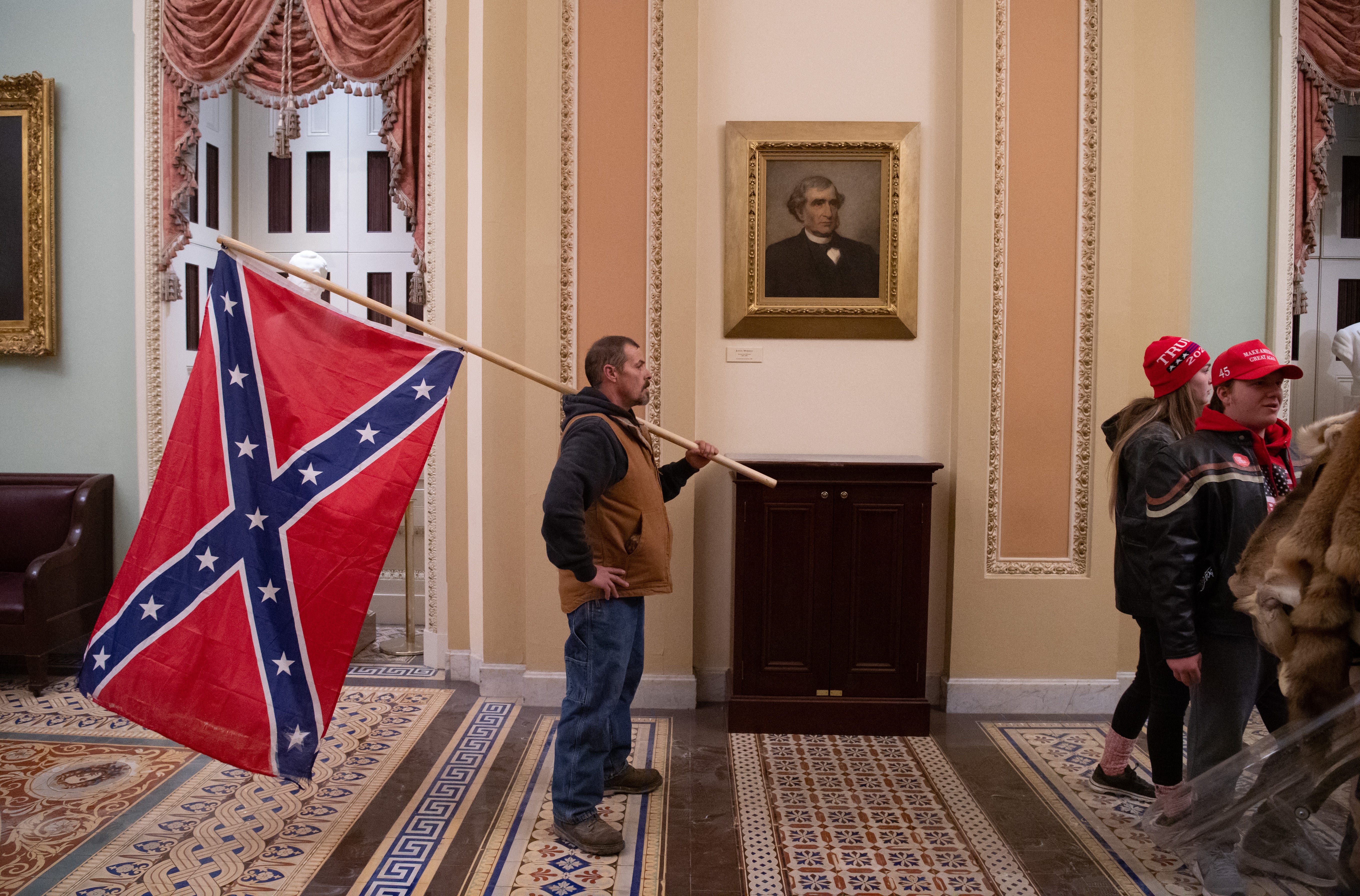
Our current era of backlash began after the election of Barack Obama in 2008, which led directly to the election of Donald Trump in 2016; you’ll recall that he turned himself into a political figure by becoming the nation’s foremost advocate of the racist “birther” theory that Obama was not actually an American. Once he took office, Trump glommed on to Confederate symbols, including the flag and statues of Confederate leaders, claiming that it was vital to preserve the “heritage” those symbols represented.
The notorious “Unite the Right” rally in Charlottesville in 2017 was prompted by an effort to remove a statue of Robert E. Lee. To this day, conservatives will angrily claim that when Trump responded to the events by saying there were “very fine people on both sides” he got a bad rap, because, they insist, he wasn’t referring to the neo-Nazis in attendance, only the neo-Confederates.

Throughout his first term, Trump continued to lament efforts to remove flags and statues, and to change the names of the 10 military facilities named for Confederate leaders. It is impossible to overstate what an outright obscenity it was that for decades, young men and women who would risk their lives were trained and housed in facilities named for traitors who waged war against the United States. It would have been no less vile to send American service members to Fort Himmler.
Then came the summer of 2020 and the murder of George Floyd. The “racial reckoning” that followed swallowed all of politics and culture for a brief time, and made display of Confederate emblems intolerable. Mississippi removed the stars ‘n bars from its state flag. NASCAR banned the Confederate flag at its races. Statues were torn down. And after Trump was defeated that November but before he left office, Congress passed a bill to change the names on those bases.
Trump threatened to veto the bill if the base names were changed, and made good on his threat. But in a sign of those times, his veto was overridden by large bipartisan majorities.
The pro-Confederate president from Queens
As the deplatforming of the Confederacy proceeded during the Biden years, the backlash accelerated. All over the country, Republicans passed anti-DEI laws and banished truthful discussion of slavery and discrimination from schools. Then once Trump took office again, he was much bolder than he had been before.
Trump all but ended asylum — except for white South Africans. His defense secretary Pete Hegseth purged the military’s top ranks of Black and female officers, then moved quickly to restore the names of those military bases to once again honor Confederate traitors.
Because the 2020 law forbade military facilities from being named after Confederate leaders in the future, the DoD had someone search through the files from the millions of Americans who have served in uniform to find individuals with the same names as the traitors. Once they found them, the names were changed back and the administration claimed, with a sneer and a giggle, that the bases are actually named after a different Bragg, Hill, Pickett, and Lee. As though anyone was fooled.
And remember my reference to putting statues back in place? That happened too. In 2020, activists tore down the only outdoor Confederate statue in Washington DC, one that celebrated Albert Pike, a general in the South’s war against America and a figure in the early development of the Ku Klux Klan. Late last year, the Trump administration reinstalled it.
So in the Trump era, the Confederacy itself is celebrated while a new and explicit advocacy for whites qua whites holds sway in both the administration and the Supreme Court.

While neo-Confederates spent decades saying they were only honoring “heritage” and “history,” this administration makes its agenda of racial supremacy much clearer. Vice President JD Vance triumphally tells the audience at Turning Point USA that with their movement in charge, “In the United States of America, you don’t have to apologize for being white anymore.”
The head of the Equal Employment Opportunity Commission makes a special plea to white men to report their oppression so they can be offered redress. Organizations public and private are threatened with federal consequences if they don’t get rid of programs to promote diversity.
“It’s not a sin to be white,” says a halfwit Kentucky congressman who stands a good chance of ascending to the Senate in November. The entire conservative movement is infested with antisemites and even genuine neo-Nazis, while the administration employs a troll army to flood the internet with Nazi memes.

For decades, the dominance of Baby Boomers over our politics and culture meant that much of our national life was defined by the divides of the 1960s — between the hippies and the squares, the old and the young, the protesters demanding change and the forces of the status quo. It was reasonable for liberals to think they won those arguments once and for all, but conservatives never admitted defeat. And today, the Supreme Court supermajority they spent decades building is fulfilling its purpose, while the administration advocates a white supremacism more shameless than anything we’ve seen in our lifetimes.
One lesson to take from this abysmal moment is that no victory is permanent and politics never ends. The right knew it, and the left can no longer ignore it. But that also means that the horrors now being unleashed on the country can be undone.
That’s it for today
We’ll be back with more tomorrow. If you appreciate today’s PN, please do your part to keep us free by signing up for a paid subscription.
Thanks for reading, and for your support.
Excellent article this morning. I am one of those ‘60’s people who thought we had fixed everything. This November has become so consequentially important to a vast number of issues. But the pressure is building in the streets now and November is six months away.
This reads the right move and draws the wrong lesson.
Callais is not a Confederacy revival. It is the terminal node of a forty-year institutional campaign: Federalist Society, state legislative capture, Shelby County, Brnovich, now this. Roberts has been working this file since the Reagan DOJ. The cost to the right was patience. The cost to the left was everything that compounds while you are not paying attention.
The complacency was not cultural overconfidence. It was a category error. Liberals optimized for symbols. The right optimized for maps, courts, and election machinery. Symbols do not compound. Procedural control does.
Statues come down and go back up. District lines, once redrawn under a gutted VRA, do not.
Johan 🐌