

PN is supported by paid subscribers. Become one ⬇️
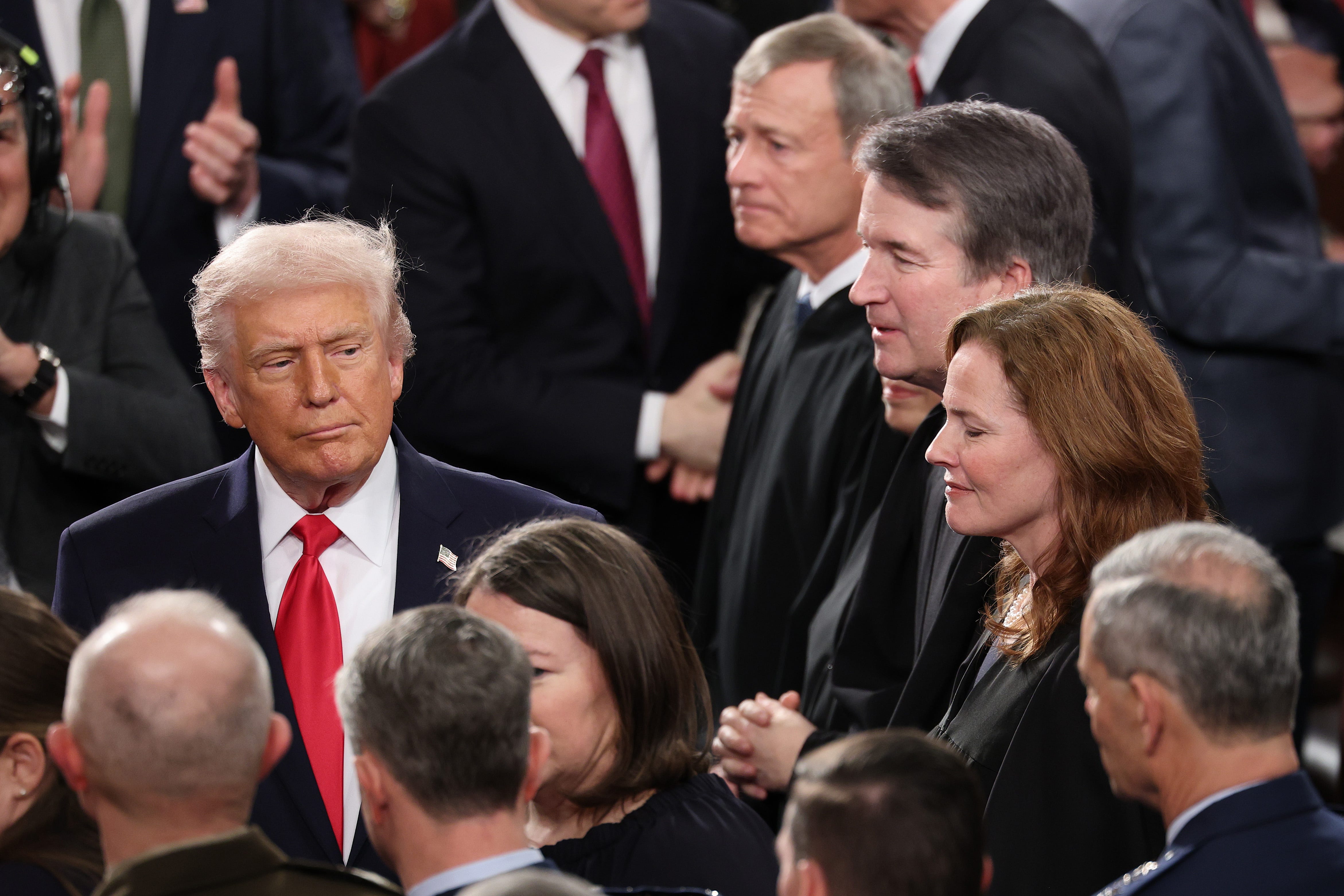
During his State of the Union speech, Trump called the Supreme Court’s ruling to strike down his illegal tariffs “very unfortunate.” With the justices sitting before him, it was an awkward moment, but it marked a deescalation from the last time he brought up the Court.
Instead of taking the ruling as an opportunity to abandon a policy that has been a dead weight on his approval numbers, Trump’s immediate response during a news conference last Friday was to double down on tariffs and target the six justices who defied him with one of his most dangerous rhetorical tools.
Trump began by launching a series of vicious personal attacks, including saying he was “ashamed of certain members of the Court,” blasting liberal justices as “against anything that makes the country strong, healthy, and great again,” and calling them “a disgrace to our nation.”
But he didn’t stop there. He also targeted the conservative justices who voted against him — including his own appointees.

Trump blared that Chief Justice John Roberts and his own appointees Amy Coney Barrett and Neil Gorsuch were disloyal “fools and lapdogs for the RINOs and radical left Democrats,” and added that those who opposed him were “very unpatriotic and disloyal to the Constitution.” He continued up by claiming, without evidence, that the Court had been “swayed by foreign interests” and that Barrett and Gorsuch were “an embarrassment to their families.”
This kind of rhetoric from Trump is not unusual. He often paints those who thwart him as traitors to the country or as personally disloyal (he does not see any difference between the two). He often uses extremely insulting language, denigrating his opponents in ways intended to diminish and dismiss them.
But the fact these attacks are common shouldn’t blind us to their power. When the president of the United States declares someone to be an enemy of the state, a lot of his partisans believe him — and some of those partisans take action.
There is good reason to believe that the justices who voted against Trump — and especially perhaps Barrett and Gorsuch — have already received death threats and harassment because of his words. Everyone who opposes Trump knows that he will try to wield his MAGA army against them in violent ways. How that affects people in each instance is difficult to know for sure. But we do know it is bad for democracy.
The Inciter in Chief
Why should we suspect that justices who opposed Trump have received death threats? There are a couple of reasons.
First, his words are calculated to make his followers angry, and to make them feel the justices are trying to personally betray and harm them. He calls them “unpatriotic” and “disloyal” and suggests they are colluding with foreign adversaries. He also specifically directed attention to the families of Gorsuch and Barrett.

This is language that tells Trump’s partisan followers that the justices are out to destroy the country. And it’s language which encourages people to focus not just on the justices, but on their loved ones. If the leader of your country, a man you admire and respect and with whom you strongly identify, tells you someone is a powerful enemy who’s bent on harming you and your nation, it’s likely you will feel passionate hatred for that person. In some cases, you will try to do something about it — quite possibly something violent.
This is not a hypothetical. There’s extensive evidence that when Trump uses rhetoric like this, violence follows.
The most flagrant instance is the January 6 coup attempt. Before and during the attack on the Capitol, Trump attacked his own vice president, Mike Pence, as disloyal for certifying election results that Trump has lost. Trump said Pence “didn’t have the courage to do what should have been done to protect our country.” That rhetoric — which echoes his attacks on the Supreme Court justices — led rioters to chant “Hang Mike Pence” and post about how they hoped to kill or maim him. (Afterwards Trump said it was “common sense” for the rioters to want to harm Pence.)
The attack on Pence is hardly the only time Trump’s words inspired violence. He’s directed some of his most vicious rhetoric against Rep. Ilhan Omar, who has reported that “death threats skyrocket” whenever he attacks her. When Trump denounced Indiana Republicans last year for refusing to go along with his gerrymandering scheme, at least 11 of them received death threats. When Trump attacked Haitians immigrants in Ohio on the campaign trail in 2024, the community was deluged with bomb threats. The judge who blocked Trump’s effort to revoke the community’s immigration status has also been targeted.
It is now simply a standard, often unmentioned part of our politics that those who the president dislikes, within his own party or outside it, will be the target of stochastic terror.
Threats distort our politics
It’s difficult to know exactly how or when threats influence political actors or alter their actions.
Ilhan Omar says she refuses to be intimidated by Trump. We know that Indiana Republicans remained firm in rejecting his redistricting plans; it’s possible the death threats they received even hardened their determination not to do his bidding. And the violence against the Capitol caused Trump’s approval ratings to crater — at least for a while.

In other cases, though, Trump’s stochastic terror may in fact have benefited him. Former Sen. Mitt Romney has said that at least one Republican senator chose not to vote to impeach Trump after the Capitol attack because they feared violence against themselves or their families. Marjorie Taylor Greene, the far-right former Georgia congresswoman who became one of Trump’s chief critics on the Epstein files, strongly suggested she was resigning and leaving politics in part because her family was deluged with death threats after Trump attacked her.
Might Romney — a consistent Trump critic — have pursued another term as senator in 2024 if he had not been receiving death threats? It’s possible even Romney himself doesn’t know for sure.
But Republicans do understand that threats against judges are a danger to democracy. After an armed man was arrested at the house of Justice Brett Kavanaugh, Republicans accused Democrats of downplaying the threat, and argued that protests about the Dobbs anti-abortion decision put justices in harm’s way.
Trump in his latest barrage praised Kavanaugh for his consistent sycophancy. But the rhetoric he aimed at Roberts, Barrett, Gorsuch, and the liberal justices is far more inflammatory than anything any Democratic leader has said about the anyone on the Court — and far more likely to lead to threats to the justices given Trump’s track record with stochastic terror.

Yet there has been precious little condemnation of Trump’s attacks, from either side of the aisle. Republicans who praised the court’s decision, like Sens. Mitch McConnell and John Curtis, did not rebuke Trump for claiming the court had traitorous motivations, or for his disgusting reference to the judge’s families. There’s been little comment from Democrats or the press, either — beyond journalists noting Trump’s comments were “blistering” and “vitriolic.”
Nor have the justices themselves made public statements about Trump’s attack. There could be a range of reasons for that. People who are targeted with gutter insults often do not want to talk about it, both because they do not want to dignify the remarks and because drawing more attention to them can give them more visibility.
Supreme Court justices are very well protected compared to the general public or even to other politicians or members of the judiciary. That’s in part because it’s crucial for the integrity of democracy that they not be swayed by threats or bullying and that people not believe they can change policy by targeting them.

And yet, the justices were targeted — flagrantly, in public, by the president of the Untied States. That should be an impeachable offense in itself. But we all know that Republicans will not vote to impeach this president — not even when he says that Supreme Court justices are traitors, not even when those justices are advancing a policy (tariff relief) that most Republicans favor.
The rule seems to be that Trump can direct his violent minions at absolutely anyone, and there will be no consequences and barely any comment. The grim takeaway is that even the Supreme Court justices, with all their power and prestige, are no longer living in a democracy.
That’s it for today
We’ll be back with more tomorrow. If you appreciate today’s PN, please do your part to keep us free by signing up for a paid subscription.
Thanks for reading, and for your support.
“There is good reason to believe that the justices who voted against Trump — and especially perhaps Barrett and Gorsuch — have already received death threats and harassment because of his words. Everyone who opposes Trump knows that he will try to wield his MAGA army against them in violent ways.” This statement couple with your last sentence before sign off is the gotcha moment. They asked for it the day they ruled on presidential immunity. They were instrumental in creating the monster that is trying to destroy us.
No sympathy. Choices have consequences. They can jump the sinking ship at any time.
Thanks, Noah. Great analysis ❤️
Roberts’ facial expression is worrisome. He looks like a child who has lost the affection of his parent and desperately wants it back. There are two possible paths forward for him: do whatever it takes to regain that affection, or mourn the loss of that affection while continuing to oppose the psychotic parent. In either case he’s a visual reminder that the deeper we dig the hole, the more pain we will suffer trying to extract ourselves from it.