

Public Notice is supported by paid subscribers. Become one ⬇️
The Founders intended states to serve as bulwarks against the risk of federal tyranny, though the record on that front has been more than mixed. Too often, state officials have invoked state sovereignty as cover for violating the civil rights of their own residents.
But now, as a dictatorial president sends thousands of militarized federal officers into the streets of American cities where they are terrorizing, kidnapping, and now killing their residents, our federalism is being put to one of its greatest tests since the Civil War.
The question we face is whether the nation’s sovereign states will use their constitutional authority to protect the rights of citizens against a tyrannical federal regime, including by holding federal officers responsible for their crimes.
The sovereign states
Under the Constitution, states are sovereign, with plenary “police powers” that include the primary responsibility for criminal law enforcement within their borders. In contrast, the federal government’s powers are “enumerated” and purportedly limited, particularly where local law enforcement is concerned.
The Trumpist phenomenon of the federal government imposing itself on states over the opposition of their residents, threatening their elected leaders with bogus criminal charges, and demanding that local police officers “stand down and surrender” is at odds with the fundamental structure of our government and puts Americans at risk. Republicans once seemed to understand this.

Conservatives long warned against what Reagan Attorney General Ed Meese called the “Dangerous Federalization of Crime,” and the “pernicious aggrandizement” of states’ police powers, which Meese claimed “endangers the constitutional principle of decentralized law enforcement authority that has worked well in America and that has been a bulwark against the centralization of police power at the national level.” William Rehnquist, who Reagan appointed to serve as chief justice, went so far as to author an opinion striking down a federal law criminalizing the possession of guns near schools on grounds that it exceeded the power of the federal government to regulate interstate commerce.
But Meese and Rehnquist could not have imagined a militarized federal legion, acting at the direction of a tyrannical president, invading major American cities in the name of going after “criminals.”
Dual sovereignty
As much of the nation was nauseated to watch videos of a mother being murdered in cold blood by ICE agent Jonathan Ross — who called his victim, Renee Good, a “f**king b**ch” and left her to bleed to death — JD Vance appeared before the cameras to declare that ICE agents enjoy “absolute immunity.”
The Trumped DOJ then let it be known that its civil rights division would not be investigating Ross’s actions or cooperating with local law enforcement investigators. Instead, they’d instead investigate the spouse of the dead mother, who DHS Secretary Noem labeled a “domestic terrorist,” smears that led to the resignations of experienced federal prosecutors in both Minnesota and DC.
Similarly, after Alex Pretti was shot 10 times by CBP agents last Saturday, federal authorities immediately labeled him a terrorist and barred local investigators from the crime scene.
Some have declared that Ross and the still anonymous killer(s) of Mr. Pretti are likely to get away with their crimes because Vance and the rest of the regime are determined to give DHS agents licenses to kill. But that will not happen if the Constitution operates as it has since 1789.
As “dual sovereigns,” states have the authority to exercise police powers by enforcing state criminal laws against federal officers who commit crimes within their borders. Ross’s rampage and the gangland-style shooting of Pretti — which egregiously violated well established policing practices and policies — are precisely the kind of situations in which courts have held that a state prosecution can proceed.
In the wake of the killing of the law enforcement officer by heavily armed suspects during the infamous Ruby Ridge standoff, an FBI sniper mistakenly shot the wife of one of the suspects and was thereafter indicted by an Idaho prosecutor. As a leading conservative judge put it in rejecting the immediate dismissal of those criminal charges, “when federal officers violate the Constitution, either through malice or excessive zeal, they can be held accountable for violating the state’s criminal laws.”
By the same token, Minnesota can hold federal officers who kill and otherwise harm their citizens in violation of the State’s criminal laws to account.
The Supremacy Clause, which provides that federal law is the “supreme Law of the Land,” permits a federal officer to obtain immunity, and thereby avoid state prosecution, only when their conduct was authorized by federal law and they did no more than what was necessary and proper in discharging their duties.

Noem has declared that every ICE officer — including the homicidal Ross and those who executed Pretti — is highly trained and adhering to DHS’s established policing policies. But that is plainly false.
In the few seconds portrayed in the videos before, during, and after the fatal Renee Good shooting, Ross violated a number of basic policing policies. He stepped in front of Good’s vehicle and then shot her three times, first as the car was turning away from him and then twice from the side as her car and lifeless body careened into a tree.
The killing of ICU VA nurse Pretti appears to be even more obviously wrongful. The multiple videos publicly available demonstrate Pretti was assaulted for having the temerity to attempt to protect a woman the agents had thrust to the ground. He was pepper sprayed, wrestled to his knees, then shot as many as 10 times even though he posed no threat.
Accordingly, while many cases present close calls in which a federal officer has a substantial Supremacy Clause immunity claim, the potential Good and Pretti murder cases are not among them. But while the law is in Minnesota’s favor, the state is already facing unconstitutional obstruction from the Trump regime.

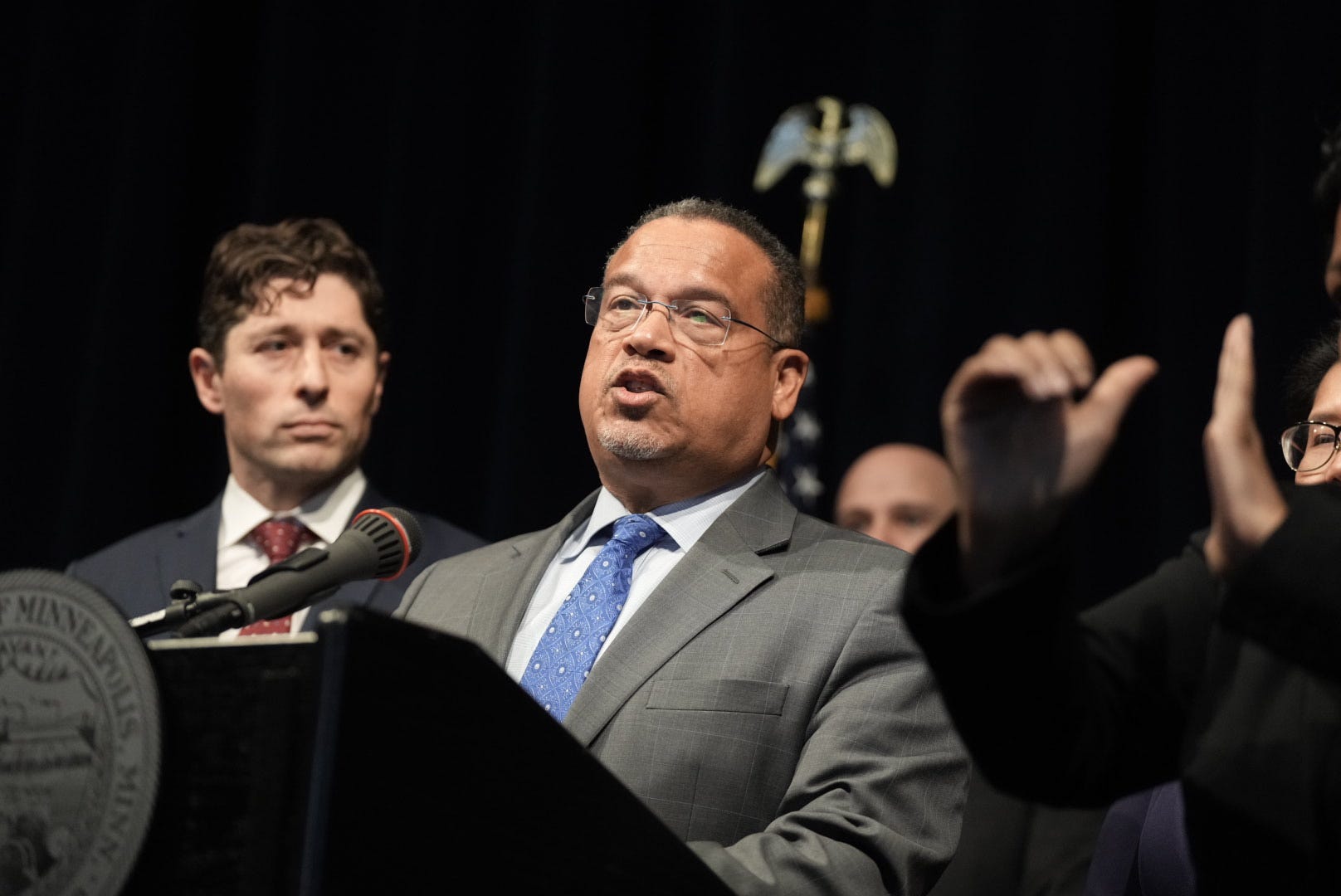
Minnesota Attorney General Keith Ellison has the authority to prosecute Ross (just as he successfully prosecuted the killer of George Floyd). But in an environment in which the Trump regime has not only been refusing to cooperate with state officials but has threatened to investigate them for fictional offenses, it seems all but inevitable Ellison and his prosecutorial team will become targets.
Furthermore, the regime has attempted to stonewall and obstruct state investigators, including by preventing them from obtaining timely access to the DHS suspects and other evidence in the federal government’s possession. In the wake of Pretti’s killing, federal agents reportedly barred state investigators from the crime scene despite the fact they had taken the unusual step of obtaining a warrant authorizing them to search their own state’s streets.
Under these extraordinary circumstances, it falls to the federal courts, which will ultimately hear the state criminal cases that may be brought against DHS officers under applicable law, to compel the federal government to satisfy its obligation to provide the sovereign state of Minnesota with access to the evidence.
At Minnesota’s request, a federal court has already issued an order requiring DHS to preserve all relevant evidence. The next far more contested step will come when state prosecutors seek an order requiring the feds to provide Minnesota investigators with access to the evidence of the DHS killings that they have tried to keep under wraps, including even the identity of the officers who shot Pretti.
In a signal of how far the Trump regime is willing to take its obstruction schemes, (former) Border Patrol commander/Nazi cosplayer Greg Bovino said DHS sent Pretti’s anonymous shooters, as well as the other officers involved in the killing, out of state, in a transparent effort to place them outside the reach of local investigators.
Such federal obstruction is ultimately likely to fail in the face of the state’s diligent assertion of its law enforcement authority. Given the fact that the Good and Pretti killings occurred in front of numerous witnesses and were amply documented by videos, state indictments appear all but inevitable. But the efforts of state officials to enforce their own laws and thereby vindicate the rights of their citizens against the unlawful actions of militarized executive branch invasion forces are only beginning.
The Tenth Amendment option
On January 10, Minnesota and Illinois (as well as the Twin Cities and Chicago) brought lawsuits challenging the legality of the Trump regime’s invasions of their states. While the suits state a number of legal theories, they are fundamentally based on the proposition that Trump’s actions constitute illegal intrusions upon their sovereignty.
The Tenth Amendment provides that “[t]he powers not delegated to the United States by the Constitution, nor prohibited by it to the States, are reserved to the States respectively, or to the people.” The lawsuits contend that Trumpers have turned that foundational constitutional principle on its head by attacking the citizens and governments of disfavored “Blue states,” systemically violating their laws as well as the US Constitution under the pretense of enforcing federal immigration laws.
Minnesota argues that the current situation in Minneapolis — where Trump has not only deployed thousands of DHS agents in a city that has only 600 police officers but also left it to those local officers to deal with the mayhem resulting from the federal invasion — thereby amounts to an unconstitutional attack on state police power.
ICE thugs intimidated and attempted to detain off duty police officers in the Twin Cities and even kidnapped a St. Paul snowplow driver who was legally in the country. Stephen Miller declared that “local and state police have been ordered to stand down and surrender” to the administration, demonstrating that Meese and Rehnquist’s warnings about the danger of the federal government tyrannically displacing core state and local government powers have come true.
Additionally, ICE’s kidnapping of schoolchildren as young as five in the Minneapolis area, as well as of parents taking their kids to and from school, has led to many absences and threatened the ability of schools being able to operate in normal course. This threatens public educations systems, which conservatives have long contended must be free of undue federal interference.
As Minnesota also argues in its complaint, far from being a targeted effort to enforce immigration laws, the ICE invasion of the Twin Cities (like the previous invasions of LA and Chicago) amounts to an effort to punish the residents of states that had the temerity to vote against Trump. That, Minnesota contends, is a violation of state sovereignty — one transparently designed to punish states Trump has designated to be his internal enemies.
Minnesota’s allegations were starkly proven when, in the wake of the Pretti killing, Attorney General Pam Bondi sent a letter to Minnesota officials indicating that the ICE occupation of Minnesota will end only if the state turns over its voter rolls to the DOJ, thereby involuntarily participating in Trumpers’ election rigging scheme.
On Monday, federal judge Katherine Menendez held a hearing on Minnesota’s request for a temporary restraining order. The judge expressed skepticism about the breadth of the relief Minnesota officials are seeking, including a complete end to the ICE “surge,” but also adroitly questioned a DOJ lawyer about whether the administration is using its violent occupation as leverage for other unrelated demands.
The Supreme Court has sometimes rejected the use of laws to coerce states into taking policy actions favored by the federal government, including in rejecting the Affordable Care Act’s initially mandated expansion of Medicaid. Accordingly, Trumpers’ use of violent occupations as a tool to force states to bend to their will seems more than a bit constitutionally problematic.
That said, a federal appellate court has stayed a far narrower preliminary injunction issued by Judge Menendez that barred DHS officers from continuing to use chemical weapons on peaceful protestors, as they did to Pretti immediately before killing him. And a different federal court rejected a trial court’s preliminary injunction imposing limits on DHS officers’ conduct during their invasion of the Chicago area.
It is therefore understandable that Judge Menendez chose not to issue an immediate ruling and instead is taking time to render a considered one in this extremely significant case.
Where is this going?
The determined and resolute response of the people of Minnesota — including most importantly those like Pretti who have (peacefully and courageously) taken to the streets to exercise their rights and protect their neighbors — have played a huge role in shifting the debate. Trump is now on the political defensive. State and local officials owe it to those they represent, including those placing their lives on the line, to continue to employ their sovereign powers to protect citizens against federal tyranny.
It is naïve to expect that criminal or civil court proceedings brought by state officials will be the primary answer to the feds’ brutal invasions of American cities. Resounding success in the courts is unlikely given the number of extreme right-wing jurists on federal appellate courts, not to mention the Supreme Court. But it’s also becoming obvious that the political tide is shifting against Trump’s internal invasions.
Just as strong pushback from Canadian prime minister Mark Carney and financial markets induced Trump to retreat from his threat to invade NATO allies, the combination of continued pressure from state governments and the growing revulsion of the voting public is having a demonstrable impact on the Trump regime.
Just yesterday, Trump told Minnesota Gov. Tim Walz — however disingenuously — told he recognizes the need for an actual investigation of the killing of Pretti, and his flack distanced the president from Stephen’s Miller’s labeling of Pretti as a terrorist.
Trump later demoted the loathsome Bovino and replaced him with his slightly less bloodthirsty “immigration czar” Tom Homan.
The term “states’ rights” is redolent of decades during with Southern states invoked their sovereignty as cover for segregation and other violations of citizens’ civil rights. But at a time when the vast power of the federal government has come under the control of a would-be dictatorship that is quite literally at war with the United States, states will now have to resist such unconstitutional federal actions in the name of civil rights.
That’s it for today
We’ll be back with more tomorrow. If you appreciate today’s PN, please do your part to keep us free by signing up for a paid subscription.
Thanks for reading, and for your support.
David, you're absolutely right that we should look to the structural safeguards in our Constitution, and you're right that states retained the power to resist tyranny being imposed by federal officials. That is why the Tenth Amendment emphasized that federal officials have only the limited "powers" that the People "delegated to the United States by the Constitution," and other powers were (by the Constitution) "reserved to the States respectively, or to the people."
But precision and accuracy of terminology are crucial. It's important not to go too far and merely trade state tyranny for federal tyranny. It also weakens your position to argue either that "states are sovereign" or that they have "plenary police powers." Neither assertion is true, and it's important to understand why.
You're right that lawyers and judges commonly throw around the expression "plenary power," but they're clearly wrong to do so. Such assertions are false. Nobody has "plenary power" under our Constitution. Instead, various officials, state or federal, legislative, executive or judicial have "jurisdiction" over various matters or processes.
It's easy to defeat the state sovereignty argument by invoking Article VI of Constitution. The Supremacy Clause and the Oath Clause, state laws establishing oaths to support our Constitution (and the Preamble and Article I's Necessary and Proper Clause) establish and emphasize that state governments clearly are not sovereign. Those parts of our Constitution (and the President's oath and federal law establishing oaths to support our Constitution) equally clearly establish that the federal government is not sovereign. Instead, the People are sovereign, as Justice James Wilson and Chief Justice John Jay emphasized in 1793 in Chisholm v. Georgia (https://www.oyez.org/cases/1789-1850/2us419) and as many SCOTUS justices have emphasized, e.g., in Alden v. Maine in 1999 (https://www.oyez.org/cases/1998/98-436) and in Citizens United in 2010 (https://www.oyez.org/cases/2008/08-205).
It's also easy to defeat the "plenary police powers" argument. The principle at work in the division and arrangement of powers in the concepts called federalism (dividing powers between state and federal governments) and the separation of powers (dividing powers between legislative, executive and judicial branches) are designed to ensure nobody anywhere ever has plenary powers over anything.
"Plenary" means "absolute," and absolute power leads to tyranny. One overarching purpose of our original Constitution was to deprive states of plenary power (which states actually did have before our Constitution was ratified in 1788). James Madison and others explained the principle at work.
In Federalist No. 48, James Madison quoted Thomas Jefferson in Jefferson's "Notes on the State of Virginia" (which were written before the Virginia Constitution, but which continued to apply to the Virginia Constitution because of its defects):
"All the powers of government, legislative, executive, and judiciary, result to the legislative body. The concentrating these in the same hands, is precisely the definition of despotic government. It will be no alleviation, that these powers will be exercised by a plurality of hands, and not by a single one. One hundred and seventy-three despots would surely be as oppressive as one. . . . An ELECTIVE DESPOTISM was not the government we fought for; but one which should not only be founded on free principles, but in which the powers of government should be so divided and balanced among several bodies of magistracy, as that no one could transcend their legal limits, without being effectually checked and restrained by the others."
Remedying the dangerous defects in state constitutions was the primary reason for the push for a national constitution. So Madison emphasized: "It will not be denied, that [all] power is of an encroaching nature, and that it ought to be effectually restrained from passing the limits assigned to it."
In Federalist No. 51, Madison emphasized that the first and most fundamental truth about the "separate and distinct exercise of the different powers of government" is that it was implemented in our Constitution because it is "essential to the preservation of liberty." Of course, "each department should have a will of its own" but we must never forget that all "executive, legislative, and judiciary" authority is "drawn from the same fountain of authority, the people."
In Federalist No. 47, Madison elaborated on why powers were divided as they were in our Constitution:
"The accumulation of all powers, legislative, executive, and judiciary, in the same hands, whether of one, a few, or many" (no matter how they are given or usurp such power) "may justly be pronounced the very definition of tyranny." "[T]he preservation of liberty requires that the three great departments of power should be separate and distinct. The oracle who is always consulted and cited on this subject is the celebrated Montesquieu."
"Montesquieu" was famous for emphasizing the following. "There can be no liberty where the legislative and executive powers are united in the same person, or body of magistrates," or, "if the power of judging be not separated from the legislative and executive powers." "When the legislative and executive powers are united in the same person or body," says he, "there can be no liberty, because apprehensions may arise lest THE SAME monarch or senate should ENACT tyrannical laws to EXECUTE them in a tyrannical manner. " "Were the power of judging joined with the legislative, the life and liberty of the subject would be exposed to arbitrary control, for THE JUDGE would then be THE LEGISLATOR.
Were it joined to the executive power, THE JUDGE might behave with all the violence of AN OPPRESSOR."
The very problem we're having with Trump is that he pretends that nobody's authority but his matters. He pretends to have the powers to make, interpret and enforce laws so that he can do pretty much whatever he wants. Our Constitution was structured with federalism, separation of powers and the Supremacy Clause and Oath Clauses of Articles II and VI to discourage, prevent and punish Trump's usurpations of power.
Thank you, Mr. Lurie. I’ll be watching to see what happens at bovino’s next posting.