

This special July 3 edition of PN is made possible by paid subscribers. Become one ⬇️
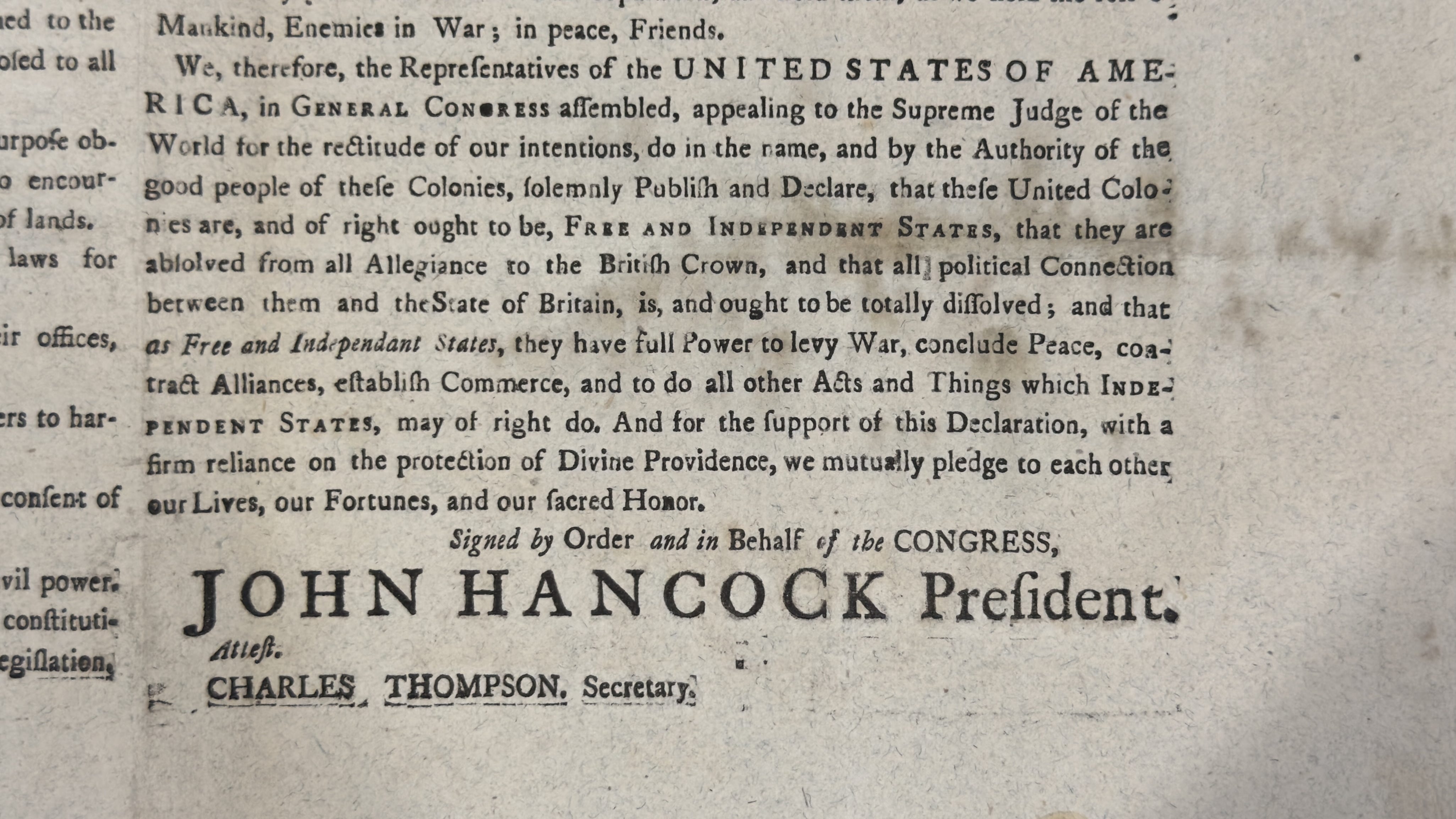
Today marks the 250th anniversary of the signing of the Declaration of Independence, a landmark moment in American and human history. Celebrations and fireworks aside, what does the Declaration mean two-and-a-half centuries later?
The Declaration is loaded with meanings, some of them inherently self-contradictory. Its opening paragraphs are spine-tinglingly profound, but the bulk of the document is a grievous rant. The document set a global standard for freedom and self-governance as naturally inherent human rights, yet bounded those rights to a privileged white, male minority. It is timeless yet also somewhat outdated for American politics today.
Unfortunately, the Declaration of Independence penned primarily by Thomas Jefferson allows self-interested parties to validate their agendas by importing into that sacred document their preferred interpretations of life, liberty, and the pursuit of happiness. Precisely because the Declaration is so ripe for political manipulation, having Donald Trump lead the nation during this semiquincentennial anniversary offers a fitting, if bleak, opportunity to litigate anew the Declaration’s political utility.
(Re)litigating the Declaration
The litigants are many. Netflix, for example, has leaned heavily into the revolutionary moment by releasing two new documentaries, plus biographical docudramas about presidents George Washington and Thomas Jefferson.
Produced and directed by Ken Burns, Sarah Botstein, and David Schmidt, “The American Revolution” is a fantastic, six-part series that focuses almost exclusively on the war. Burns and his team deftly use war narratives as a trojan horse to subtly — and sometimes not-so-subtly — smuggle onto viewers’ screens the message that women, slaves, and Native Americans also played vital roles in the fight for independence.
When “Revolution” was released last autumn, Burns made the rounds on Capitol Hill, cozying up to Republicans in ways that alarmed some critics. From a purely strategic standpoint, he shrewdly played Washington politics the same way contemporary lobbyists do when building coalitions to protect their interests, which in Burns’s case is ongoing federal support for PBS programming.
Although “Revolution” avoids mentioning Trump, its inclusive set of narrators and topics delivers an implicit corrective to the white-washed histories of the founding moment. “Revolution” is Burns’s anniversary gift, carefully but not too obtrusively wrapped with a multicultural bow.
Then, last month Netflix released a five-part series called “The American Experiment.” Shepherded by nearly a dozen producers headlined by Tom Hanks and directed by Brian Knappenberger, “Experiment” mixes recreations with interviews from both notable colonial scholars and contemporary politicians to explain the principles contained in the Declaration of Independence and Constitution. (The documentary includes an important, useful interlude about the failed and often forgotten first attempt at an American republic: the doomed Articles of Confederation.)

“Experiment” arguably would’ve been stronger had it excluded the politicians, if only because tens of millions of Americans might blanche at the prospect of learning about the founding era from polarizing figures like Hillary Clinton, Al Gore, Ted Cruz, and Rand Paul. To its credit, however, the filmmakers are less subtle about addressing the threats that so worried the founders — the documentary directly addresses Trump and the domestic terrorist attack he led on the US Capitol on January 6, 2021.
Whom does “Experiment” elevate as the exemplary counterpoint to America’s current president? None other than George Washington, the predecessor whose name graces the nation’s capital Trump is presently corrupting and destroying.
Washington, the anti-Trump
Historians and political scientists typically rank Abraham Lincoln and Franklin Delano Roosevelt as among the greatest US presidents. But Washington was the nation’s most indispensable chief executive, and for one reason: He relinquished power.
In a stunning rebuke of the precedent set by centuries of priests, kings, and authoritarians before him, Washington surrendered control of the continental army after the war and then voluntarily returned to his homestead in 1797 following two terms as America’s first president.

Voiced in “Experiment” by the most famous TV president, Martin Sheen, Washington is glorified in the documentary for his foresight and forbearance. On December 23, 1783, in Annapolis, the imposing Virginian relinquished command over the revolutionary army he led to victory. In an event planned by his revolutionary cohorts Jefferson, James McHenry, and Elbridge Gerry (yes, that Gerry), Washington and his compatriots enjoyed a celebratory feast the night before his address.
The next day, Washington stood in the well of Maryland’s state senate chamber and, before 200 witnesses, declared, “Having now finished the work assigned me, I retire from the great theatre of action, and bidding an affectionate farewell to this august body, under whose orders I have so long acted, I here offer my commission, and take my leave of all the employments of public life.”
That last bit proved premature, of course. Six years later, following his presiding over the second Constitutional Convention in Philadelphia that produced a new US Constitution to replace the ill-fated Articles, Washington was unanimously chosen as America’s first president.

Washington was far from perfect. As the largest colonial landowner, freedom not only meant rescuing citizens from the royal thumb but liberating his vast acreage from trans-Atlantic control. He owned slaves. He used state power to put down the Shays’s Rebellion that, were somebody to replicate that act today, would send conservative populists into delirious denouncements of wealthy, elitist, coastal oppressors.
But Washington set the precedent for the exercise of power in a free nation. His refusal to consolidate control for himself remains a model for the United States and world.
Meet the new tyrant, same as the old tyrant
Unfortunately, not everyone reveres Washington’s example.
In the months leading up to the 250th anniversary of the Declaration of Independence, many commentators noted the irony of Trump celebrating a document that delineates complaints about King George’s abuses of powers, many of which eerily mirror Trump’s own tyrannical actions.
In a cogent essay, William Becker, co-editor of “Democracy Unchained: How to Rebuild Government for the People,” provides a line-by-line comparison:
Trump’s tariff policy? The Declaration fumes: “He has been cutting off our trade with all parts of the world (and) imposing taxes on us without our consent.”
His ICE policies? Jefferson saw that problem from a mile away: “He has kept among us, in times of peace, Standing Armies without the Consent of our legislatures.”
How about January 6? An easy one, short and sweet: “He has excited domestic insurrections amongst us.”
By greedily attempting to expand and consolidate control over a nation forged by a Declaration and organized by the Constitution — neither of which he has probably read nor regards as sacred — Trump stains the founding documents. He believes in life, liberty, and the pursuit of happiness, but only for himself.

Independence and freedom exist in the absence of tyranny and elevation of the rule of law over self-interested rulers. Trump threatens this core promise that Jefferson asserts in the Declaration. Modern American politicians who are neither blinded by partisanship nor drunk with their own power recognize that threat.
“I think the American people would do well to reflect in the 250th year since the signing of the Declaration … and to particularly encourage our elected representatives to take back the authority and the role that the founders intended,” warns one prominent US politician.
AOC? Elizabeth Warren? Jon Ossoff?
Nope, the quote above belongs to none other than Trump’s first vice president, Mike Pence, who got a front row seat to the abuses possible when an out-of-control president is unchecked by the supposed stewards of our democratic system.
United they stood
The Founders were hardly of one mind. They disagreed about the promise and perils of popular rule. They disagreed about how much power to concentrate in the national government or any branch within it. And, of course, they disagreed about civil liberties and rights — particularly who was and wasn’t entitled to such protections.
The one connective thread that bound together the revolutionary patriots was their opposition to, and fear of, absolute and unchecked rule perpetuated by autocrats. Sure, Alexander Hamilton was less wary about centralizing power in a strong presidency than his friendly nemesis Thomas Jefferson. But their disputes were more a matter of how, not whether, to best secure the blessings of liberty.

Were they alive today, and almost without exception, the revolutionary leaders would be appalled to see this anniversary presided over by a man who treats with contempt the project they risked their lives to bequeath to us. Almost daily, Donald Trump’s presidency dishonors their legacy by desecrating not only the White House, the National Mall, and the capital city during what should be a celebratory moment, but the rule of law itself.
The Atlantic magazine dedicated its entire November 2025 issue to the revolutionary era. More than a dozen articles from a range of scholars examine the war, the revolution’s leaders and ideals, the founding documents, even the patriotic cuisine. In “The Moral Foundation of America,” Princeton University emerita professor of religion Elaine Pagels concludes her essay with a chilling entreaty.
“The Founders knew that monarchy had been the norm for most of human history, and they saw how difficult that would be to change. The cruel and dangerous reversion to rule through fear and violence that we are seeing now was among their greatest concerns,” she writes. “Now is the time for those of us who love what the Founders entrusted to us to pledge anew — to one another, to our children, and to those who come after us — that we stand for their Declaration.”
To borrow from Jefferson, that truth ought to be self-evident. Sadly, in the Trump era it no longer is.
That’s it for this week
We’ll be back with more Monday. If you appreciate today’s PN, please do your part to keep us free by signing up for a paid subscription.
Thanks for reading, and for your support. And if you’re in the States, happy 4th of July!
How very sad that the estimable Ken Burns has to explain democracy to Americans! Of course, MAGA won’t watch … and thanks to Trump, it won’t learn in the classroom.
Perhaps the only sense in which Trump provides any semblance of public service is to illustrate essential history that we seem to have forgotten. To rediscover what “independence” meant to the people who declared it and fought for it, it is very well worth reading the Pulitzer-Prize-winning "The Radicalism of the American Revolution" by the late great historian of the American Revolution Gordon Wood. Wood was killed last month in a tragic accident, but his works and words are very well worth our continued attention.
Again and again, Wood used the words "dependence" and "independence" to show that a demagogue and tyrant like Trump is the opposite of what the brave people of the Declaration of Independence (and the many similar declarations of that time) and the Revolutionary War had in mind. The intimidation and tyranny of Trump is the opposite of the independence and the public service of true public servants for which the generations of the Declaration fought, suffered and sacrificed very much.
"Power and Liberty: Constitutionalism in the American Revolution" is another outstanding book (and even shorter and easier to read) by Wood that is perhaps even more worthy of our attention in the time of Trump. It is an outstanding clarification of how Trump (and many other so-called public servants) routinely violate their oaths of office to support and defend our Constitution. Wood shows how our so-called public servants’ often selfish, self-aggrandizing and exaggerated sense of their own importance and its role in our self-government is the opposite of “government of the people, by the people, for the people,” as President Lincoln put it in his Gettysburg Address.