

🎄🎄🎄 PN HOLIDAY SPECIAL 🎄🎄🎄 Click the button below to sign up for an annual paid subscription for the special price of $40 ⬇️
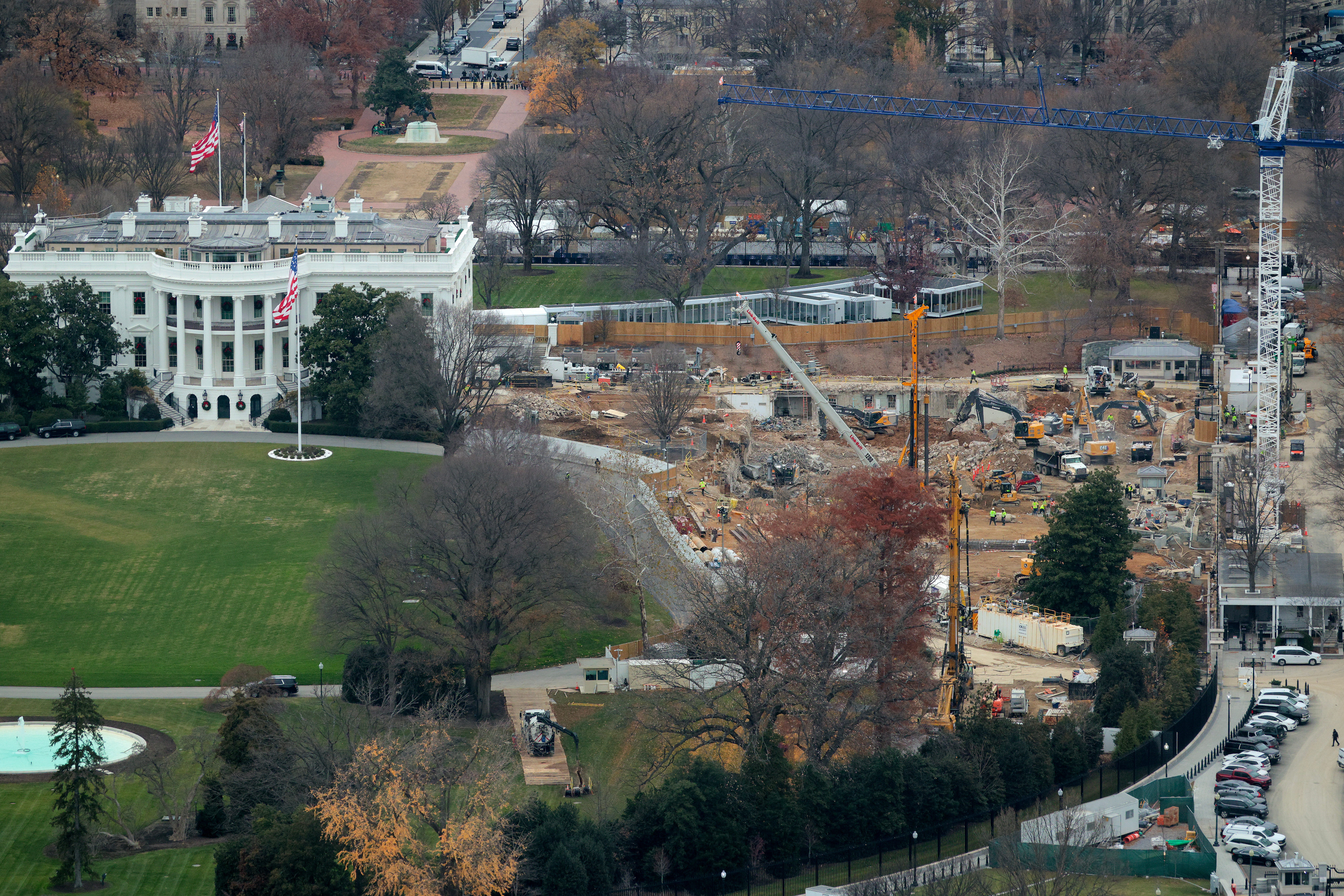
Last week, the National Trust for Historic Preservation sued the Trump administration over the White House ballroom project, saying the law requires that plans be reviewed and approved by two federal commissions and the construction must be authorized by Congress.
But according to the administration, construction can’t be halted for even the briefest moment — or our national security will be imperiled.
How does putting a pause on the Big Gilded Ballroom compromise national security? Well, the administration can’t say … because it would compromise national security.
It’s kind of a fool’s game to treat the administration’s court filings as legitimate legal arguments. That’s not only because Department of Justice attorneys are distressingly comfortable with deceiving judges and defying orders. It’s also because the administration doesn’t genuinely believe it should be required to justify or defend its actions, so instead of legal arguments, we just get assertions of raw, unchecked power.
The most blatant version of this is the administration’s favorite one to raise — namely, that President Trump gets to do what he wants because he is president. But the vague, fact-free invocation of national security is in the same category, albeit less obviously so. One is basically “you can’t tell us what to do,” while the other is more “we don’t have to tell you what we’re doing or why we are doing it.”
Legal mush
Indeed, in the ballroom case, the administration doesn’t bother to make a legal argument about national security at all. Instead, there’s just the bald assertion that there are “security concerns that warrant permitting the current below-grade construction to continue.”
The filing making that claim doesn’t deign to explain anything about those concerns. Instead, it just refers to a declaration from the deputy director of the Secret Service explaining that it “coordinates with the contractor on these temporary measures to ensure the security and safety of the President, the First Family, and the White House complex.” And though apparently the contractor has completed most of these, “improvements to the site are still needed before the Secret Service’s safety and security requirements can be met. Accordingly, any pause in construction, even temporarily, would leave the contractor’s obligation unfulfilled in this regard and consequently hamper the Secret Service’s ability to meet its statutory obligations and protective mission.”

You will note that none of this appears to refer to national security as such, but rather to the personal security of the president and his family. Certainly, the personal security of the president is a national security issue, but the Secret Service declaration says only that the contractor needs to do some more work to meet the Secret Service’s requirements for the safety of the president and his family.
The brain geniuses at the DOJ and the Secret Service do not seem to have realized that by saying the contractor still needs to do more work to make things adequately secure, they just told the world that the president and his family are not currently adequately secure and will only become so when a private contractor finishes some tasks. For an administration so very worried about security, that seems like kind of a bad thing to reveal?
A note from Aaron: Working with brilliant contributors like Lisa takes resources. If you aren’t already a paid subscriber, please sign up to support our work 👇
So, neither the administration’s memo nor the Secret Service declaration ever mentions national security, but just “security concerns.” National security only appears in a different filing asking the court for permission to submit an in camera, ex parte declaration. “In camera” means that the declaration would not be viewable by the public, but “ex parte” means it would also not be viewable by the plaintiff or its attorneys. Now, there are “national security concerns inherent in any pause to this Project,” and it cannot even be shared with opposing counsel “without compromising the interests of national security.” (But apparently it’s fine for whatever random contractor is currently working on this thing to be privy to national security information.)
You can see that if you take this at face value and treat it like a normal legal argument, everything falls apart. There’s no reference to any legal authority. There’s no detail. It’s just “there are security concerns, as evidenced by the Secret Service saying there are security concerns and therefore there are secret national security concerns and the project cannot be stopped, and you cannot have any more details.”
How do you possibly push back against that? It’s just mush.
Also mush? Invoking national security as the rationale for basically eliminating federal employee unions.
Magic words
In March, Trump issued an executive order saying more than 40 agencies and subdivisions had intelligence or national security work as their core function. The law allows the president to exclude from union protections employees whose primary purpose is national security, so Trump simply declared that nearly two-thirds of the federal workforce had national security as their primary purpose.
As with the ballroom, this falls apart the minute you apply even the most cursory scrutiny. The idea that a substantial majority of federal employees have national security-focused jobs is ridiculous. The idea that a substantial majority of federal employees have national security-focused jobs, but security implications were overlooked for decades until Trump came along, is even more so.
The argument that having civil service protections threatens national security because unions are hostile to Trump and therefore he will be delayed in protecting the American people is equally dumb, but the administration trotted it out in court nonetheless.

Perhaps the silliest argument that got floated here, though, was that the Department of Defense Education Activity, which runs K-12 schools that the children of military personnel attend, “has a primary national security function given its role in educating servicemembers’ children, which is critical to DoD’s recruitment and retention efforts.” So, as long as you basically Six Degrees of Separation from every individual job all the way out to the overall health of the federal government, you can claim it’s a national security concern.
Also a national security issue? Being mean to fossil fuel companies. No, really.
When Hawaii announced it would be suing fossil fuel companies for damages related to the effects of climate change, such as wildfires, the administration sued Hawaii first, saying that we are facing an energy crisis, and overregulation has impeded the development of the country’s energy resources. But since “[a]n affordable and reliable domestic energy supply is essential to the national and economic security of the United States, as well as our foreign policy,” Hawaii can’t be allowed to sue an oil company.
Well, at least this argument relies on some sort of authority, right? Up there in quotation marks? Yeah, about that. What the administration is quoting there is one of Trump’s executive orders, where he just vibed about how much he wants fossil fuels. That’s not legal authority. That’s not anything, really. National security interests don’t arise just because Trump says they do.

The notion that the federal government gets to dictate what causes of action a state brings and what private parties a state sues simply by waving a national security wand is not just ridiculous — it’s unworkable. Imagine the Biden administration trundling down to Texas and telling Gov. Greg Abbott he can’t sue Planned Parenthood because an affordable and reliable abortion provider supply is essential to the national and economic security of the United States.
Tariffs on imported lumber? National security requires it.
Tariffs on imported vehicles? National security, duh.
Every other tariff? National security, glad you asked.
Microsoft hiring Lisa Monaco, who was a deputy attorney general during the Biden administration and homeland security adviser during Obama’s presidency, to be its head of global affairs? National security requires that she, a private citizen, be fired by a private company for having overseen the Biden DOJ’s response to January 6.
Of course, when it comes to things like your secretary of defense using a private, commercial, freely available messaging app and bragging about military strikes without bothering to see who all is on the group chat? No big deal, not a national security concern at all.

Suffice it to say that if either Congress or the Supreme Court were functioning branches of government, this sort of thing would not fly.
A functioning Congress would not let Trump usurp its tariff power regardless of whether he said the magic words “national security” or not. A functional Congress would not have confirmed Pete Hegseth, or, at the very least, would have impeached him after Signalgate. A functioning Supreme Court would never have invented immunity for Trump and then spent the last 11 months giving him everything he wants simply because he wants it.
But since the conservatives running both of those branches have just given up, Trump is free to keep invoking spurious national security concerns any time he feels like it. They’re not going to stop him, so why shouldn’t he?
That’s it for now
We’ll be back with a new Nir & Rupar later today. If you appreciate today’s PN, please do your part to support us by taking advantage of our holiday special and becoming a paid subscriber if you aren’t one already.
Thanks for reading and for your support. Happy holidays.
Thank you, Ms. Needham. Well said. If everything is national security or an emergency, then nothing is. Hopefully the greatest con man in world history is facing his Waterloo - voluntarily or involuntarily. It would be wonderful if the majority party in Congress had even an iota of the moral courage of our Founders.
Excellent points about “National Security “. Didn’t they think about this first before they suddenly tore down the East Wing? Silly question.