

Public Notice is supported by paid subscribers. Become one ⬇️
In 2024, it was just possible to pretend that Trump’s populist bombast might translate into a real antitrust policy. His VP pick, then-Sen. JD Vance, provoked dramatic pearl-clutching from the Wall Street Journal with his avowed support for muscular corporate regulation.
But corporations were never fooled. They plowed a record $239 million into Trump’s inauguration fund — more than double the $109 million he raised in 2017, and almost four times what Biden raised in 2021 (albeit during covid).
Among the well-wishers was Live Nation Entertainment, which contributed $500,000 to the party. That turned out to be a pretty good investment.
On Monday, the Trump Justice Department ended a federal antitrust lawsuit against the concert behemoth, allowing it to hang on to Ticketmaster and the hundreds of concert venues that make up its stranglehold on America’s live music market.

The mid-trial settlement blindsided the 39 states and the District of Columbia that had joined as co-plaintiffs and infuriated the federal judge overseeing the case. It’s likely to infuriate the fans, too, as they continue to see massive Ticketmaster surcharges — service fees, platinum fees, per-order fees, payment processing fees, facility fees, magical money-sh*tting unicorn fees — on top of already sky-high ticket prices.
And the pain may be just beginning. In September, Live Nation’s CEO Michael Rapino said “the concert is underpriced and has been for a long time.”
Monopoly money
It’s hard to believe that concert ticket sales used to be a service that venues paid a nominal fee to offload to vendors. Today venues and vendors, along with artists and fans, are cogs in what Live Nation describes internally as its “flywheel.”
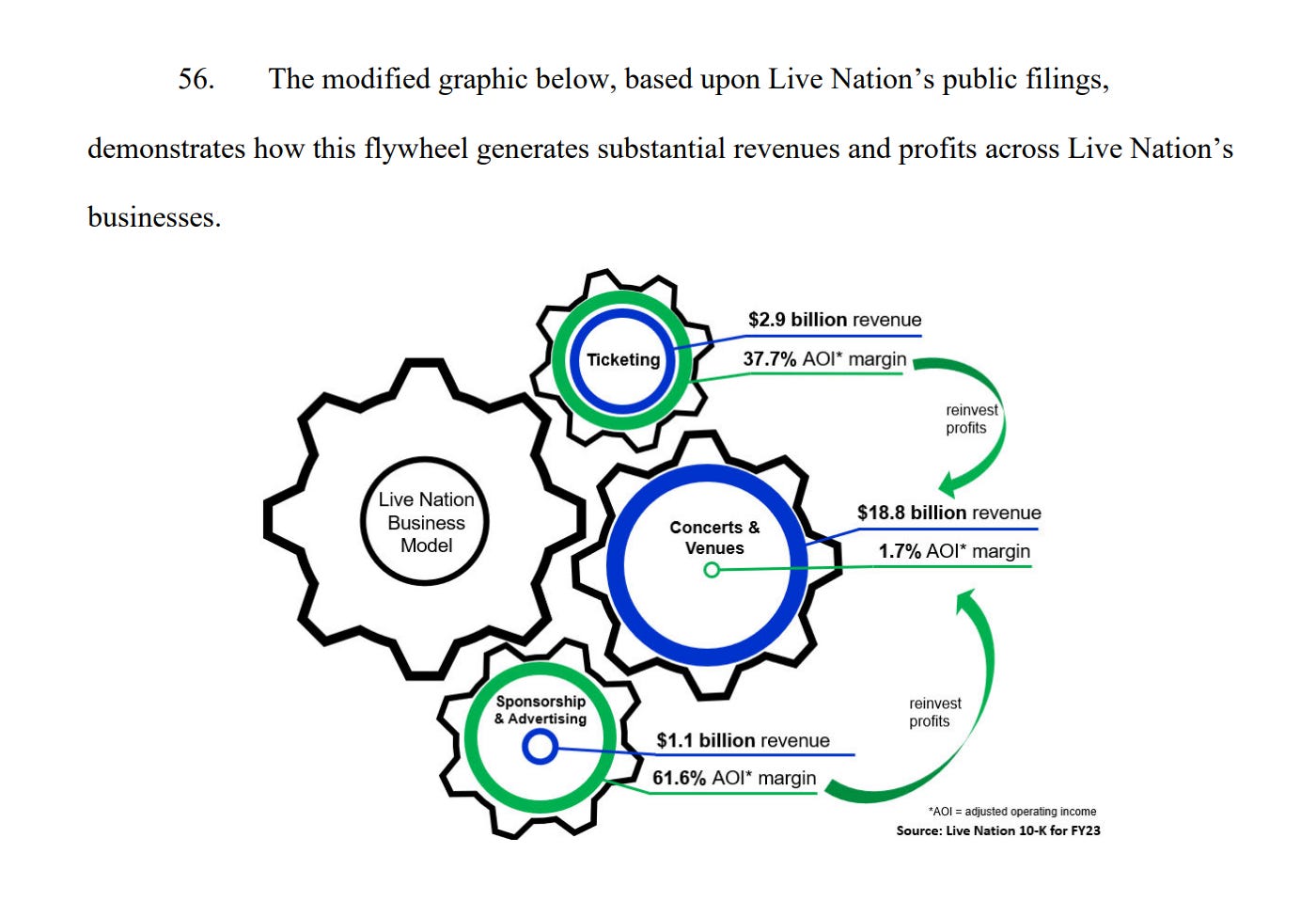
Live Nation is a classic vertical monopoly: a single entity that comprises virtually every link in the supply chain. It owns the venues, controlling at least 460, including more than 60 of the top 100 amphitheaters in the US, according to the New York Times. It controls the artists, with more than 300 of the top acts under its management. And it sells roughly 80 percent of tickets at major concert venues, particularly the arenas and outdoor amphitheaters that matter most for national tours. All of this has made it spectacularly profitable, with 2025 revenues up nine percent, to $25.2 billion.
The anticompetitive conduct that maintains this flywheel is not subtle. Live Nation uses its dominance in concert promotion — control over which artists play where — as a cudgel against venues that dare to sign with a rival ticketer.
As Rapino admitted in 2019, “We can’t say to a Ticketmaster venue that says they want to use a different ticketing platform, ‘If you do that, we won’t put shows in your building.’ It also says we can do what’s right for our business, so we have to put the show where we make the most economics, and maybe that venue [that wants to use a different ticketing platform] won’t be the best economic place anymore because we don’t hold the revenue.”
When Barclays Center in Brooklyn switched from Ticketmaster to its competitor SeatGeek in 2021, Live Nation CEO Michael Rapino called the arena’s CEO John Abbamondi, and angrily warned that it would “be a tough time to deliver tickets or concerts with a new competitor in town, regardless of ticketing.” The arena had anticipated 17 Live Nation shows that year. It got eight. A year later, the venue returned to the fold, breaking its contract with SeatGeek more than five years early.
Live Nation ran the same playbook against Australian concert promoter TEG when it attempted to expand into the US market in 2021. The pressure campaign involved Oak View Group, a venue development company which survives off of Live Nation’s crumbs. In private texts, executives called it a “pimp” and a “hammer” for Live Nation, and its CEO Tim Leiweke promised Rapino “I always protect you on rebates, promotor position, ticketing.” (Lieweke was indicted for antitrust violations in July 2025 by Trump’s own DOJ, and then pardoned by Trump in December after lobbying by former Republican Rep. Trey Gowdy.)
According to the government’s complaint, Rapino “threatened commercial retaliation” against Silver Lake, the private equity firm which had investments in both TEG and Oak View Group. And they weren’t kidding! When the LA Coliseum dared to allow SeatGeek to sell some tickets to a 2021 benefit concert featuring Drake and Kanye, hundreds of Stubhub ticket-holders were refused entry. Shortly later, TEG exited the US promotions market entirely. Upon hearing the news, Rapino texted Oak View cofounder Irving Azoff “Love ya.”
Live Nation VP Dan Wall protests that the company merely “had a problem with Silver Lake’s decision to make multiple conflicting investments in the industry.” Because if there’s one thing Live Nation cannot abide, it’s anticompetitive market manipulation!
And all the while, ticket prices kept rising, as sunburned Americans squatted in the grass, sipping $17 Miller Lites on a general admission ticket that cost $173 plus fees.
But then in 2022, Live Nation managed to piss off the Swifties. During presale for the The Eras Tour, Ticketmaster’s website collapsed, forcing desperate fans to fork over thousands of dollars on the resale market. Live Nation was hauled before Congress, where everyone from Sen. Amy Klobuchar to Kid Rock denounced it as a monopoly.
Break it off?
In May 2024, the Justice Department, along with 39 states and the District of Columbia, filed an antitrust lawsuit against LiveNation. The complaint detailed the flywheel, the Oak View Group collusion, the TEG threats, the exclusive ticketing contracts, and the fee extraction machinery in exhaustive, damning detail. It demanded that the company spin off Ticketmaster, effectively reversing the 2010 merger that created the juggernaut.

Blessing that merger was not the Obama administration’s finest hour. Back in 2010, Live Nation was the country’s second-largest primary ticketer and hoping to eliminate the nascent competition. The DOJ greenlit the deal after Live Nation agreed not to retaliate against venues that signed with Ticketmaster competitors. A DOJ official involved in the review later acknowledged to the New York Times that lawyers had considered litigation but thought it “virtually impossible” to win, in part because the music industry was so closely knit that it was “very hard to find credible witnesses” willing to testify against the combined company.
This time around, the government made a different calculation. And after 15 months of discovery, prosecutors amassed enough proof to survive a motion for summary judgment.
Jury selection began in New York on March 2. The first witness was Abbamondi, who testified that he understood Rapino’s call to be “a veiled threat — maybe not-so-veiled threat — that it would be difficult for them to put concerts in Barclays Center” if he ditched Ticketmaster. A second witness, the chief revenue officer of the Minnesota Wild’s arena, said that a Ticketmaster executive told him the venue would lose Live Nation concerts if it switched ticketers.
When court adjourned on Friday, March 6, the DOJ lawyers were in the middle of a direct examination of Jay Marciano, CEO of Live Nation’s largest competitor, AEG. The judge cautioned the jurors to turn off their alerts and not read the news, releasing them until Monday morning. But on Sunday evening, March 8, the United States and Live Nation informed the court they had agreed to settle the case.
Double cross
The news of the government’s about face was a shock, if not exactly a surprise. The Wall Street Journal reported in August that Live Nation hired MAGA insider Mike Davis to lobby the administration and named Trump’s pal Ric Grenell, the current head of the Kennedy Center, to its board of directors. Soon they added Kellyanne Conway to the roster of lobbyists, according to The American Prospect.
But with no agreement by March, all parties assumed a deal was off the table. No one would spend years investigating and preparing for trial, assembling 40 co-plaintiffs and empaneling a jury, only to abandon the field three days later.
And yet … that’s what the Trump DOJ just did.

The settlement is a playful slap on the wrist. Live Nation’s damages to the states are capped at $280 million — less than one percent of its 2025 revenue. The company retains Ticketmaster, although it must agree to allow venues to use multiple ticketers on a new “platform sharing” system and to open its amphitheaters to other promoters. And Live Nation’s fees are capped at 15 percent of ticket price at venues it owns.
Sen. Elizabeth Warren called it a “betrayal of every music lover and concertgoer exploited by Live Nation-Ticketmaster” and noted that the Trump administration had “ousted the DOJ’s antitrust enforcer” before cutting the deal.
Judge Subramanian was apoplectic at the abuse of court resources.
“It shows absolute disrespect for the court, the jury and this entire process,” he fumed. “It is absolutely unacceptable.”
But the judge isn’t half as furious as the states, who’ve been left holding the bag. In joint federal-state antitrust litigation, the Justice Department will always take the lead — after all, it has the greatest resources and the most experience enforcing federal law. The state co-counsels might provide support, particularly when it comes to their state-law claims. But the feds are the ones who prepare witnesses, issue subpoenas, and craft a trial strategy. Now, the DOJ is abandoning the field, and actually taking their witnesses with them.
That’s because, before the DOJ can finalize its settlement, it has to satisfy the requirements of the Tunney Act, which was passed passed in 1974 after it emerged that Richard Nixon’s DOJ had dropped antitrust cases against International Telephone & Telegraph shortly after the company donated $400,000 to the Republican National Committee. That’s about $3.1 million adjusted for inflation — much less than the Live Nation’s $500,000 inauguration check, although that figure doesn’t include Davis, Conway, and Grenell.
Under the Act, the court must investigate the proposed settlement and ensure that it’s in the public interest. It’s rare for a judge not to approve a settlement under the Tunney Act, but the feds will almost certainly rely on the same expert witnesses they designated for trial if and when they have to defend the agreement in court. And if the states are adverse to the settlement, as 27 of them have said they are, then they’ll have to attack those witnesses they were relying on for their case in chief — a case they were never planning on having to make themselves.
The state plaintiffs immediately moved for a mistrial, arguing that their case would be prejudiced if they had to explain to the jury that the federal government just noped out for, uh, reasons.
“The United States is not handing off a baton to finish a race; it is leaving a project halfway through construction, while taking the lead crew members, supplies, and designs with it,” they argued.
But Judge Subramanian seems to be hoping that something can be salvaged from this exercise. He ordered the states to sit down with Live Nation and the DOJ and see whether they can hammer out something the states can agree with.
Publicly, the states have vowed to fight on.
“My attorney general colleagues and I have a strong case against Live Nation, and we will continue our lawsuit to protect consumers and restore fair competition to the live entertainment industry,” New York Attorney General Letitia James said yesterday.
In reality, it will be extremely difficult for the states to prosecute this case on their own — particularly if they’re forced to pick up this trial in media res. Thanks to the Trump administration’s corruption, a mafia-like monopoly survives, and Americans will continue to pay exorbitant fees to see live music.
Trump take ticket … along with everything else.
That’s it for today
We’ll be back with more tomorrow. If you appreciate today’s PN, please do your part to keep us free by signing up for a paid subscription.
Thanks for reading, and for your support.
Everything trump touches dies, including justice for consumers. I hope the maga ticket buyers save enough on eggs to cover the exorbitant ticketrobber fees.
It should be no surprise that psychologists have a terms that describe every behavior in trump, hegseth, and the whole cabal: excessive pathological selfishness, or greed personality trait. Let’s see, do the check all the boxes?
- Overly self-centered behavior.
- Envious.
- Lack of empathy.
- Insatiable, and a belief that the world is a zero sum game.
- Expert at manipulation.
- Focused on satiating their immediate needs and leave it to others to cope with the consequences.
- know no limits.
Of course, the Christian Bible summed it up perfectly before psychology was a science:
Pride, greed, lust, envy, gluttony, wrath, and sloth.