

PN is supported by paid subscribers. Become one ⬇️
Joe Rogan seems confused. Theo Von is not sure the Donald Trump now in the White House is the same person he voted for in 2024. And Andrew Schulz has done a full 180-degree reversal on Trump’s trustworthiness.
The Stand-Up Podcast Bros, it seems, are finally taking a seat.
Somehow shocked that a second Trump term would entail more than fun UFC memes and busty, hubby-seeking trad chicks in red hats, the pod-fluencers of the “manosphere” who helped persuade millions of young men to go full MAGA in 2024 are now confronting the realities of Trump’s 2025/26 Retribution Tour.
Geez, you mean Trump is really going to unleash legions of ICE stormtroopers clad in helmets, Kevlar vests, and balaclavas to round up mostly non-criminal immigrants — um, some citizens, too — and disappear them into detention centers? There was no way to foresee that happening, well, other than those “Mass Deportation Now!” signs delegates gleefully waved at the 2024 Republican National Convention in Milwaukee. Besides, look how cool beanstalk-tall Barron Trump looks on stage — he’s all grown up!

Listening to the manosphere’s top podcasters puzzle aloud at what they wrought is an abject lesson in the perils of political media in the influencer era. The problem isn’t that politically ignorant pontificators have inserted themselves into politics; unlike doctors, lawyers, even electricians, punditry requires zero qualifications or professional licenses. Cocksure but poorly informed loudmouths have always been with us.
No, the problem is that shrewd politicians like Trump know how to promote themselves and their agendas by exploiting ostensibly non-political media spaces dominated by political novices.
More on that in a moment, but first — the podcaster reckoning.
I didn’t pod for this
Joe Rogan opened the floodgates of what might be called the Great Bro-Caster Awakening on the June 18, 2025, episode of his podcast.
If the Trump campaign had told people they were going to round up construction workers, Rogan lamented, “I don’t think anybody would have signed up for that. They said, we’re gonna get rid of the criminals and the gang members first, right? And now we’re seeing Home Depots get raided. Like, that’s crazy.”
A few weeks later, Rogan doubled down, calling ICE’s tactics “fucking crazy” and “insane.”
Home Depots aren’t the half of it, Joe. ICE is rounding up people, including kids, at schools and even churches. To meet their bonus-inspired quotas, some of the more creatively sinister agents have begun disguising themselves, too.
A month later, Andrew Schulz went further, indicting Trump for false promises across the board.
“Everything he campaigned on, I believed he wanted to do,” Schulz told his Flagrant podcaster listeners. “I voted for none of this. He’s doing the exact opposite of everything I voted for.”
Apparently Schulz voted for Trump to not personally enrich himself by selling pardons, shake down media companies through civil suits, and impose tariffs willy-nilly on products and countries based on some bogus calculation. Good call, Andrew.
Finally, in September Theo Von took umbrage with the Department of Homeland Security exploiting him to promote one of their deportation videos, demanding that DHS remove the post using his image.
“Yooo DHS I didn’t approve to be used in this,” Von posted on X.
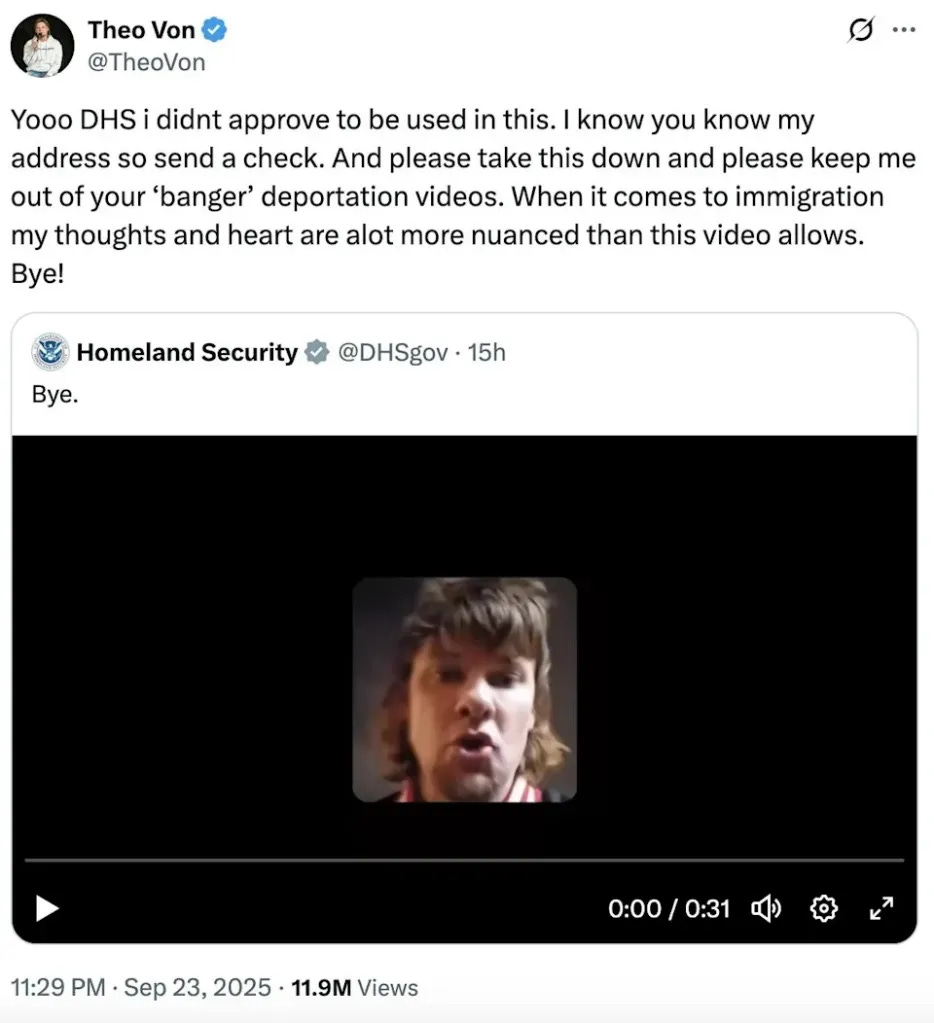
Used, indeed.
Von’s complaint about DHS came a little more than a year after Trump appeared on his This Past Weekend podcast in August 2024. The two chatted about cultural topics including UFC fighting, which is a popular manosphere interest and linkage institution for Trump. In fact, unprompted by Von, Trump name-dropped UFC’s Dana White, a big Trump supporter whom Von noted had helped to connect Von with Trump. During their chat, Von and Trump also fan-boy’d about Elon Musk and Kid Rock.
Von is nothing if not fawningly affirmative. Notice from the transcript how often Von’s replies literally start with “yeah,” or some other confirmatory phrase. Rogan and Schulz were equally cowed by Trump during their interviews. Forget softball questions — these are media tee-ball events.
All three podcasters now express reservations and regrets, which is fine and merits some praise and encouragement. But for the kid traumatized by watching his father or abuelita forced to the ground, handcuffed, and whisked away in a van, the pod-bros’ sudden awakenings are too late.
Their laments also ring hollow: They did vote for all of this and, worse, encouraged tens of millions of impressionable followers to do the same. Sorry to tell you, Joe, but the hard truth is that many MAGA devotees would have signed up for exactly the ICE raids and tactics that have shocked sensible Americans. And Schulz’s claim that Trump is doing the “exact opposite” of what he promised during the campaign is a convenient self-delusion.
The podcasters’ revisionist history of the 2024 campaign confirms that they are kickboxing above their political weight class. Absolving themselves of responsibility is necessary, however, because that’s the only way manosphere listeners who may likewise be grappling with a case of voter’s remorse can exonerate themselves, too.
All the young dudes carry the news
Comedians have always been fixtures in politics because satire and parody are inherently political. Jokesters need not be experts to mock politicians, nor should the bar for political expertise be higher for comics on the left or right.
Indeed, liberals might reconsider conservatives’ longstanding gripe that athletes, movie stars, musicians, comedians, and other entertainers simply stay in their lane and out of politics altogether. It might be fine to hear less from George Clooney if that meant sidelining Ted Nugent as well.

The problem is that podcast bros package political content as apolitical culture-talk and lifestyle vibes. Whether intentional or unwitting, the blurring of rhetorical fault lines is manifestly dangerous. A person listening to Ben Shapiro or the Pod Save America crew makes a conscious choice to consume political news and commentary. But as Politico’s Calder McHugh argues, the power of podcasters like Rogan derives from how apolitical most of their content is.
“[T]his group of people rarely discusses politics,” writes McHugh. “Instead, to varying degrees from show to show, they interview fellow comedians, or stream video games, or talk about sports and the women they’re dating, or simply shoot the breeze. When they do get political, it doesn’t always fall along obvious ideological lines.”
The young men who tune in are not digesting much politics, but when they do digest political content it therefore goes down easier, like the pill a dog owner buries inside a chewy treat.

In an influential New Yorker piece published shortly after the 2024 election, Nathan Heller introduced readers to the concept of “ambient” information flows, the phenomenon by which voters are passively influenced by “rubbing against” various news sources. Heller concludes that Democrats and the Kamala Harris campaign made a “crucial messaging error” when they “misjudged today’s flow of knowledge — what one might call the ambience of information.” The Trump campaign, by contrast, “maximized his influence over networks that people rub against, and has filled them with information that, true or not, seems all of a coherent piece.”
Trump’s youngest son Barron understood these new media dynamics. He encouraged his father to appeal to the manosphere’s younger, “bro voters” by appearing on shows like Rogan’s, whose audience feasts upon politically-empty but culturally-rich appeals to masculine tropes. Many of those listeners are low-information and low-propensity voters who, say, might be peeved by reports that women shun conservative men on dating apps, making them perfect targets for “ambient” political appeals.
After he won in 2024, Trump praised Barron for helping him cultivate the youth vote.
“He said, ‘Dad, you got to go out. Do Joe Rogan. Do all these guys,’ and we did,” said Trump, explaining Barron’s influence. “He understood the market.”
The bro vote, past and future
Among the eye-popping exit poll results from the 2024 election was this: The gender gap was widest among Americans under 30. Although the gap shrunk slightly between 2020 and 2024, no generation is as polarized along gender lines as younger Americans. (Trump’s support among young men has since cratered, so the Gen Z gender gap could narrow in the upcoming midterms and 2028 presidential contest.)
Results from the 2016 election, when most of today’s under-30 Americans were still too young to vote, confirmed that Trump is particularly attractive to citizens who express feelings of “status threat.” Whites, men, and others who believe social changes are curbing their influence are drawn to MAGA’s traditionalist appeals and incessant attacks on social movements like #MeToo, wokeism, and Black Lives Matter.
Threats to male dominance are particularly acute for younger men, who did not inherit the patriarchal advantages their fathers and grandfathers did. Today, roughly 57 percent of undergraduate students and 60 percent of graduate students are women. At 52 percent, the share of undergraduates today who are white has plummeted from 82 percent 50 years ago. Law, medical, and other professional schools likewise feature rising shares of women and minorities.
As the economic landscape shifts beneath their feet, confused and aggrieved young white men — and a growing number of non-white Gen Z men, too — are, ironically enough, searching for the “safe spaces” they tend to mock.
That’s why Joe, Theo, and Andrew thrive. In the pod universe, young dudes can commiserate about bad prop sports bet or glean tips for get-rich-quick crypto buys. And if they trust the manosphere to curate that content for them, why not rub up against those podsters’ political insights and judgments too?
That’s it for this week
If you appreciate this edition of the newsletter and aren’t already a paid subscriber, please help us keep Public Notice thriving and free by becoming one.
There will be no Saturday edition of the newsletter this week, as I’m in California for a long weekend vacation. We’ll be back with more Monday. Until then, thanks for reading, and have a good one.
The manosphere podcasters built audiences by packaging politics as apolitical lifestyle content, creating “ambient” information flows that condition listeners without triggering critical analysis.
As a behavioral economist and former FSO who studied propaganda and authoritarian systems, I recognize this mechanism immediately: you bypass rational evaluation by embedding political messaging in trusted non-political contexts. Young men consuming UFC talk and dating advice don’t activate skepticism when the same trusted voice casually endorses authoritarianism.
Now these morons claim they are surprised by ICE raids and deportation tactics Trump explicitly campaigned on.
This isn’t awakening, it’s incentive-driven repositioning. They profited from algorithmic amplification of MAGA content, now they’re hedging as Trump’s brand deteriorates and audience retention requires distance.
The behavioral tell: they express regret about outcomes, not the mechanism that produced them. Think about that…
They still don’t understand, or won’t admit, that they were useful idiots in a systematic capture operation where apolitical platforms became radicalization infrastructure.
The real stupidity isn’t political ignorance, it’s believing you can monetize authoritarian messaging without consequences, then acting shocked when the system you helped build starts eating everyone, including you.
— Johan
Professor of Behavioral Economics, Former Foreign Service Officer
I suspect some or most of the recalibration is financial. As Trump’s brand deteriorates they don’t want to be tied to him, so a little mea culpa and feigned ignorance about what should have been obvious will maybe keep their audiences from bolting.