

PN is supported by paid subscribers. Become one ⬇️
For communities crushed by President Trump’s brutal immigration crackdown, there isn’t a world where people simply get over it.
During Operation Metro Surge, the federal government inflicted unprecedented violence on Minnesota, particularly on the state’s most vulnerable populations. There’s a temptation to try to forget what cannot be forgiven. But preserving the truth of what actually happened, the villainy and the heroism, the hatreds and the kindnesses, is the only way to move forward.
And any candidates and politicians who want to minimize what happened or sweep it under the rug should never be trusted with power ever again.
Minnesota Republican US Senate candidate Michele Tafoya’s pretend evenhandedness (“I’m not thrilled with the way Operation Metro Surge was rolled out here in Minnesota, but…”) has to be one of the most cowardly ways to face the aftermath of Metro Surge. It stands in contrast to the efforts by the Governor’s Council to Record the Truth of Operation Metro Surge to simply bear witness to the terror of what actually happened.
It’s a difficult and delicate thing to ask people to remember the hurt they suffered, even more so when the federal government that inflicted it remains in power. Speaking out against the administration has proven to be a dangerous, even deadly, affair, so the Truth Council (which was created by Gov. Walz after the occupation ended) partnered with The Advocates for Human Rights to create a process for collecting the stories of survivors and witnesses.

The organization has spent decades helping survivors of human rights violations to document what happened, from Cambodia to Sierra Leone to Liberia. For their work with the Truth Council, they trained over 250 people as “story collectors” and connected with over 200 partner organizations.
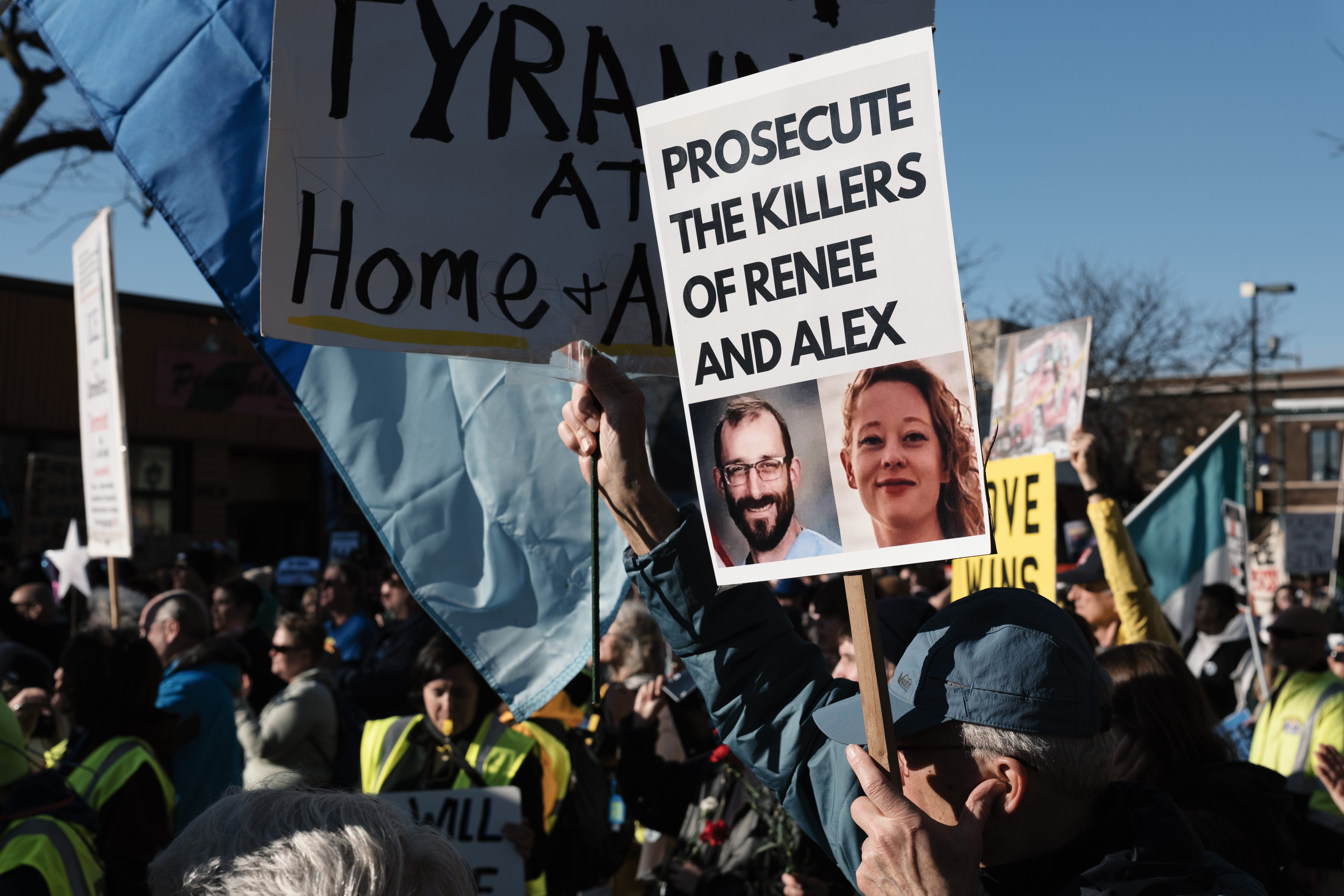
Everyone knows some of these stories. The murders of Renee Good and Alex Pretti are indelible, as is the memory of five-year-old Liam Ramos’s abduction. But thousands of Minnesotans suffered at the hands of ICE, in ways ranging from abject cruelty to outright violence. The Truth Council is charged with documenting “the harms and abuses” experienced by Minnesotans, and the first public meeting last week was full of these brief stories, tiny sharp remembrances of pain and humiliation:
“An elder who needed new dentures was too scared to leave her home to access dental care. So she ate baba or kanji with little protein for months on end because she couldn’t chew her food without new dentures.”
“The mother taken at her child’s bus stop has an anaphylactic peanut allergy and ICE denied her food for six days because the federal government could not be bothered to provide a meal free of the allergen.”
“A convoy of SUVs filled with agents sped through an intersection where our kids were climbing on their buses to go home, raced towards the school and halted in front of the main entrance”
“She taught her mother how to crawl up into the attic space and hide in case federal agents came to their door for questioning.”
The Council is also tasked with making findings about how to “prevent the recurrence of unlawful or harmful conduct by federal agents.” Sarah Lopez, the policy director of Unidos Minnesota, relayed a story — which actually did receive media coverage at the time — that stands out as emblematic of the petty, relentless viciousness of ICE agents:
“In Willmar, four agents sat down at lunch at El Tapatio,” she said. “And that evening, after the family closed early, agents followed them out and detained the owners of the restaurant and the dishwasher.”
Imagine being one of those agents. Imagine going to a small family restaurant and being fed and cared for, only to turn around and arrest those same people later that day. Imagine how warped and broken you have to be to behave that way.
Along with the accounts of victims, survivors, and witnesses, it’s also important to remember the ICE agents at the center of stories like this. The Truth Council doesn’t exist only to amplify those voices, but also to document the behavior of the federal agents who terrorized the state.
But for every story of humiliation and harm at the hands of ICE goons, there were stories about Minnesotans coming together, demonstrating solidarity and resilience and resistance. And that’s part of the charge of the Truth Council as well, to “document how Minnesotans came together, supported one another, and persevered.” And they really did. During the public meeting, people offered up stories of mutual care, of making spaces of joy even in terror:
“Neighbors banded together to protect one another, deliver groceries, and pay bills. Parents patrolled their neighborhoods. Educators organized carpools and packed meals. Restaurants fed people at a loss. Minnesotans persevered and made their voices heard loudly and peacefully.”
“On the day that kids returned from distance learning, our students had a brass band that played on the front steps of the school to welcome them back.”
These sorts of stories aren’t just here to document perseverance. They also relate to preventing the recurrence of violent conduct by ICE thugs.
What Minnesotans learned, what the world saw, was that the way to push back against Trump’s thugs was to meet them with solidarity and community. And the federal government had no real way to combat that. It’s pretty evident Trump and DHS thought that there would be more public support for their violence and were surprised to learn that everyday Minnesotans — people who couldn’t be written off as wild-eyed antifa progressives — refused to stand by and do nothing as their neighbors were abducted. Well, that and the fact that the notion of kindness, of care towards one’s community, is utterly foreign to this administration.

While the Advocates were responsible for gathering stories, the state provided analysts to review agency and external data and compile numbers and findings.
Sometimes, numbers can obscure the story, giving things an abstract quality that pales in comparison to the immediacy of individual accounts. But here, both the stories and the numbers provide a narrative showing how Metro Surge took over the state, how it deformed and taxed communities in smaller, persistent ways.
During the week of January 12, the Twin Cities United Way received 1,042 food requests. The 2025 amount? 351. HOME Line, a statewide tenant advocacy organization, reported that the number of people seeking help to pay rent in January 2026 was almost 85 percent higher than the previous January. From December 2025 to January 2026, calls to the Minnesota Department of Education’s Community Support Line jumped 615 perecnt.
So, in light of all this violence, all this resilience, all of these impacts, what do Minnesota GOP candidates have to say? Do they choose to uplift and defend all Minnesotans, or are they trash like Tafoya?
Guess what? They are trash like Tafoya.
Just last month, House Whip Tom Emmer, running for reelection in Minnesota’s Sixth Congressional District, declared that his constituents were begging him to “please thank Donald Trump for trying to keep us safe and trying to get these illegals out.”
In Minnesota’s Eighth Congressional District, Republican Pete Stauber is running to keep his seat, and he’s not shy about lying to his constituents about fraud and trying to blame Trump’s ICE goons on … Joe Biden?


After two Minnesotans were murdered in cold blood by ICE, GOP Rep. Michelle Fischbach, who represents Minnesota’s Seventh Congressional district, sang a paean to federal agents: “Our federal law enforcement officers deserve our respect and support as they work to uphold the law and keep our communities safe. We must reject rhetoric that limits cooperation with federal authorities and instead focus on the rule of law to ensure the safety of all Minnesotans.”
State House Rep. Lisa Demuth, who is the GOP’s nominee for the governor’s race, handwaved away the murders of Good and Pretti and blamed the victims.
“The death of two Minnesota residents — that’s the cost of it. But it was local decisions, high-level local decisions that inflamed the entire situation,” she said.
When ICE comes to town, communities band together, while conservatives celebrate their violence. That’s not just in Minnesota.
In Maine, the federal government launched Operation Catch of the Day shortly after the ICE murders in Minneapolis. As immigrants sheltered in place, as healthcare workers and public school students stayed home out of fear, Sen. Susan Collins did some of her patented brow-furrowing: ”There are people in Maine and elsewhere who have entered this country illegally and who have engaged in criminal activity. They could be subject to arrest and deportation pursuant to the laws of the United States, and people who are exercising the right to peacefully gather and protest their government should be careful not to interfere with law enforcement efforts while doing so.”
None of these people are fit to represent their constituents. They’ve made clear that given the choice between protecting ICE thugs and protecting their constituents, they’ll choose ICE every time.
Why accountability is required
One thing that will eventually have to be grappled with is what to do with people like this — ICE agents and GOP politicians alike — once the Trump regime is finally toppled.
The consequence for those agents can’t be that they simply return to their hometowns and go about their business. There has to be some sort of reckoning with the harm they caused before they get a chance to even think about returning to polite society. You can’t live in community with people like that.
There might be a path forward for those four ICE agents, but it shouldn’t be an easy one.
Minnesota’s Truth Council is doing the heavy, hard work of documenting what happened, but Minnesotans and everyone else who was attacked and affected by ICE will one day have to take the next step: reconciliation.
That sounds … mushy, right? It sounds like the same path that former President Barack Obama took after succeeding George W. Bush, and that Joe Biden took after the first Trump term — that we just try to move on, live together, and return to some sort of bipartisan balance.
But that’s not what reconciliation means. It’s not a way of saying we all just need to get along. It’s a way of saying we need to hold people accountable and assess exactly what level of culpability they have and to shape a future that ensures this doesn’t happen again.

Minnesota no doubt partnered with The Advocates for Human Rights precisely because the state understands that truth is only the first step. That organization also works on transitional justice, which includes truth and reconciliation processes. It requires setting up a formal system — a new, or parallel justice system, basically — to determine who is most responsible for the violence that has gripped the United States and the level of punishment that is appropriate. We’ve learned from the unsuccessful attempts to hold Trump responsible for January 6 and from the unwillingness of the federal government to prosecute ICE agents that our existing judicial branch simply is not cut out to deal with that level of lawlessness. We need something dedicated explicitly, and only, to these efforts.
Truth and reconciliation also requires a commitment to institutional reforms and reparations. Whoever is in power on the other side of the Trump era can’t go back to business as usual, can’t leave something like ICE fully intact and hope that moderate reforms do the trick and get rid of the bad apples. The whole structure is rotten to the core.
Reparations will be necessary as well. Immigrant communities have been shattered. People have been deported, in violation of court orders, to countries they never lived in and have no connection to. The economic impact on Minneapolis, the epicenter of Metro Surge, ran into the hundreds of millions of dollars. Communities can’t simply pick themselves up by their bootstraps and move on. Money has to be redistributed from the bribe-fueled, corrupt government that Trump built, and given back to its victims.
We’re only in the most nascent stages of this sort of reform, the stage of gathering stories and data. But one day, Trump and his ilk will be out of office, and we’ll be ready to take the next steps.
There’s a reason that Billy Bragg’s “City of Heroes,” written for Minneapolis during Metro Surge, is not about revolution, nor is it about passivity. It’s about bearing witness to every bit of violence that was thrown at the city and being brave enough to stand still and stare it down. We’re going to have to be brave enough to do that, perhaps for quite a bit longer, and brave enough to think about what it looks like on the other side.
When they dragged people from their cars
I got in their face
When they took families from their homes
I got in their face
When they murdered our sister
I got in their face
And when they murdered our brother
I still got in their face
That’s it for today
We’ll be back with a special Saturday edition of the newsletter tomorrow. If you appreciate today’s PN, please do your part to keep us free by signing up for a paid subscription.
Thanks for reading, and for your support.
The original sin of the Justice Department is Alex Acosta’s sweetheart deal and the pass given to Jeffrey Epstein and Donald Trump, which by the way, is still ongoing. I will never forget.😞
Politicians will preach expedience and reconciliation; as Americans it is our duty to demand the full weight of justice.