
PN is supported by paid subscribers. Become one ⬇️
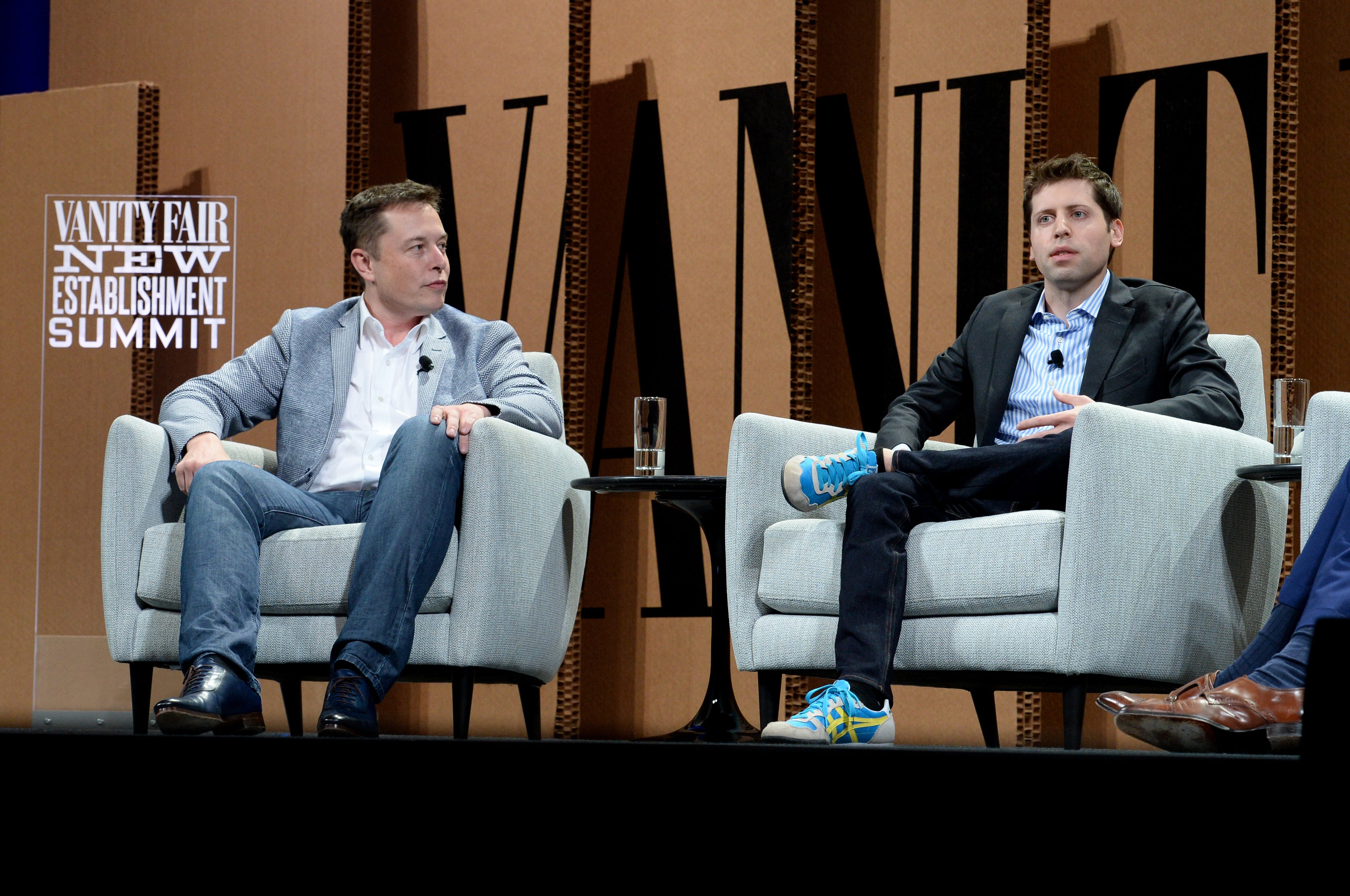
Elon Musk and Sam Altman are currently kicking the shit out of each other in a federal courthouse in Oakland. Two of the most destructive men on earth are each claiming to be principled humanitarians, and Musk’s customary chaos monkey litigation strategy is on full display.
The short version: Musk funded OpenAI in 2015 as a nonprofit dedicated to developing artificial intelligence safely, for humanity's benefit. Then Altman turned it into an $850 billion juggernaut for his own enrichment. Musk is suing to get “his” share of OpenAI back, or, as of three weeks before trial, to return the money to the charity — a share which he now values at $134 billion. And he’d also like to unwind the conversion of OpenAI to a for-profit company, for the good of humanity.
By sheer coincidence, this would massively benefit Musk’s own company xAI, whose chatbot Grok is prone to calling itself MechaHitler and will helpfully answer questions like “what are the good races?”
It’s only a shame they can’t both lose.
For the good of all mankind
In 2015, tech leaders sounded the alarm about the societal impacts and potential misuse of artificial general intelligence. Musk was one of the signatories to an open letter advocating thoughtful research “to reap its benefits while avoiding potential pitfalls” before unleashing this powerfully technology.
Altman, who was running the tech incubator Y Combinator (later rebranded YC), wrote that “development of superhuman machine intelligence is probably the greatest threat to the continued existence of humanity.”
Altman pitched Musk on a nonprofit research lab which would develop AI responsibly and deliberately, serving as a counterweight to Google, which had just acquired the British company Deepmind. They conceived of OpenAI as a charitable foundation which would nurture AI as an open-source, safety-focused project, with no pressure to maximize shareholder returns.

On December 8, 2015, OpenAI filed a certificate of incorporation in Delaware stating the organization’s charitable function: “The resulting technology will benefit the public and the corporation will seek to open source technology for the public benefit when applicable. The corporation is not organized for the private gain of any person.”
Musk lent his name, his connections, his recruiting power, and approximately $44 million to the project. In a 2016 email to Altman and OpenAI’s CEO Greg Brockman, he wrote, “whatever it takes to bring on ace talent is fine by me. Deepmind is causing me extreme mental stress. If they win, it will be really bad news with their one mind to rule the world philosophy.”
By 2017 the parties were locked in conflict. In part, this is because Musk was pushing to take control of the project, assume the title of CEO, and bring OpenAI into Tesla’s ambit. But Musk also suspected that Altman and Brockman were secretly plotting to convert OpenAI to a for-profit company with a major assist from Microsoft. And he was right.
“Either go do something on your own or continue with OpenAI as a nonprofit,” Musk wrote in a September email. “I will no longer fund OpenAI until you have made a firm commitment to stay or I'm just being a fool who is essentially providing free funding for you to create a startup.”
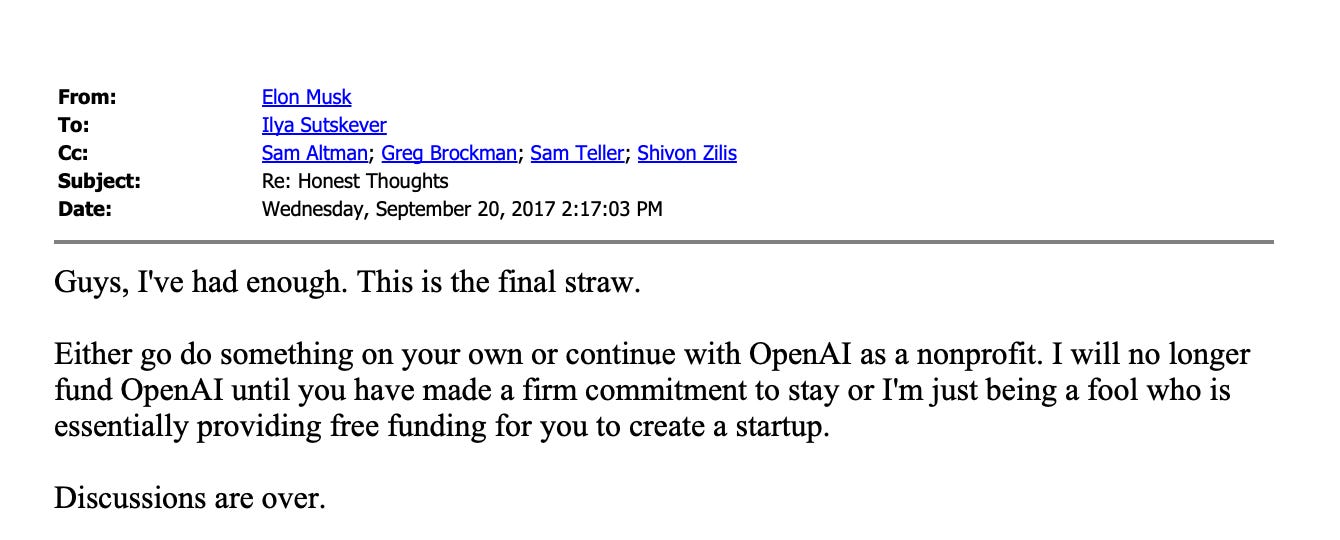
Altman responded: “i remain enthusiastic about the non-profit structure!” and Brockman immediately echoed his boss. According to Musk’s complaint, he continued to fund OpenAI based on those representations.
But at the same time, Brockman was taking personal notes that told a different story.
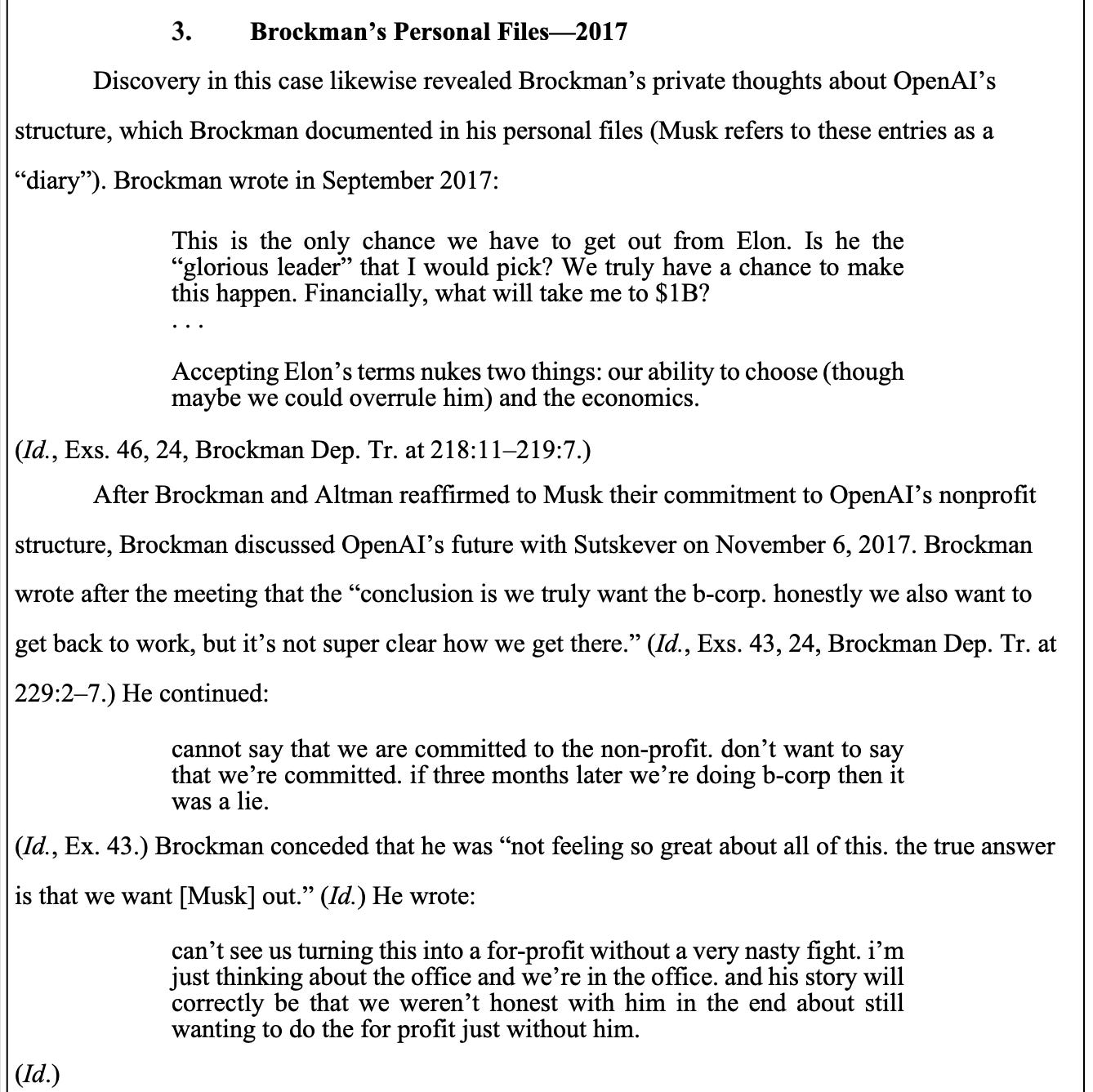
Brockman’s diary entries feature prominently in Judge Yvonne Gonzalez Rogers’s denial of OpenAI’s motion for summary judgment. (And recurring stress dreams for OpenAI’s lawyers … probably.)
At the same time he was assuring Musk that they were committed to running the company as a charity, Brockman was privately admitting that he was “not feeling so great about all of this. the true answer is that we want Elon out.”
“It’d be wrong to steal the non-profit from him. to convert to a b-corp without him. that’d be pretty morally bankrupt,” Brockman worried, while simultaneously conceding that “it would be nice to be making the billions.”
They decided to make the billions.
After Musk resigned from the board in February 2018, Altman and Brockman forged ahead with the conversion. They would probably argue that it was Musk’s withdrawal that forced them into Microsoft’s arms, since OpenAI needed to replace the cash they were no longer getting from Musk. And they’ve claimed all along that Musk was fine turning it into a for-profit company — as long as he was the one running it.
But Microsoft clocked the bait-and-switch problem, too. Its Chief Technology Officer Kevin Scott emailed Altman in March 2018, “I wonder if the big OpenAI donors are aware of these plans? Ideologically, I can’t imagine that they funded an open effort to concentrate [machine learning] talent so that they could then go build a closed, for profit thing on its back.”
In 2019, the for-profit subsidiary launched, padded with billions in seed capital from Microsoft, plus a massive subsidy in compute. The nonprofit’s intellectual property was transferred to the new entity, and the employees followed. What had been a publicly subsidized charity generating enormous goodwill and tax-advantaged donations became, in essence, a shell holding a stake in a company now valued at over $850 billion.
But for some men more than others
In 2024, Musk filed a 26-count law suit against Altman, Brockman, OpenAI, and Microsoft alleging fraud, breach of contract, antitrust violations, and RICO — the proverbial kitchen sink complaint, brought by the proverbial chaos agent.
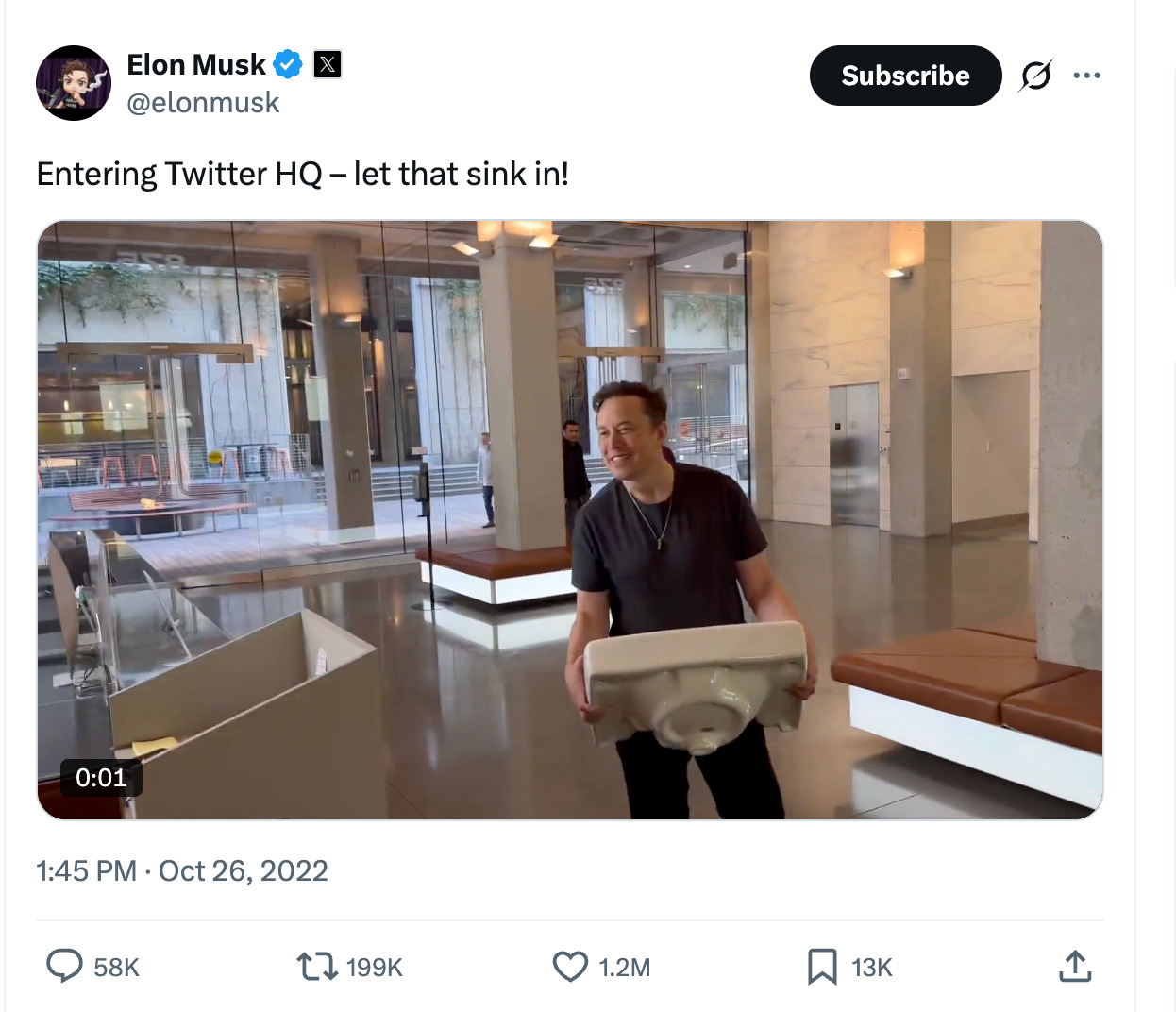
By January of this year, Judge Rogers had whittled it down to five counts: unjust enrichment, constructive fraud, fraud, and breach of charitable trust against the OpenAI defendants, plus aiding and abetting breach of fiduciary duty against Microsoft. But Musk had several crazy cards yet to play.
For nearly two years he’d demanded that OpenAI pay him $134 billion, the figure calculated by his damages expert as the portion of the company’s current value attributable to Musk’s early contributions. But three weeks before trial, he informed the court that he was instead suing to return the money to the charity. He also wanted the entire 2025 restructuring unwound, with Altman and Brockman removed from their positions.

Musk’s lawyer Marc Toberoff raced to tell the Wall Street Journal that his client, the richest man in the world, was not demanding a 12-figure payout for himself, but for charity. Musk immediately posted the article to his 200 million followers on X.
OpenAI’s lawyers were apoplectic, accusing Musk of “sandbagging the defendants and injecting chaos into the proceedings, while trying to recast his public narrative about his lawsuit.”
But Musk wasn’t done. A week before the trial was set to start, he made a conditional offer to the court: if Judge Rogers would agree to go to trial on the breach of charitable trust and unjust enrichment claims, he’d voluntarily dismiss the fraud counts. It’s not usual to play “let’s make a deal” with a federal judge, and the timing of the ploy ensured that OpenAI would waste millions of dollars in legal time and prepare for trial with the fraud counts front and center. But on Friday Judge Rogers granted the motion and dismissed the fraud counts.
The case will proceed in two stages. In the first, the jury, acting in an advisory capacity, will decide if OpenAI and Microsoft are liable. If yes, and if Judge Rogers agrees, the case will proceed to a damages phase under her supervision alone.
Nine men (and women) in a box
The case got off to a rocky start, as potential jurors had strong opinions about the plaintiff.
But Judge Rogers refused to dismiss jurors just because they happened to notice that Musk is odious.
“The reality is that people don’t like him,” she said, according to The Verge’s Liz Lopatto. “Many people don’t like him, but that doesn’t mean that Americans nevertheless can’t have integrity for the judicial process.”
On Tuesday, the parties made their opening statements. Musk’s lawyer Steven Molo claimed that “the defendants in this case stole a charity.” OpenAI’s lawyer William Savitt accused Musk of “sour grapes.”
“My clients had the nerve to go on and succeed without him. Mr. Musk did not like that,” he told the jurors.
Musk took the witness stand and portrayed himself as the savior of humanity, although he did admit that the understood the project would require at least a partial for-profit component, since inputs for OpenAI’s training models are so wildly expensive. He’ll be back on the witness stand today to be cross examined by OpenAI’s lawyers.
The witness list includes Altman, Brockman, Microsoft CEO Satya Nadella, and Shivon Zilis, a former OpenAI board member and the mother of four of Musk’s children. Discovery has already yielded a mountain of gossipy dirt, particularly about Musk. The court has ruled that he can’t be asked on the stand about using “rhino ketamine” at Burning Man in 2017, but can be questioned about his texts with Zilis that show her feeding him information on OpenAI after he left the company. There will be plenty of fireworks, although most lawyers rate Musk’s chance of unwinding the OpenAI conversion and banishing Altman from the company at close to zero.
Judge Rogers expressed reluctance to kneecap the AI industry, and, even if she were open to drastic remedies, the statute of limitations on the remaining claims is four years from the time the breach was discovered. To win Musk will have to convince a jury that he was unaware of a topic which was widely reported, even as he was tweeting about in realtime.

But Musk may not care if he loses. He’s a serial litigant with infinite money who harasses his enemies with pointless trollsuits to bleed them dry in court. He’s also the owner of a competing AI company that would greatly benefit from crippling OpenAI, or at the very least making Sam Altman look bad.
Of course, Musk can’t pants Altman without pantsing himself, too, and this lawsuit has laid bare the careless way these oligarchs handled a technology that they themselves believe might soon destroy humanity. If we do reach P(doom), it’ll be thanks to these feckless egomaniacs.
But at least they’ll give us lots of opportunities to point and laugh along the way.
That’s it for today
We’ll be back with more tomorrow. If you appreciate today’s PN, please do your part to keep us free by signing up for a paid subscription.
Thanks for reading, and for your support.
They’re both scammers
And meanwhile their huge data centers waste clean water, pollute the air, and guzzle fossil fuel at the same time that the insane clown "President" that Musk bought and sold to.the American voters has provoked a worldwide fuel shortage.