

Public Notice is supported by paid subscribers. Become one ⬇️
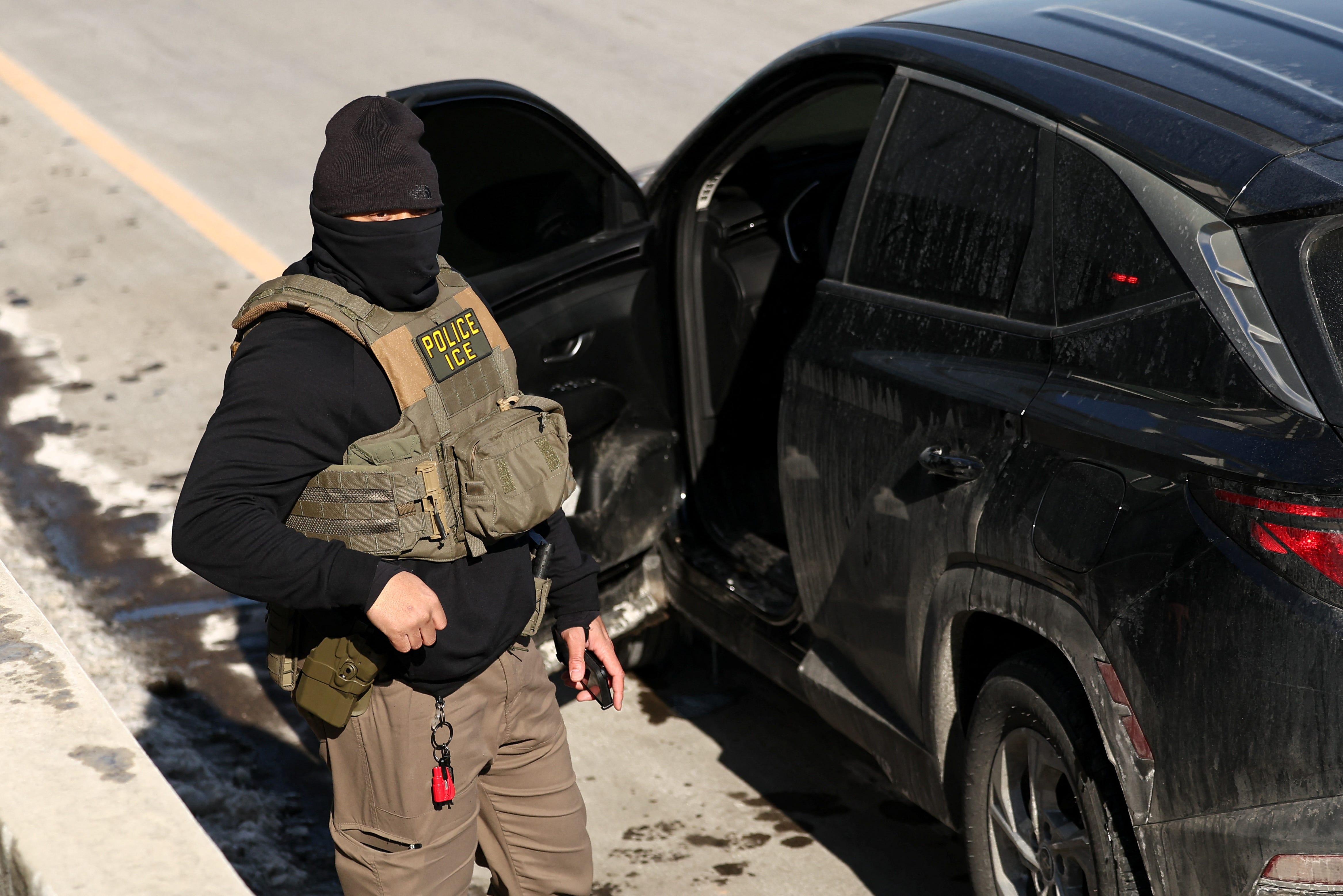
Last weekend, Minnesotans desperate to stop thousands of heavily armed, masked, and violent federal immigration agents from terrorizing the state suffered a setback when US District Judge Katherine Menendez declined to grant the state’s request for a preliminary injunction. So, ICE gets to stay, and that, to use a very technical legal phrase, absolutely sucks.
As Attorney General Keith Ellison acknowledged, the ruling doesn’t inherently mean Judge Menendez is at fault here.
Yes, it’s tempting — and totally understandable, particularly for those of us in Minnesota — to feel angry and defeated when judges don’t take bold, swift action to rein in this lawless administration. But Judge Menendez’s decision isn’t a failure of will. It’s a result of a world where conservatives on the nation’s highest court have decided their job is to help President Trump achieve a desired result, law and procedure be damned.
But this complete abdication of duty has created two different, but related, problems.

First, in their zeal to give Trump what he wants, the Supreme Court’s conservative majority frequently uses the shadow docket. This short-circuits the normal litigation process, with the Court inserting itself into the mix before there is a final lower court and appellate court decision. The speed and secrecy of the shadow docket also means the Court decides without the benefit of extensive briefing and oral argument. So, the court is making huge decisions based on not much at all, and in doing so, they provide very little in the way of reasoning.
Those decisions are not meant to be binding precedents that lower courts are obliged to follow, especially because a one-paragraph decision that cites no legal authority doesn’t really lend itself to providing meaningful guidance. But the Supreme Court now treats those decisions as binding if it suits them, dinging lower courts for not following along with their vibes.
Next, the Supreme Court has also limited what lower courts can do by largely barring them from issuing nationwide injunctions. That limits the reach of a lower court decision to that jurisdiction. So, plaintiffs must bring suits in multiple jurisdictions, and each lower court must fully address each case rather than rely on an earlier nationwide injunction. Lower courts have learned that the conservative justices will eagerly tie their hands before throwing them under the bus, and are forced to navigate a world where their decisions no longer stand, but they aren’t really told why.
Perhaps the most corrosive effect of the Supreme Court’s behavior, though, is that it leads people to believe courts have the power to do whatever they want whenever they want. The Supreme Court can grant vast, sweeping, immediate relief based on very little, so why can’t Judge Menendez do so as well? If ICE murdering people in the streets doesn’t warrant immediate relief, what does?
The most facile — but nonetheless true — answer is that the Supreme Court can do whatever it wants, but other courts can’t.
Between a rock and a hard place
For lower courts to grant emergency relief, such as a temporary restraining order or a preliminary injunction, they have to follow longstanding precedent. The most important factor in granting a preliminary injunction is whether the party requesting it is likely to “succeed on the merits.” So in the Minnesota case before Judge Menendez, to grant the state a preliminary injunction throwing ICE out immediately requires that she assess the state’s legal theories and decide they are likely to win when all is said and done.
And that’s the problem. The administration’s actions are unprecedented, as are the actions of the conservative justices. Trump is functionally doing whatever he wants with no real authority to do so, and the justices are letting him. This means plaintiffs have to keep coming up with novel legal theories, attempting to bend existing law into a new form that could protect them. But when a lower court is offered a brand spanking new line of legal reasoning, it can’t really assess, at an early stage, whether the plaintiff would ultimately succeed because there is no developed body of law to rely on.

And that’s what happened here. Minnesota argued that the administration is violating the Tenth Amendment, which reserves all powers to states except those that are explicitly given to the federal government under the Constitution. The related Anti-Commandeering Doctrine bars the federal government from making states use their resources to enforce federal mandates.
Minnesota approached this in two ways. First, it contended that Operation Metro Surge violates that doctrine because the state has been forced to expend a massive amount of resources addressing the harms caused by the surge, and that diverts resources from state and local needs. Judge Menendez framed this as the “resources theory.”
Next, it argued that the surge isn’t a real, aboveboard exercise of federal law enforcement, but rather a pressure campaign to make the state adopt Trump’s preferred policies and ignore its own laws. The judge referred to this as the “improper influence theory.”
The latter argument got what seemed like quite the boost after Attorney General Pam Bondi sent a truly unhinged ransom note the same day CBP agents murdered Alex Pretti. Bondi’s letter offered an absurd quid pro quo: if the state were to give the administration all its Medicaid and Supplemental Nutrition Insurance Program data AND all its voter data AND repeal all sanctuary policies AND require all detention facilities to hold detained immigrants AND let ICE have access to every detained person to check their immigration status, then the feds would leave. Maybe.
Both the resource and improper influence arguments are well-supported by the facts. Minnesota is indeed expending massive, costly resources to deal with ICE. In one four-day stretch, Minneapolis alone spent $2 million on overtime for the police department. Economic activity is cratering, but harder to quantify. Immigrant workers and business owners account for $41 billion in economic output yearly for the state, but thanks to ICE, business revenues at immigrant-owned or -run businesses have plunged. People aren’t going to work. Kids aren’t going to school.
Bondi’s letter — along with multiple statements by other administration officials — does an awful lot to support the contention that the federal government sent ICE to terrorize the state under the pretext of some vague fraud concerns, when its real goal is instead to force the state to bend the knee on entirely unrelated things.

The resources argument makes intuitive sense, but there are no existing Tenth Amendment cases that address the same issue. Rather, as Menendez points out, the cases the state relies on concern the federal government doing things like conscripting state law enforcement into federal service, requiring states to enact a federal regulatory program, or barring states from enacting certain legislation. In those types of cases, states are challenging federal statutes as unconstitutional, but that isn’t what is happening in Minnesota.
The administration hasn’t passed a law demanding Minnesota expend state resources on federal initiatives. Yes, it’s actually far worse that the administration instead sent thousands of armed agents to make the state enforce federal immigration law in the way Trump wants, but that is, at least for purposes of the Tenth Amendment discussion, beside the point. That doesn’t mean Judge Menendez outright rejected the argument, but the novelty of it means she can’t assess whether the state will prevail at trial.
The improper influence argument also makes intuitive sense, particularly given the administration’s eagerness to put its protection racket demand in writing. Can the federal government really just blanket a state with federal law enforcement under false pretenses and agree to leave only if the state yields to it?
The intuitive answer is, of course, no. But as with the resources argument, the improper influence argument here is a novel one. And it has to be, because what the administration is doing is unprecedented. There’s no developed body of case law about what a state should do when the federal government essentially goes to war against it.

The problem for Judge Menendez here is that, at this early stage, she has to rely on declarations from the parties, rather than the full assessment of credibility that happens at a trial. The government has indeed said, both in public and in court filings, that Operation Metro Surge is happening because Minnesota is riddled with fraud and the state’s sanctuary policies require the federal government to surge agents to enforce federal immigration law.
Yes, those are both lies. You know it, and Judge Menendez likely does as well. But she can’t write a decision saying that at this stage, because there hasn’t been anything in the way of fact-finding that allows her to make that determination.
The judge also highlighted a different issue, which is that to determine what is proper versus improper influence, she would need to “identify the precise point at which a legitimate effort to enforce federal immigration law becomes unconstitutionally coercive and infringes on a state’s sovereignty.” Qualitatively, she notes, the state can’t say what number of federal agents is improper versus normal, nor is it possible to quantify what level of ICE lawlessness is enough that it counts as unconstitutional coercion.
This isn’t Menendez saying that the state failed to make its overall case in some way, but rather that to provide early emergency relief, she would need the state to be able to explain where the line falls. But of course, the state can’t do that, because nothing like this has ever happened. There’s no Supreme Court case saying “2,000 federal agents is far too many, but 150 is just fine” or “federal agents violating Fourth Amendment rights occasionally is fine, but murdering bystanders isn’t.” And, unlike the Supreme Court, Menendez has to be able to hang her decision on some law somewhere.

Menendez is also stuck with the fact that Minnesota is in the Eighth Circuit, which is now a deeply conservative court with only one Democratic appointee. Earlier this year, Menendez explained, the Eighth Circuit held that “federal courts do not exercise general oversight of the Executive Branch,” but that addressing the improper influence theory would require her to do so.
As with the resources argument, Menendez isn’t saying that the state can never win here, but only that it can’t win at this stage.
She’s not wrong, but it still doesn’t feel quite right.
It just takes a handful of Republicans
There should be something a court can do, something a state can do, to stop this.
The notion that Minnesotans have to keep enduring violence at the hands of the federal government while a case winds its way through the courts, which could take years, is untenable. But there is no world where any lower court judge could fix this, because case-by-case litigation isn’t going to fix this, especially not in a world where the Supreme Court routinely tells lower courts to pound sand and ignores its own precedent.
There is one body that could fix this quickly and universally, and that is Congress. Congress has the power to pass laws barring the federal government from deploying murderous goons to blue states. Congress has the power to pass laws that define how much pressure from the federal government is too much.
Most importantly, Congress has the power of the purse and could cut off the administration’s unfettered access to billions of dollars. Heck, it could just dissolve the Department of Homeland Security or eliminate ICE. But the legislative branch, under Republican control, isn’t at all interested in any of that.
Where the Supreme Court has unconstitutionally increased its own power to help make Trump’s dreams come true, Congress has done the opposite: it has unconstitutionally abdicated the power it’s supposed to wield so it, too, can help realize Trump’s fascist dreams — which for residents of the Twin Cities continues to look a lot like a dystopian nightmare.
That’s it for today
We’ll be back with more tomorrow. If you appreciate today’s PN, please do your part to keep us free by signing up for a paid subscription.
Thanks for reading, and for your support.
Thanks, Lisa. We have a major conundrum in Minnesota. The total disregard for humanity and the rule of law is just unbelievable to me. It’s horrifying to not have the shooters of Renee Good, Alex Pretti, and all others immediately arrested and jailed. It’s even worse to be blatantly lied to by the people responsible for creating this situation.
I'd be interested to hear from a legal historian if this Supreme Court is the most mendaciously politically biased in history. I'd guess it would give other corrupt Supreme Courts in history a run for