

Public Notice is proudly celebrating 5 years and counting of independent journalism. Support our work by becoming a paid subscriber ⬇️
It’s been a whirlwind couple of weeks for Nvidia’s Jensen Huang.
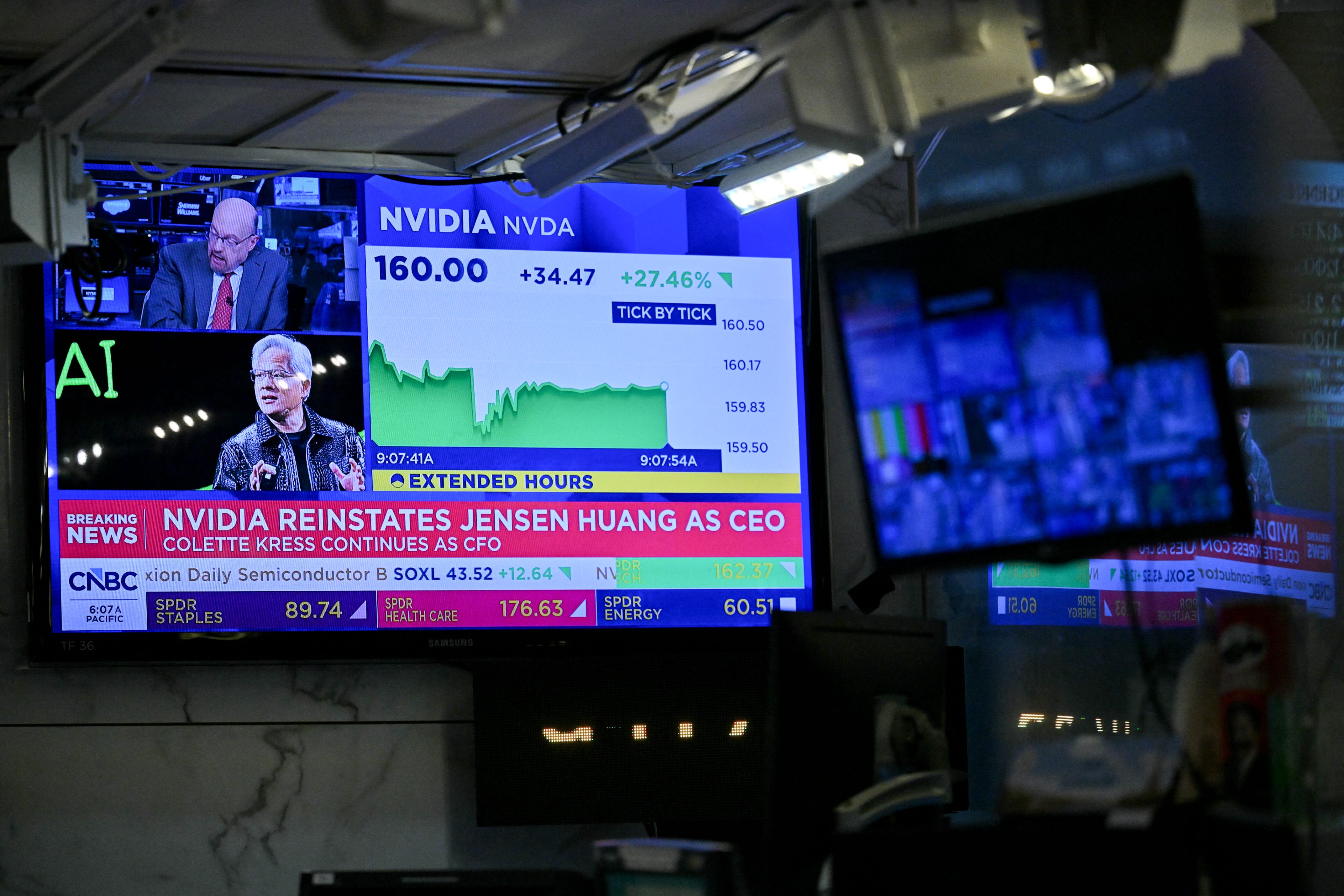
After flying high for years, he was ousted on November 12 — er, sorry, he resigned on November 12, because that’s what we let really rich people do when they monumentally screw up. But just 11 days later, he was back in the saddle thanks to pressure from President Trump, a totally cool and normal thing for the president to do.
Honestly, it’s hard to get your brain around the magnitude of this scandal, perhaps because it’s not one scandal. It’s like a Russian nesting doll of scandal upon scandal.
It’s a national security scandal. It’s a corruption scandal. It’s a political scandal. It’s an economic scandal. It’s also the inevitable result of how President Trump has approached his time in office, and it’s as impeachment-worthy as his extortion of Ukraine and his fomenting of an insurrection.
Let’s start with the national security part, because that’s likely the most impeachable part.

Having the president of the United States call into a board meeting to demand that a major corporation reinstate its CEO would be beyond comprehension in the best of circumstances, an unprecedented government intervention. But in the case of Huang, it’s far worse.
First, a reminder that while this scandal only burst into the open recently, Trump has been aware of the fact that Huang was in a relationship with Alice Huang, a suspected Chinese spy, since May, when Secretary of State Marco Rubio told him just as he was about to board a plane to Beijing with Huang tagging along. Trump ignored the warning, and Huang tagged along.
Of course, it wasn’t just Trump who was warned. Commerce Secretary Howard Lutnick — who has proven himself to be as mercenary as Trump — got a classified memo from Rubio even before Trump was informed. In fact, Commerce began an investigation into export control violations back in 2024, when we still had a functioning government.
And speaking of a functioning government.
The contortions the administration went through to make Jensen Huang’s restoration happen are genuinely breathtaking. Attorney General Todd Blanche, possibly the most craven person in the administration, gleefully wrecking the justice system to please Trump, came up with the idea to say that while the DOJ was investigating Nvidia, Huang wasn’t the target. Then, it was just a short hop to breezily declaring there was no evidence Huang was a national security risk.
Contrast the treatment of Huang with, say, the administration’s treatment of former Democratic Rep. Eric Swalwell.
Swalwell was allegedly involved in some fashion with Christine Fang, a Chinese national suspected of being an intelligence operative who worked on fundraising for Swalwell’s campaign in 2014. Declassified FBI documents showed that Swalwell acknowledged having a physical relationship with Fang a handful of times, but when federal agents told Swalwell about their concerns with Fang in 2015, he cut ties and helped out with the investigation.
Nonetheless, the House Ethics Committee investigated Swalwell for two years, and the Trump administration continues to try to bring a criminal case against him, including considering sending agents to China to talk to Fang to see if she had damaging information about Swalwell.
Of course, the administration’s interest in Swalwell stems from the fact that Trump remains angry that Swalwell played a key role in Trump’s 2021 impeachment over the January 6 insurrection. But even if we pretend the administration’s concerns were genuine, there is no world where Swalwell’s actions posed a greater security risk than Huang’s.
But that doesn’t really matter.
In the personalist regime of Trump, only his wants matter, and Trump wanted Huang returned to his perch atop Nvidia. So, while Blanche engaged in the fiction that there had been some meaningful reassessment of risk, it was an unnecessary fiction: we all know what is going on here.
Of course, Donald Trump didn’t blithely discard our national security interests simply because he doesn’t care about national security — though that is certainly the case. Like all things, he did it for money, and that’s the corruption scandal.
“Corporate parties just fell in line”
First, there’s the direct corruption, a literal straight line from Huang to Trump, a $25 million donation to the bribe palace ballroom. Then, there’s the more indirect, yet no less appalling, corruption of Trump’s miraculously timed stock trades.
A CNBC analysis found that Trump traded Nvidia shares at least 103 times since retaking office in January 2025, with transactions totaling $27 million to $97.5 million. If you’re wondering why that is such an absurdly big gap, you can thank a very forgiving US law that only requires politicians to report assets in very broad ranges. CNBC also found that by the end of last year, Nvidia was one of Trump’s three largest individual stock holdings.
And then there’s a tertiary corruption: Trump’s constant need to juice the stock market. Trump has become addicted to being a market mover, and the markets have become addicted to letting him do it. After the catastrophic market sell off when Huang stepped down, it was almost inevitable that Trump would seek to put his thumb on the scale, force Huang’s restoration, and then take credit for a soaring stock market. Indeed, one can imagine a world where, had the markets not collapsed on news of his ouster, Huang might not have gotten his job back at all.
Next, this is also a political scandal. Not simply because it is a scandal involving elected officials, but because it is a scandal that strikes at the heart of how a free market democracy is constituted.
There’s an invented quotation often wrongly attributed to Benito Mussolini that fascism is “the merging of the state and the corporation.” But that’s the wrong comparator. What Trump is doing with corporations is much more akin to that of Nazi Germany.
Northwestern Professor Peter Hayes, who has written about the intersection of corporations and the state in Nazi Germany, described the Nazi economy as “a hybrid of market mechanisms and state directives, a mix of incentives and instructions, rewards and reprisals, opportunities and obstructions.” Ultimately, writes Hayes, “corporate parties just fell in line and paid in their allotted share of the operating capital in order to get a piece of the economic action in occupied territories.”

Pliant, agreeable corporations have been rewarded with government investments — 41 of them by last count on the Cato Institute’s dashboard of government ownership. The government now has positions in Intel, IBM, Westinghouse, and more. Pliant, agreeable corporations have been rewarded with the government looking the other way on antitrust violations, such as the administration eagerly rubber-stamping Paramount’s mega-merger after it paid $16 million to “settle” with Trump in a sham lawsuit he brought in his personal capacity.
Less pliant, less agreeable corporations have been threatened. Look at what happened to Disney when late-night host Jimmy Kimmel dared make a joke the administration didn’t like: “This is a very, very serious issue right now for Disney,” FCC Chair Brendan Carr told conservative podcaster Benny Johnson. “We can do this the easy way or the hard way. These companies can find ways to take action on Kimmel or there is going to be additional work for the FCC ahead.”

Finally, this is an economic scandal that is also a deep policy failure: Huang’s presence at the helm of Nvidia was deemed critical to the functioning of the global economy. AI companies are engaging in what the Council on Foreign Relations characterized as “circular financing,” where the biggest companies are “buying and selling AI infrastructure among themselves and lending each other vast sums in exchange for future purchase commitments.”
That churn and entanglement has Nvidia at the center of much of it, which meant that when Nvidia lost around $1.7 trillion in market value after Huang’s departure, that loss was not confined only to Nvidia, but rather a hazard that could swallow companies whole.
This is a textbook example of the “key man risk” problem, where one person is so central to an organization’s success that their departure — even if voluntary — utterly compromises the company’s functioning or value. Huang, it turns out, was often operating on handshake deals, a terrific and normal way to run a bazillion-dollar company. That lack of formality and contracts made Huang himself central to the deals, so the only way to fix the giant hole in the economy created by Huang’s absence was to put Huang back.
None of this should be normal
It feels almost impossible to imagine there was a time when this sort of thing wasn’t endemic or routine, when presidents didn’t personally profit from the presidency, when the government didn’t routinely intervene in the free market in a fashion that benefits only the very few. It feels almost impossible to imagine there was a time when people like Trump, people like Huang, weren’t cloaked in elite impunity: being so rich, so powerful, that they are untouchable.
It feels almost impossible to imagine there was a time when Donald Trump wasn’t openly, publicly, committing impeachable offenses all day every day.
It’s going to take a lot to unwind Trump’s self-dealing and to restore genuine government oversight. The Democrats’ spectacular showing in the midterms is an excellent first step, but it’s a long road ahead. The guardrails that have been blown through don’t just have to be rebuilt. They have to be radically strengthened. We don’t need any more Jensen Huangs. And we certainly don’t need any more Donald Trumps.
Check out Aaron’s appearance on Tim Fullerton’s podcast
There will be no new episode of the PN Pod this week due to the holiday weekend, but if you need your fix of me talking, I joined Tim Fullerton’s podcast this week to talk about all things clipping, the degraded state of Trump and his movement following the midterms, staying sane amid an insane political environment, and much more.
Check it out:
That’s it until Friday
We won’t be publishing tomorrow because of Thanksgiving but will be back with a new edition on Friday. Happy Thanksgiving to all our American readers — we hope you have a lovely day and long weekend.
Thanks for reading.
Nesting dolls is the perfect description…..terrifying……how do we fix this?