

PN is supported by paid subscribers. Become one ⬇️
Last week, the Supreme Court gutted what remained of the 1965 Voting Rights Act.
The right-wing majority ruled that gerrymanders disenfranchising Black people and other minorities can only be ruled unconstitutional if they can be shown to be intentionally racist. As Justice Elena Kagan wrote in her dissent, the focus on intent rather than outcome creates “an almost insurmountable barrier for challenges to any voting rights issues to prove discrimination.”
When Republicans disenfranchise Black people and brown people, they can now simply claim they are doing so for partisan reasons. In fact, since the Court ruled that intentionally creating minority-minority districts is unconstitutional, states can claim they must prevent Black people from being elected to abide by the law.
The Supreme Court has, intentionally, reestablished the regime of white supremacy and Jim Crow.

It is difficult to overstate how bleak this decision is. The US was only a true multiracial Democracy for 58 years, but that period has ended. Black and Latino representation at the national level, but even more at the state and local level, is likely to be devastated. There are currently 61 Black representatives in the House. It could be decades before we reach that level again, if ever.
The “could be” here is important, though. Nothing is set in stone. Democrats do not need to acquiesce to fascism. In fact, they have many tools to resist the white supremacists who control state governments in the South and the reactionary majority on the Supreme Court.
They can, and must, fight back.
Republicans turn back the clock 65 years
Following the Supreme Court decision, white Republicans in the South have rushed to disenfranchise Black people and reestablish white power.
Louisiana immediately suspended its House primary elections so it could redraw maps. The GOP no doubt plans to gerrymander Troy Carter and Cleo Fields — the state’s two Black Democrats members of Congress — out of their seats. Tennessee, Alabama, South Carolina, and Mississippi are also discussing redrawing their maps to prevent the election of the five Democratic representatives in those states. Florida was already in process of drawing a new map to create four new Republican districts.
Georgia Gov. Brian Kemp has said his state will not redraw its congressional map to oust two Democratic representatives, and other southern states (like South Carolina) may decide that implementing new maps is unfeasible this close to the election. But certainly for 2028, if they can, Republicans will continue their rush to disempower Black voters and seize more seats through racist gerrymandering.
The GOP’s goal is to deny Black and brown people representation. Only white votes, they believe, should count, which means that only Republicans, the white identity party, can rule — no matter how unpopular that party is with the country as a whole.
Luckily, though not coincidentally, Republicans are attempting to put their white supremacist plan into effect at a time when the party is, in fact, enormously unpopular. Donald Trump’s approval just hit a low of 36.7 percent in the Fiftyplusone poll aggregator, which means he’s 23 points underwater.

Those dismal numbers have translated into brutal losses in special and off-year elections — Democrats have flipped 30 seats since Trump’s election in 2024, while Republicans have flipped zero. The average swing in special elections for 2025-26 has been 12.9 points, according to The Downballot. Among those specials are some jaw-dropping results, such as the 25 point swing towards Democrats in the very red Georgia special election last month.
The huge Democratic swings make redistricting potentially perilous for the GOP. Gerrymandering is done by diluting Republican voters in extremely red districts and spreading them out to less red districts that are thought to be relatively safe. But if you are facing 15 or 20 point swings, those less Republican districts start to be precarious.
If Republican numbers do truly collapse, some of these gerrymanders could even turn into dummymanders, where Republicans lose more seats than they would have had if they hadn’t remapped. Florida — which has seen some massive swings, especially in South Florida — is one state where experts believe the Republican Party may potentially put their own incumbents in jeopardy.
Trump’s extreme unpopularity has another effect: it supercharges Democratic opposition. Democratic voters are demanding their representatives fight as if the fascists are at the gate (which they are). And Democratic representatives have, after some hesitation, begun to respond.

In the past year, at Trump’s behest, Texas, Ohio, North Carolina, and Missouri gerrymandered nine seats for Republicans in an unprecedented mid-decade redistricting power grab. In the past, Democrats have responded to such attacks mostly with high-minded statements about the need for nonpartisan maps.
This time, though, Democrats fought back. California and Virginia both passed new maps that gave Democrats nine more seats. Along with a surprise court-ordered blue seat in Utah, that means Democrats were one seat up before the last round of redistricting. After last week’s Supreme Court decision, that means Republicans will probably net a total of five to 10 seats, depending on which Southern states do and don’t draw new maps.
That is gross and unfair — but it’s a lot less than the 20-30 seats Trump was hoping to seize to ensure a permanent House majority. As a result, the Democrats still have a good chance to win the House. One conservative estimate at the Brookings Institute suggested (pre-VRA ruling) that Democrats could pick up 21 seats, which would give them 236 seats and the majority. If they lose 10 of those to redistricting, they’d still be up 226-209 — not a huge majority, but a significantly larger cushion than Mike Johnson currently has.
Good for the gander
Democrats don’t have to surrender after 2026 either — and they aren’t planning to.
As Greg Sargent reports at the New Republic, an analysis by Fair Fight Action circulating among Democratic leaders suggests that Democrats could still gerrymander 10 seats in New York, Colorado, Oregon, and Maryland, where they control legislatures and the governor’s office.
If Democrats win legislatures in Pennsylvania, Minnesota, and Wisconsin, they could seize another 12. Illinois already uses a very Democratic-friendly map (the state is currently represented by 17 Democrats and three Republicans), but it too might be able to squeeze out another Democratic seat. And if Democrats win the Georgia governor’s race, they could block a Republican gerrymander there.
In short, if there is a Democratic wave in 2026, the party could well be in a position to more than offset Republican gains.

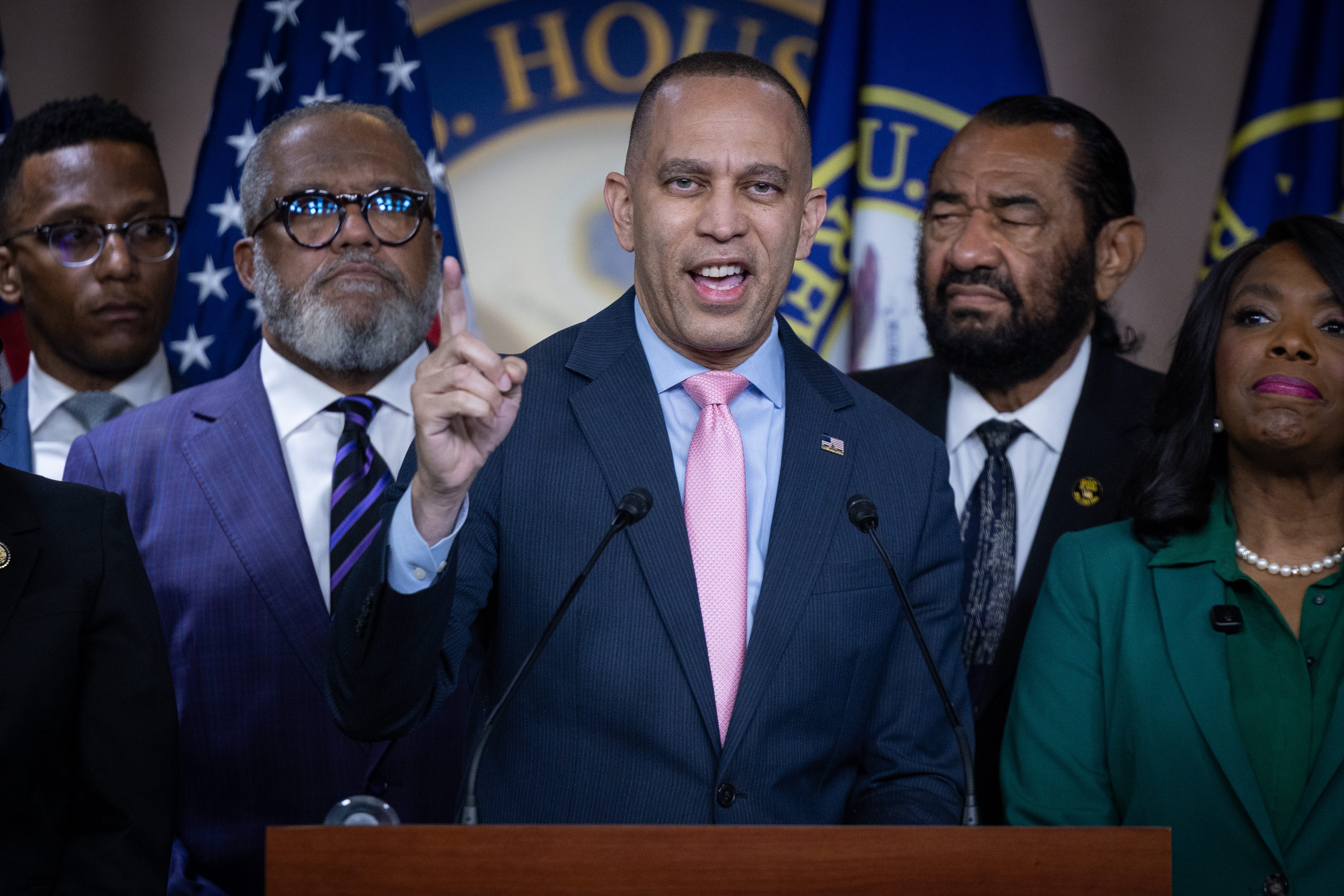
These aren’t just progressive pie-in-the-sky proposals. House Democratic leader Hakeem Jeffries said the party will definitely look to gerrymander New York, Colorado, Maryland, and Illinois. New York Gov. Kathy Hochul confirmed last week she is “working with the legislature to change New York’s redistricting process so we can fight back against Washington’s attempts to rig our democracy.”
Key Democratic politicians in positions of power recognize that the Supreme Court has launched an all-out attack on multiracial democracy, and they’re already moving to defend their voters and their country.
Longer term, Democrats can fight back harder.
Unrigging the Court
The Roberts Court is likely to strike down any voting rights or anti-gerrymandering legislation. But if Democrats win Congress and the presidency in 2028, they can address that problem by ending the filibuster and expanding the Supreme Court.
Again, this is not theoretical or implausible. Trump and the Supreme Court have radicalized the center of the party, and Democratic centrists have taken note. In a recent poll conducted by G. Elliott Morris’s Strength in Numbers operation, expanding the Court had solid support among Democrats, and was even slightly favored by independents, leading to majority support overall.
Jeffries has, apparently, seen the numbers. He said last week that “everything is on the table to deal with this corrupt MAGA majority” in the next Congress. Juliana Stratton, the Democratic candidate for Senate in Illinois, has enthusiastically argued for abolishing the filibuster; so has Sen. Chris Murphy, who is widely thought to be considering a challenge to leader Chuck Schumer in 2026 or 2028. Given the presidential veto, Democrats will have limited options in 2027 — but these sorts of promises could be crucial in 2029.
In 1876, when Reconstruction ended, both parties collaborated in the bipartisan effort to destroy Black voting power and exile Black representatives from Congress. Today, things are different. Over the last six decades since the passage of the Voting Rights Act, Democrats have become a party that relies on a multiracial coalition. In most ways that matter, Black and Latino voters are the Democratic Party, or at least a core part of it.
Democratic politicians are often underwhelming; they can be all too eager to remove their backbones at the drop of a Trump tweet. But they seem to be realizing that a return to white supremacy is a return to a time when the current Democratic Party could not exist, because most of its voters would be disenfranchised and subject to extremes of racist terror.
Our old democracy is dead. If we don’t want Jim Crow and rule by the Klan, we’d better be willing to rip up our current institutions and make better ones.
That’s it for today
We’ll be back with more tomorrow. If you appreciate today’s PN, please do your part to keep us free by signing up for a paid subscription.
Thanks for reading, and for your support.
Congress has the power to hurt SCOTUS through docket control, budget cuts, and rapid responses to bullshit statutory construction cases like the odious decision in Callais by reenacting the laws with additional language rejecting those ruleings. Before we fiddle with court-packing we should try to re-establish the guardrails this bunch of anti-democracy rogues has put in place.
If Dems take the legislature, another step would be to hold hearings on the anti-democracy. anti- Congress, and pro-Trump decisions.
Then hold a hearing on the meaning of the Constitutional provision that federal judges hold office during good behavior. These decisions aren't just bad law, they are an affront to American ideals of the role of government and the Constitution.
Then start impeachment proceedings. I expect several of them to retire to spend more time with their families. That's what happened when Roosevelt threatened to pack the Court.
Voting Rights Act was 1965. Civil Rights Act was 1968.