

Ahead of PN’s 5th anniversary next week, we’re offering paid subscriptions at the special yearly rate of $40 (or about 16¢ per edition). This newsletter is only possible thanks to the support of paid subscribers. If you’re not already one of them, please sign up and keep PN thriving for many years to come.
Thanks!
The recent months of Democratic primaries frequently appeared to be battles among factions for control of the party in advance of 2028.
But, as the end of the Trump era approaches, the question should not be which faction will prevail, but whether a broad and resilient Democratic coalition can be forged in a time of political and economic crisis, as happened nearly 100 years ago during the presidency of Franklin Delano Roosevelt — resulting in the New Deal policies that remade the nation for the better for decades.
The plague of growing economic inequality, and a growing national recognition that decades of radically regressive GOP policies have utterly failed, can provide an historic opportunity for Democrats to establish a “New New Deal.” The question is whether the party and its leaders will be up to that task.
Taking on fear
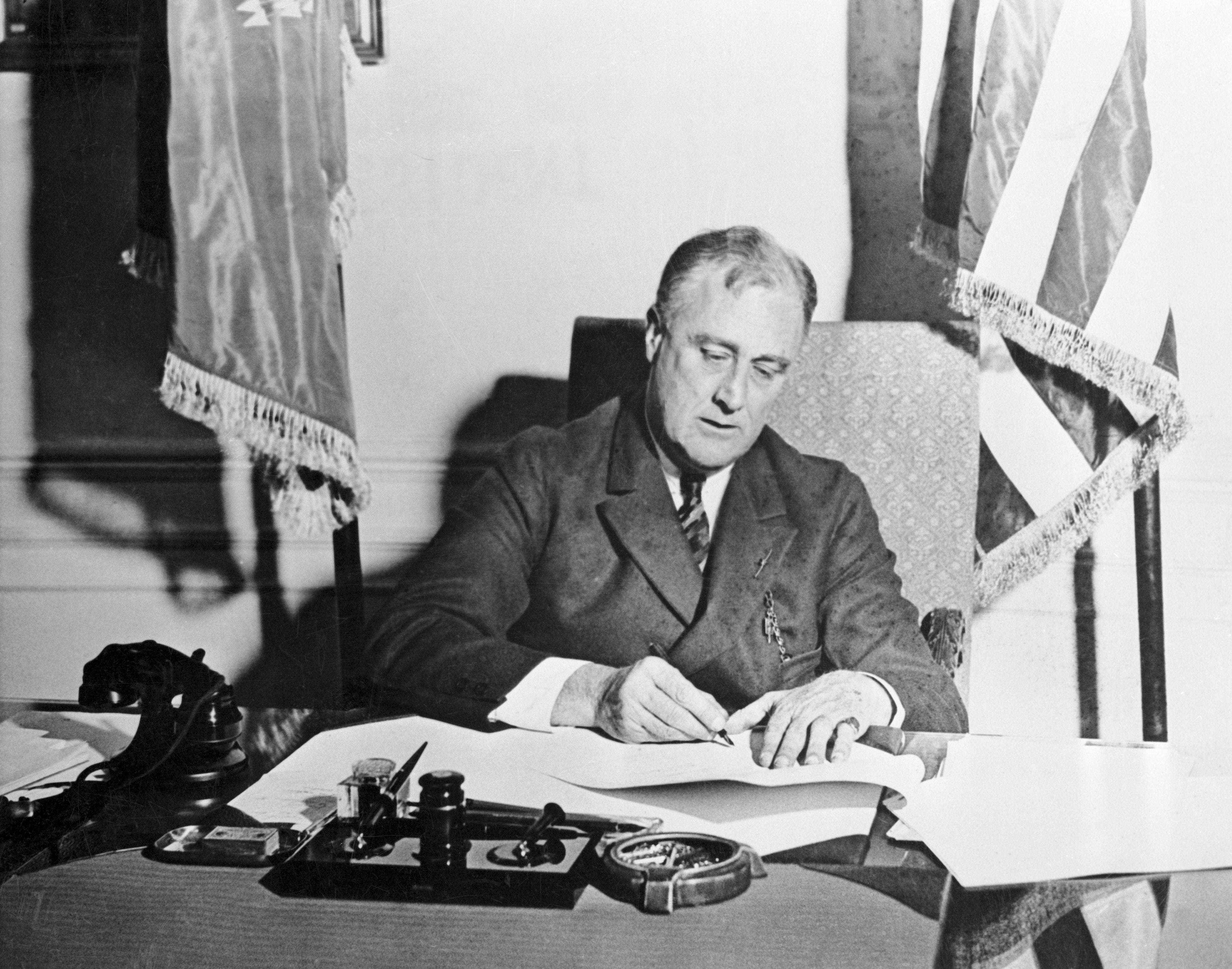
In 1932, FDR accepted the Democratic nomination for president by promising “a new deal for the American people” in the midst of a catastrophic Great Depression that had crushed the lives of virtually all but the wealthiest Americans.
Upon entering office, Roosevelt famously declared “the only thing we have to fear is fear itself,” and called Congress into a special session to commence the first tranche of what was to become a remaking of the federal government, and with it the nation.

By 1936, the New Deal Congress had enacted, among many other things, the comprehensive regulation of the banking and financial systems, Social Security and the nation’s first robust protections of labor rights, ultimately overcoming opposition from some of the most powerful constituencies inside and outside the government.
But more importantly, the New Deal Democratic Party established — through hard-fought political battles, but also coalition building — a national consensus that government had an essential role to play in improving Americans’ lives.
While the New Deal was intrinsically liberal, it was constructed with buy in from every constituency. It was the pluralism of the New Deal coalition that proved to be its strength and source of resilience. It welded together constituencies that had long been in tension, and even kinetic conflict — including farmers and urban laborers and Easterners and Southerners — because all of them had substantial stakes in key elements of the programs FDR’s administration implemented.
The political and normative impact of the New Deal was extraordinary. It set much of the agenda of the federal government for decades, as the nation accepted the once radical liberal proposition that government has the authority — and even the duty — to blunt the abuses of concentrated power and wealth, attempt to end the scourge of poverty, and promote the growth of a middle class that achieved relative prosperity based solely on wages.
Republican presidents inevitably governed within the New Deal framework, even as they criticized it, and sometimes added to it — as Richard Nixon did in establishing the EPA, and with it the first comprehensive federal environmental regulations.
Democratic presidents, with varying success, sought to expand on FDR’s ambitions, most notably through Lyndon Johnson’s Great Society, which established Medicare and Medicaid. So while LBJ’s ambitions to complete FDR’s project were blunted by his war in Vietnam, the moral and political core of the New Deal remained largely unchallenged for decades.
All of that began to change, however, in 1980 with the election of Ronald Reagan.
Breeding cynicism
Reagan came of age as an actor (and an FDR Democrat) during the New Deal, but devoted his later political career to attacking and delegitimizing the New Deal project.
As Reagan’s own Depression-era generation faded away, the ideology of Reaganites — proudly rooted in the free market views of the failed president who preceded FDR, Herbert Hoover — came increasingly to prevail.

Reagan and many of his acolytes were steeped in a libertarian-tinged ideology that imagined “market forces” would bring the broad-based prosperity that the New Deal and Great Society had failed fully to deliver. But, ultimately, it was cynicism, not idealism, that turned out to be the greatest weapon in their arsenal.
Right-wing opponents of “big government” found that when they starved the government of resources and ballooned the deficit by cutting taxes, particularly for the wealthy, voters began to accept their claim that government was presumptively destructive, if not evil.
In this fundamentally changed political environment, even Democratic presidents like Clinton and Obama found their abilities to preserve the still-unfinished project of FDR routinely frustrated. The ambitious, and ultimately popular — but always economically and politically tenuous — Affordable Care Act has exemplified the problem of trying to use the levers of government to solve intractable problems after so many Americans had come to mistrust them.
The GOP’s reliance on Americans’ cynicism to power an endless assault on government was, however, always problematic.

The inevitable byproduct of ever more aggressive deregulation and increasingly regressive tax cuts was an increasingly economically unequal nation, thus putting the lie to Reagan’s promise of a shiny and universally prosperous city on a hill.
Then came the Trump GOP’s chaotic hacking away at programs intended to protect the ability of poor and working Americans to obtain healthcare, food, and shelter, with the resulting “savings” used to fund yet another tranche of deeply regressive tax cuts. Actions like the termination of enhanced ACA subsidies, which middle class self-employed voters (many of them Republican) relied on simply to stay above water, seemed almost calculated to put a thumb in the eye of the very “forgotten men and women” that Trump and his party cultivated.
The current economic situation — in which the American economy continues to grow, but working Americans have an ever-shrinking share of the wealth — has been a long time coming. But Trump’s nihilistic policies have starkly put the lie to the Reaganite promise of prosperity through assaulting the government.
America’s wage earners now receive the smallest share of the nation’s income since relevant records began to be kept after World War II. Meanwhile, Trump’s incessant paeans to the stock market actually serve to remind frustrated Americans that corporate profits continue to grow, along with the wealth of a small number of investors, while they are falling behind.
It is squeezed wage earners who bear nearly the full brunt of increased inflation, particularly the youngest members of the work force, who are largely locked out of the opportunity to buy homes and otherwise obtain the fundamental building blocks of middle-class life. Hence the palpable rage that has seen its expression in the many highly educated and relatively prosperous young people who have embraced self-declared socialist candidates during recent Democratic primaries.
It is no coincidence, then, that the reputation of a Democratic project the GOP devoted decades to defaming has begun to be revived. Democrats are increasingly taking to lionizing the New Deal and calling for its revival. And it now seems not just possible, but likely, that the next Democratic presidential candidate could effectively campaign on a program of delivering a New New Deal.
Defining the New New Deal
Former Obama advisor Ben Rhodes recently asserted that, in order to regain political momentum, “Democrats must put themselves on the side of Americans who feel as if they don’t have any power” in the way Roosevelt did at the convention in 1932. That is certainly a worthy goal. The question is how to build the kind of broad-based Democratic coalition out of the ruins left by a failed Republican project, as FDR did nearly 100 years ago.
Rhodes dismisses “establishment” Democrats’ focus on “restoring congressional tariff authority, reinstituting Obamacare subsidies and reversing Medicaid cuts” as “cloistered” and unduly “rooted in the past” — and insufficiently “populist.”
Yet it is largely the resilient popularity and importance of Social Security, Medicare, and Medicaid (as well of the ACA) at a time of increasing economic insecurity that makes calling for a New New Deal politically salient. Put otherwise, being rooted in past Democratic successes in making American society more broadly prosperous is part and parcel of what makes such an appeal potentially effective.
Indeed, self-described progressive candidates — such as Troy Jackson in Maine — are placing initiatives like restoring the GOP’s Medicaid cuts (which are overwhelmingly unpopular) at the center of their campaigns.

That is not to say that entirely new elements won’t be essential to the success of a New New Deal. After all, the economic and political realities of the current moment are far different from those FDR confronted in the 1930s.
For example, as progressives contend, the time has long passed for fundamental reforms to the funding of medical care; though, like all intractable problems, it is one without easy solutions. Champions of “Medicare for All” often ignore the fact that the existing Medicare program is on the road to insolvency. Even more radical reforms, which limit the profits of the massively profitable healthcare sector, are probably required, though they will be politically difficult to achieve.
Second, reforming the housing market — which is currently skewed in class terms, but also by age, with the growing class of seniors owning an outsized portion of the nation’s residential property — also presents a massively challenging political and economic puzzle.
Finally, redistributing the increasing concentration of wealth that now threatens to equal that during the Gilded Age will be both the most politically challenging, and essential, element of any New New Deal.

The “AI revolution” is projected to consume a greater percentage of the nation’s GDP than the railroad industry during the later 19th century. And, absent reforms, the vast majority of the wealth resulting from this new tech revolution will be captured by a small cohort of the super rich, further increasing the nation’s economic inequality.
The massively wealthy do not give up even fractions of their wealth easily, particularly when they have spent as much time and effort wiring the government in their favor as they have during the Trump era. Yet the surprisingly universal outbursts of opposition to AI data centers is an initial indication that Americans are losing their patience for the ever-growing concentration of wealth in the hands or a handful of extraordinarily wealthy individuals and the companies they control.
It is that kind of well justified anger that could provide the starting point for the broad-based coalition Democrats long believed had passed beyond their reach — if party leaders now start doing the hard work of determining how to productively harness it, as President Obama recently suggested.
Coalition building, not factionalism
The very nature of the evil Trumpism has exacerbated — a country facing an ever-growing gap between the extremely rich and most everyone else — creates the potential for building a broad-based Democratic coalition on a scale unseen in decades. And despite the urgency of the circumstances, there is little doubt that the US has the economic resources to improve the quality of life of virtually all of its citizens.
But diverse coalitions like FDR’s are rarely successfully built for a reason. They require balancing the interests of, and inevitably regularly upsetting, extremely divergent cohorts of voters and interests. The success of them comes from sustaining a recognition of broader common interests and a willingness to compromise to achieve them.
Most notably, FDR had to balance Southern and Northern Democrats in an always fractious alliance, which forced him to make some uncomfortable compromises. That alliance ultimately collapsed decades later in the wake of the Civil Rights Movement, setting the stage for the election of Reagan.
A certain way for Democrats to lose the political opportunity presented by the end of the Trump era will be to descend into factionalism, as the infighting within the party during recent months have sometimes appeared to threaten. As in 1932, much will depend on who the Democratic nominee for president is in 2028. The candidate will have to have the extraordinary political skills necessary to lead the party to victory and to a New New Deal, and constituencies will have to be willing to make the hard compromises required to achieve such a result.
That’s it for today
We’ll be back with more tomorrow. If you appreciate today’s PN, please do your part to keep us free by signing up for a paid subscription.
Thanks for reading.
they’d better