

PN is supported by paid subscribers. Become one ⬇️
Decades after Richard Nixon went to China, America needs a president with the strategic mindset of Nixon (but not his amorality) to deal with a Chinese regime that has become a hub of authoritarianism across the globe.
Instead, we have Donald Trump, who just went to China as a supplicant, freely offering to help China undermine America itself in return for the promise of alleviation from the consequences of his own catastrophic political and military blunders and profits for his cronies.
The unintended consequence of realpolitik
In 1972, Nixon and Henry Kissinger pulled off the greatest gambit of the Cold War when Nixon surprised the world with a visit to China, a country that had been largely closed to the West since the victory of the Chinese Communist Party in 1949.
Kissinger famously labeled Nixon’s foreign policy, and particularly the opening to China, as “realism,” reflecting a willingness to deal with the rule of the most repugnant regimes in order to serve what the two deemed to be the interests of the United States.

The “realpolitik” opening to China yielded immediate successes, not the least of them outflanking the Soviet Union, leading to a nuclear arms control regime that lasted for decades and likely ultimately hastened the unraveling of the USSR. And China went on to embrace capitalism after the passing of the murderous dictator Mao Zedong in 1976.
But Nixon and Kissinger’s accommodation with China 54 years ago ultimately ended up facilitating two problematic developments: First, China has become an industrial colossus that is deeply integrated into the economies of the US and the rest of the West, and second, the Chinese regime — still fully controlled by the Communist Party — is a committed opponent of the West, and has become the financial and industrial engine of authoritarianism and despotism across the world.
China, the interdependent enemy of the West
Under its first post-Mao leader, Deng Xiaoping, China’s communist regime emulated the strategy of its nemeses, Japan and Taiwan, by relentlessly pursuing an industrial economy based on creating products for export to the West. That led to the country becoming deeply codependent on the US and other Western nations by funding the debt required for their purchases of the massive quantities of Chinese goods, and likewise making US farmers heavily dependent on Chinese markets.
But far from pursuing political liberalization, China, since the fall of the Soviet Union, has turned back to a leader-centered, and near totalitarian, dictatorship under Xi Jinping. Xi has pursued an increasingly audacious policy of threatening and intimidating China’s neighbors, foremost among them Taiwan, and occupying parts of the South China Sea with an increasingly massive (and menacing) military.
Under Xi, China also serves as the financial and industrial lifeline for other despotisms that are openly adversarial to the West, both profiting from their economic and political vulnerabilities (often due to sanctions) and bolstering their efforts to destabilize US and Western allies.
Effectively addressing the rise of China has posed a difficult challenge for American presidents going back decades. But in Trump, Xi has found the most willing of dupes.
Trump’s Chinese ties
A decade ago, Trump won his first presidential election to a large extent based on his promise to be “tough” on China. But Trump’s business history gave every indication there was little substance behind the rhetoric.
In 2012, Trump went on the David Letterman show to call for moving manufacturing “back to the US” from China. But Trump was also marketing a line of ties that, as Letterman demonstrated, were made in China. (Watch below.)
Unsurprisingly, after entering office, the Trump family demonstrated an avid interest in making more money for themselves in China, exemplified by Ivanka Trump’s pursuit of trademarks in the country.
As covid overcame the United States, Trump spent the last half of his first term demonizing China, including by promoting conspiracy theories that the virus was hatched in a lab by the CCP, perhaps aided by Dr. Fauci. But Trump also demonstrated an increasing affinity for Xi, who has many of the same dictatorial features Trump admires in Vladimir Putin.
Trump ended up exiting (or rather, being forced out of) office in 2021 without having done anything to materially address the actual military, industrial, and economic dangers China posed to the US. When he returned to the White House in 2025, China was even more firmly established as the economic and industrial lifeline of the principal adversaries of the West and its allies, such as Russia (which was increasingly in conflict not just with Ukraine, but also the rest of Europe) and Iran (which was menacing not just Israel, but also the US’s oil producing Gulf allies).

Xi had fully mastered a strategy of both taking advantage of China’s rogue’s gallery allies — including by purchasing oil and other commodities from sanctioned malign regimes at discounts — while selling them key items of military and other technology, and thereby indirectly reaping the benefits of those regimes’ assaults on the West. For example, China has been the principal purchaser of oil and gas products from Russia and Iran, as well as the main provider of essential missile and drone-related technology to those countries.
Xi’s calculation is obvious: The distraction of conflicts like the ones with Russia and Iran makes China’s Western counterparties weaker. As a result, the US and Europe are more vulnerable to be bested by China in the economic sphere and less likely to effectively challenge China’s military-driven challenges to its Asian neighbors.
From realpolitik to realobtuseness
During the 2024 campaign, attacks on China were again Trump’s favorite theme. He promised that, by imposing massive tariffs on China, he would create an instantaneous “golden age” in the United States. But when Trump was back in the White House and began imposing tariffs on trading partners around the world in April of last year, it was China that most effectively retaliated.
China took advantage of the US’s primary trade, industrial, and economic vulnerabilities in ways surgically calculated to cause maximum political damage. For example, China turned to other nations to buy agricultural goods, most significantly soybeans, which US farmers have long produced in massive quantities, largely for export to China. China also began to cut off US access to rare earth minerals — many only mined in China — which are required for critical industrial applications. And the tariffs themselves increased the cost of the Chinese goods Americans consume and disrupted supply chains, feeding inflation.

It did not take long for Trump to begin to cave. Even before the Supreme Court nullified key parts of his tariff gambit, he had begun make “deals” in return for China simply agreeing to purchase some of the soybeans and sell some of the minerals it had freely transacted in with the US before Trump’s return to power.
But that was only the beginning of Trump’s transformation of the United States from purported fierce adversary of China into China’s supplicant. Instead of opposing the Axis of Evil, Trump begged to join it.
Among the many catastrophic miscalculations underlying Trump’s debacle of a war against Iran was his failure to consider the roles that would inevitably be played against US interests by China and Russia.
Trump has remained publicly unfazed as Russia has provided weaponry and intelligence to the Iranian regime (including drones) to assist it in killing American soldiers. Furthermore, even as Trump has helped Iran bomb US bases, he has continued to aid Russia in its war on Europe by cutting Ukraine off from key weapons systems and announcing the withdrawals of US troops from Europe.
But China is a far more important ally of convenience to Iran. The Iranian regime would certainly collapse if it was unable to sell its oil and gas to China, given the sanctions Iran operates under. And getting cheap Iranian oil is a huge economic benefit to China.
China is not just an economic lifeline to Iran, but an industrial and military one too. With Iran cut off by sanctions from legal access in the West to many key technologies — including those required to build drones, missiles, and uranium enrichment facilities — China has become the sole supplier to Iran for many such items (as it is for Russia). And China, like Russia, has shown no inclination to stop supplying such materials to Iran now that they are being used to kill Americans.
But that has not stopped Trump from heaping praise on Xi, and calling him a friend.
The summit of un-equals
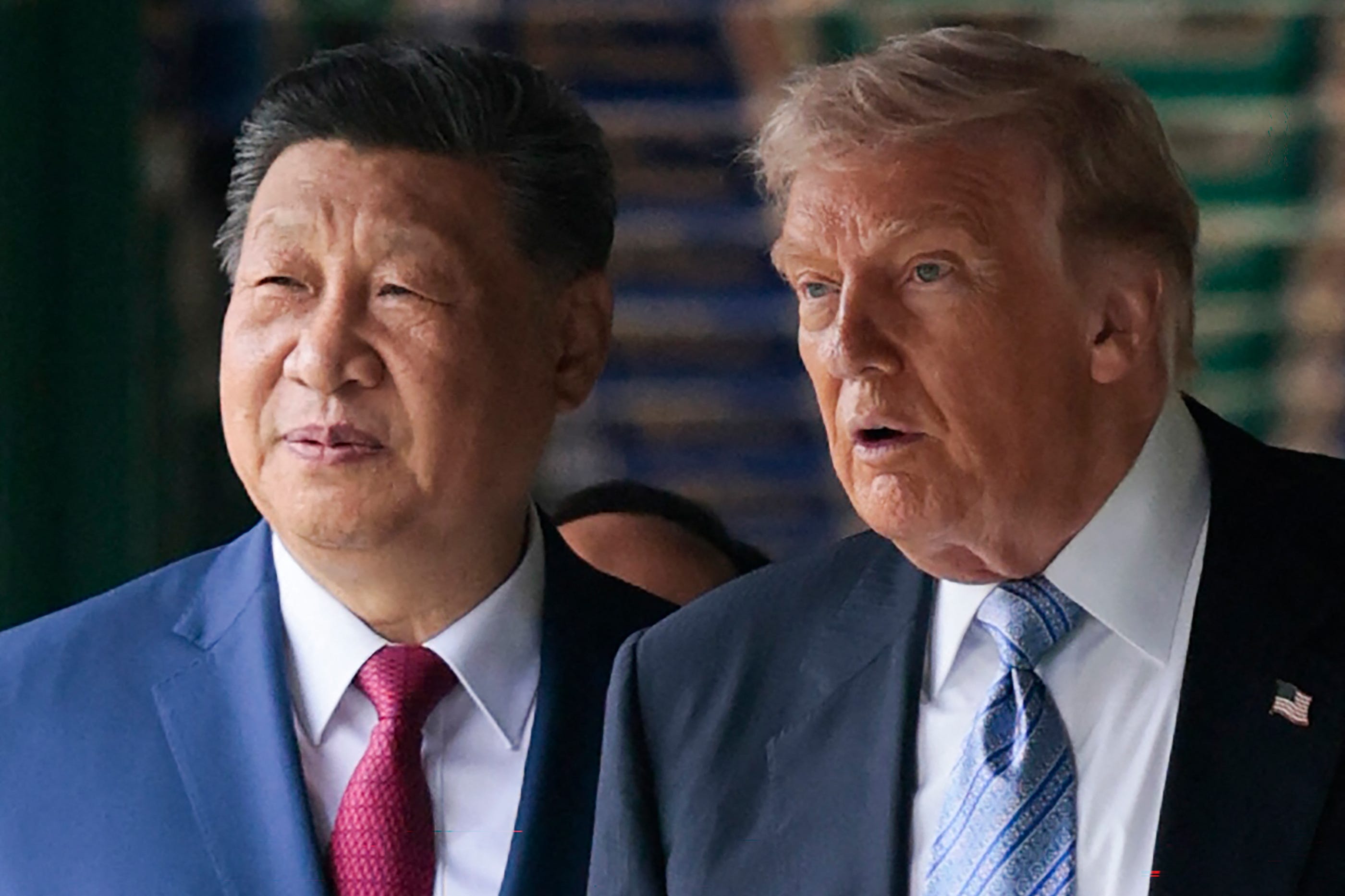
Trump went to China without a clear strategy and with his vulnerabilities on open display.
In the past, presidential summit meetings with strategic adversaries like China come after months of planning and with carefully defined goals. There was not a hint the Trump administration had done any of that work.
But Trump clearly had an agenda, that of being a supplicant, willing to beg Xi for help addressing the many catastrophic consequences of his own misrule.

First, Trump was desperate for some way, any way, to bring his debacle of a war with Iran to an end, and plainly looking to China — Iran’s key military and trade ally — to help him out of the box of his own construction.
Trump’s problem bore a surface resemblance to a challenge Kissinger and Nixon faced when they went to China, seeking to pressure the country to help the US extricate itself from the Vietnam War. But unlike Nixon, who had great leverage over China due to the US’s massively outsized economic and military power, Trump went to China with far more vulnerabilities — including the explosion of oil prices resulting from his war of choice — and few cards of his own.
Second, Trump also plainly hoped he could beg China into addressing the consequences of his catastrophically failed trade war by resuming purchases of US agricultural goods, and ensuring a reliable supply of rare earth minerals for US industry.
Finally, after his tariff gambit failed to force China to make massive investments in American factories as he had promised voters, Trump brought a crew of US CEOs with him for the China trip, apparently to beg Xi to make such investments (including ones involving his family and cronies).
Now that the trip is over, there has yet to be an indication that Trump achieved any of his unrealistic goals. But by the time he was on his way back home, he gave every indication he had been an enthusiastic beggar.
Xi opened the summit with a stark threat, declaring that if the United States does not handle the Taiwan question “properly,” the two countries “will have clashes and even conflicts, putting the entire relationship in great jeopardy.”
The meaning of Xi’s statement was clear: If the United States continued to make good on its commitment to supply defensive arms to Taiwan in the midst of increasingly overt Chinese military threats to the US ally and technology trading partner, China might go to war with the United States. This threat was as outrageous as it was absurd and called for a clear pushback from the United States. But that was not to be.
To the contrary, in a Fox News interview conducted at the end of the summit, Trump indicated he is indefinitely delaying a planned arms sale to Taiwan — just as China wants — calling it a “negotiating chip.”
Furthermore, during the interview, Trump portrayed Taiwan (not China) as a US adversary, and seemed almost sanguine about the prospect of abandoning it to be overrun by China.
Apparently, Trump is unaware of, or unconcerned with, the economic catastrophe a Chinese invasion of Taiwan would wreak on the United States, given Taiwan’s role in producing the world’s most advanced semiconductors for US companies. And given what we know about Trump’s pliability regarding China, one can only imagine what Trump offered to Xi in return for aid in ending his war with Iran in some slightly face-saving manner.
With Trump advertising his willingness to make “deals” with China that pose the gravest of risks to the United States, the question once again arises — as it has during Trump’s dealings with Putin — whether he is a fool, traitor, or some combination thereof. At the end of the day, however, the answer may not really matter, since either way, Trump is a menace to the country he was elected to lead.
Decades ago, critics attacked Kissinger and Nixon for the amorality of their approach to foreign policy, which openly sacrificed principle for what the two deemed to be US interests. But in the era of Trump — who is not only wholly amoral, but also entirely unconcerned with the interests of the country he leads — the Nixon era almost seems like the good old days.
That’s it for today
We’ll be back with more tomorrow. If you appreciate today’s PN, please do your part to keep us free by signing up for a paid subscription.
Thanks for reading, and for your support.
Thank you, Mr. Lurie, for this unequivocal and sober report on the absolute disaster that is Trump's Ärt of the Deal".
You pulled no punches in your analysis. One wonders if the damage is insurmountable or if America will find an administration to rectify the Trump catastrophe.
Trump didn’t even know there was a game.