

PN is supported by paid subscribers. Become one ⬇️
The new year so far has been a miserable chronicle of democratic collapse and authoritarian brutality. Trump and his regime of bloodthirsty goons inaugurated 2026 by invading Venezuela, disgracefully smearing Renee Nicole Good, the woman murdered by an ICE agent in Minneapolis, and generally doing everything they can to visit sadistic, unaccountable tyranny upon the world.
Amid the understandable despair, it can be easy to miss flickers of hope. But the fact is that the regime is ramping up violence and terror in part because its grip on the nation, and even on its own party, seems to be slipping. Last week it suffered two humiliating defeats in Congress, one in each chamber.

The administration will probably be able to contain the damage. But the signs of revolt in the legislature highlight the extreme and increasing unpopularity of Trump’s program of imperialism abroad and gutting the safety net at home.
The House passes ACA subsidies
For months, House Speaker Mike Johnson has been struggling, and often failing, to keep control of his legislative agenda. He’s run the House in large part by doing whatever Trump wants and forcing Republicans to get in line. He’s used his control of the floor to prevent bills that have bipartisan support from getting a vote.
But the tension with his own caucus has reached a breaking point. Republican members are increasingly signing discharge petitions, forcing Johnson to hold votes on legislation he and Trump would rather bury. Johnson’s majority is narrow, so it only takes a handful of defectors to join with Democrats and the anti-Johnson coalition can seize control of the floor.

In November, after months of stalling and thrashing, the House passed a discharge petition forcing a vote on the release of files related to Trump crony and billionaire child abuser Jeffrey Epstein. The House then voted almost unanimously to pass the measure, because even as low as Republicans have sunk, they still don’t want to be associated with billionaire child abusers.
The Epstein vote was dramatic, but it was the beginning, not the end, of Johnson’s troubles. Shortly after the vote to release the files, a handful of Republican moderates, led by Nebraska’s Don Bacon, showed actual signs of life and defied leadership to block a censure resolution of Democratic Rep. Stacey Plaskett. (Plaskett had texted with Epstein during a congressional hearing in 2019.)
Then last month, five Republicans joined with Democrats to pass a discharge petition forcing a vote to overturn Trump’s executive order banning collective bargaining for federal workers. The bill, cosponsored by conservative Democrat Jared Golden and moderate swing-district Republican Brian Fitzpatrick, passed with 20 Republican members in support, 231-195.
Last week, it happened again. Four Republicans signed onto a discharge petition to force a vote on extending ACA tax credits. Without those subsidies, premiums have already doubled on average for people who use the exchanges.
Trump and Johnson and their henchghouls are indifferent to and/or enthusiastically in favor of an America in which people are impoverished by medical emergencies and die of preventable illness. But swing seat Republicans are terrified of backlash from constituents. After the discharge petition forced the bill to the floor, 17 of them voted for a three year extension which would push the next renewal past the 2028 presidential election.
The Senate tries to restrain Trump’s warmongering
It’s not just the House where Trump is struggling to hold onto Republican support. Senate Republicans voted unanimously to pass the bill forcing release of the Epstein files in November.
More, the Senate has quietly been racking up rejection after rejection of Trump’s nominees. So far a record-breaking 55 of them have been withdrawn over the last year — and withdrawals usually indicate the nominee lacks Senate support. In a 53-47 Republican controlled Senate, that means at least four Republican senators are willing to vote against the president.

More dramatically last week, the Senate voted 53-47 to advance a resolution to the floor that would block Trump from using military force “within or against Venezuela.” The resolution is a direct rebuke to Trump, who has been threatening a “second wave” of military assaults on the country after kidnapping President Nicolas Maduro in an attack which killed around 100 people.
The resolution was cosponsored by Democrats Tim Kaine, Adam Schiff, and Chuck Schumer, and by Kentucky Republican Rand Paul, who consistently opposes military force abroad.
Republican Sens. Susan Collins of Maine and Lisa Murkowski of Alaska, who at least periodically side with Democrats, voted for the measure. But the real surprise was that conservative Sens. Josh Hawley of Missouri and Todd Young of Indiana — usually consistent Trump supporters — also supported the bill.
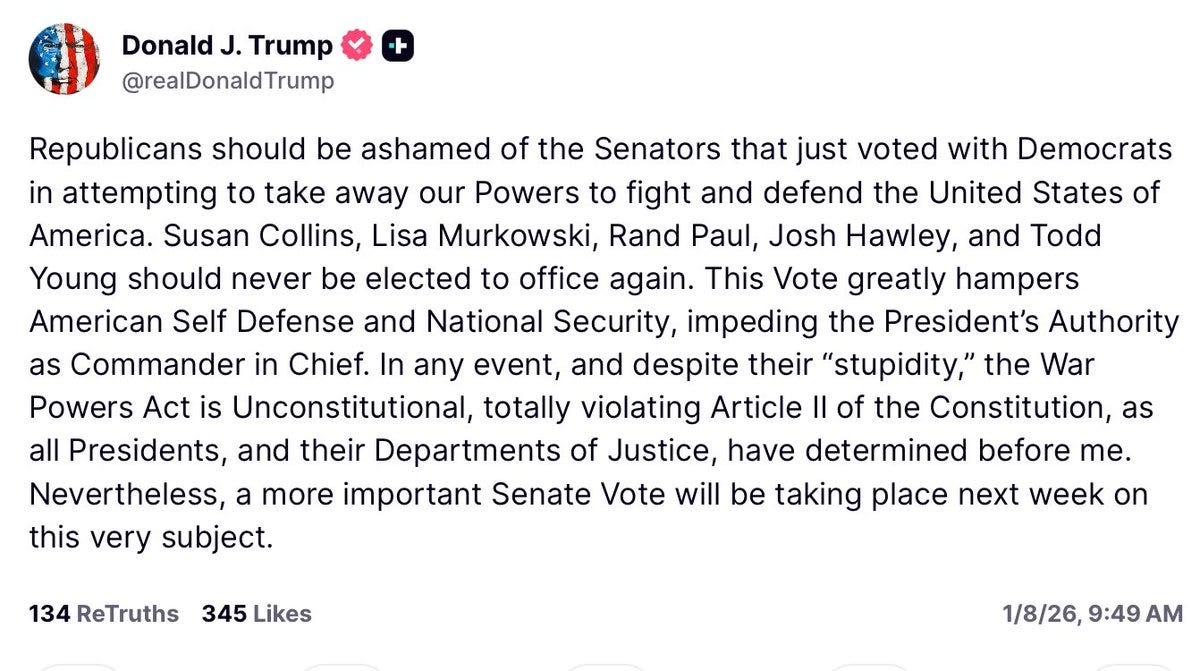
Trump, enraged, declared that the Senate was trying to “take away our powers to defend the United States of America” and huffed that the Republican Senators who voted against him — including loyalists Hawley and Young — should “never be elected to office again.”
This sort of bluster from Trump has in the past been effective at keeping Republicans in line. As political scientist Jonathan Bernstein says, “there’s a realistic scenario in which Trump in 2028 and beyond actively campaigns in general elections against Republicans he holds grudges against” — and Trump supporters also regularly send vicious threats to Republican leaders.
In this case, though, Republicans have powerful incentives to oppose further action in Venezuela, because that action is incredibly unpopular. Analyst G. Elliott Morris writes that Americans oppose military intervention in Venezuela by a “25-50 point margin (depending on question wording).” The Republican defections in the House have a similar logic — an AP-NORC poll found that Americans favored extending the subsidies 43 percent to 12 percent.
Opposition matters
So far, with the sole exception of the Epstein files vote, congressional opposition has not reached a point where Congress can pass legislation over the president’s opposition. The ACA subsidy extension is unlikely to pass the Senate in its current form; the Senate Venezuela war powers act is unlikely to overcome the filibuster.
Trump also demonstrated his continued domination of the party last week when the House failed to override his veto of a bill to complete a pipeline delivering clean water to southeast Colorado. The bill had passed Congress unanimously. Colorado Rep. Lauren Boebert believes that Trump blocked it as revenge for her decision to sign the Epstein files discharge petition. Boebert is a liar and conspiracy theorist, but in this case she is probably right.

Even here, though, Trump doesn’t exactly look like a tower of strength. The vote to override the veto was 248-177 — short of the two thirds needed, but still a substantial bipartisan effort, with close to 30 Republicans crossing the aisle to vote against their own president.
For years, swing district House members largely knuckled under and knuckled under again while the House Freedom Caucus and rabid right-wingers got all the red meat they wanted. Now, all of a sudden, GOP members are getting used to defying Trump and leadership. That’s ominous for Trump’s agenda.
Defiance can have concrete positive outcomes, too. The Senate is unlikely to pass the ACA subsidies as is. But it seems possible that there will be some compromise — perhaps a two year extension with tweaks to income caps and elimination of certain plans. That wouldn’t be ideal, but it would nonetheless be a major boon to a lot of people who rely on the ACA for insurance.
Congress needs to do more
Democrats in the House deserve credit for holding the caucus together and getting Republicans to sign on to discharge petitions. Democrats in the Senate deserve credit for defeating some nominees and for getting Republicans to defy Trump on some votes in the Senate. But Democrats have also mystifyingly caved and compromised in instances where a tinge more spinefulness could have won important victories.
Last week, for example, seven Democrats crossed party lines to confirm Alexander Van Hook to a lifetime appointment as a district judge. Van Hook, like all Trump nominees in 2025, refused to acknowledge that Joe Biden won the 2020 election in questions for the record he submitted in writing to the Senate.
In response to the question “Did Trump lose the 2020 election?” Van Hook responded with evasion: “Congress certified Joe Biden as the winner of the 2020 election and he served as the 46th president of the United States.” When asked whether the Capitol was attacked by a violent mob, or whether it constituted an insurrection, he claimed that he could not express a view on a political matter.

These responses are in line with those of other Trump judges, who all are obviously refusing to speak truthfully and defend the Constitution in order to curry favor with Trump.
Defending the coup attempt — and that is what Van Hook and all other Trump nominees are clearly doing — should be disqualifying. Yet Sens. Dick Durbin, Maggie Hassan, Tim Kaine, Amy Klobuchar, Jean Shaheen, Peter Welch, and independent Angus King all voted to confirm him. There were numerous GOP absentees on the vote; without Democratic support, Van Hook would not have been confirmed.
Democratic appeasement is frustrating. Republican appeasement is expected, but also repulsive. Trump is, again, vetoing bills that Republicans unanimously passed. Yet the bulk of the GOP won’t stand by their own priorities. They act as if they are Trump’s cringing vassals, not charged with the preservation and defense of a coequal branch of government.
Last week, though, showed that Congress does have power and the ability to act if Democrats stifle their knee-jerk desire for bipartisanship and Republicans actually try to serve their constituents and uphold their constitutional duty in some minimal way.
There’s unlikely to be any one moment when the dam breaks and Trump loses GOP support across the board. But there is a steady drip of frustration and dissent from within his own party that has weakened him and will continue to weaken him. And that may mean that we will, in fact, after much suffering, perhaps be able to end this fascist nightmare, and start building a country that stands for something other than hate and cruelty for all.
That’s it for today
We’ll be back with more tomorrow. If you appreciate today’s PN, please do your part to keep us free by signing up for a paid subscription.
Thanks for reading, and for your support.
Great article as always Noah!
No fault of the article but it kind of sucks, though, that the best that can be said of Republicans in congress is that they sometimes don't make things worse (and never make things better) for the people...
Great post, Noah. The sooner they oust Mike Johnson as speaker, the better. I am shocked about Hawley’s vote, but not really. The video of him running from the Jan 6 riot still plays in my head…