

This edition of PN is made possible by paid subscribers. Become one 👇
Last Thursday, the case against the “Broadview 6” imploded in spectacular fashion.
In a dramatic courtroom hearing, Judge April Perry revealed shocking misconduct by the US Attorneys Office in the indictment of individuals protesting ICE’s Midway Blitz dragnet.
The government tried desperately to cover up the rot at the heart of the case, even dismissing the felony charge in an attempt to hide the grand jury transcripts — all the while snorting indignantly at the “histrionic” suggestion that the US Attorneys Office for the Northern District of Illinois would engage in impropriety. And the coverup continues.
Prosecutors abruptly announced that they were dismissing all charges, then argued that the former defendants are necessarily excluded from the sanctions phase of the case, since they’re no longer parties.
Nothing to see here, kids! No endemic corruption at the DOJ and abuse of prosecutorial authority for political ends. Move along!

Throwing elbows in the city of big shoulders
Last September, ICE and CBP agents surged into greater Chicagoland, arresting people who’d been living in the US for years and committed no crimes while clashing with the citizens who protested. The ICE facility in Broadview was a particular flashpoint.
The building was designed to quickly process immigrants and had only a holding cell with no beds or showers. Nevertheless, people were detained at Broadview for days or even weeks, sleeping on concrete floors next to overflowing toilets, denied medical care and basic hygiene, and given just three bottles of water a day. On November 5, a federal judge ordered DHS to provide bedding, showers, food, medical care, and access to phones and lawyers for detainees at Broadview.
Outside the facility, clergy members stood vigil and protesters filled the street. On the morning of September 26, demonstrators staged a “Jericho Walk,” moving back and forth in the public crosswalk to block access to the building. Broadview Police were on hand to create space for official vehicles, but at 7:45am, an ICE agent drove his Ford Expedition directly into the crowd.
A few dozen protesters surrounded the car, banging and shouting, and inflicting minor damage — someone tore off a wiper, and someone scratched PIG in the paint. The agent drove slowly and wound up being a couple minutes late for work. He was never in any danger and joked with his colleagues about “trash in the street” and how riot control is “fun.”
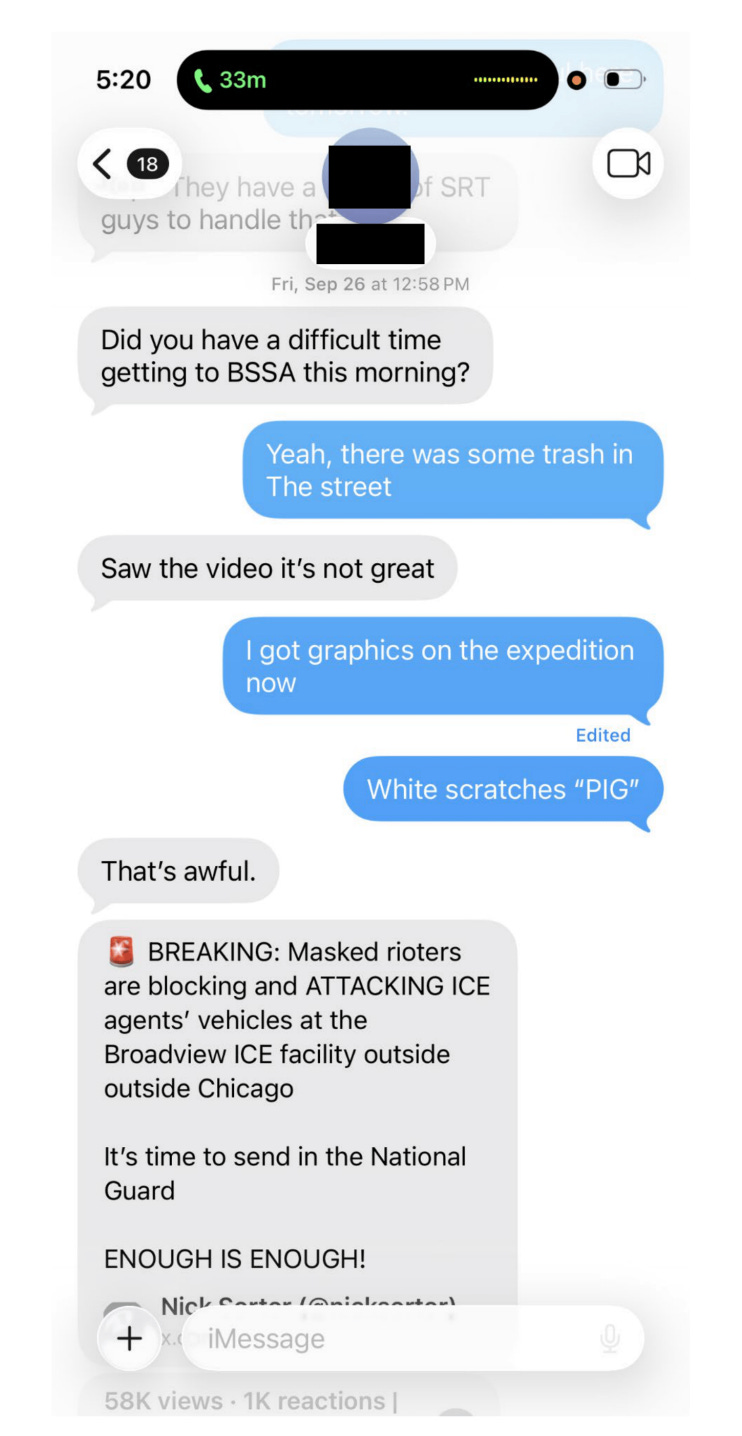
The incident was caught on at least a dozen cameras, and prosecutors might well have been able to identify the culprits and charge them with misdemeanors. But instead they indicted six members of the crowd for felony conspiracy to impede a federal agent in the conduct of his duties, a crime with a potential six-year prison term.
The law in question has never been used to prosecute protesters for civil disobedience, and notably five of the six defendants were connected to local politics: congressional candidate Kat Abughazaleh, her field director Andre Martin, Oak Park Village Trustee Brian Straw, Cook County Board of Commissioners candidate Catherine Sharp, and Cook County Democratic Committee Member Michael Rabbitt.
Grand jury, gross misconduct
The charges represented a direct assault on the First Amendment, effectively criminalizing speech and making every member of a crowd liable for conspiracy if one individual broke the law. But unbeknownst to the defendants, the indictment itself suffered from a fatal defect which was only revealed when Judge Perry finally kicked loose the grand jury transcript.
Grand jury proceedings are presumptively secret and can only be unsealed by court order. But based on the colloquy at a hearing on Thursday, we can pretty clearly infer what happened. It seems that there were three presentations to a special grand jury which met every Thursday in Chicago to hear complex cases.
Lead prosecutor Sheri Mecklenburg first presented the case on October 9. Judge Perry described “improper prosecutorial vouching to the grand jurors, with [Mecklenburg] putting her personal credibility and trustworthiness on the line in support of the charges” at that original presentation. That is absolutely verboten, but the jurors refused to indict, returning a “no true bill” or a “no bill,” and it seems to have escaped the notice of Mecklenburg’s superiors.

On October 16, the judge says that Mecklenburg, a 20-year veteran of the US Attorneys Office, “ask[ed] grand jurors who had made up their minds already to not partake in the second hearing.” Grand juries are made up of 23 ordinary citizens, and prosecutors need only convince twelve of them to vote for an indictment. Having been shut out the week before, the prosecutor apparently invited anyone who would absolutely refuse to indict to leave the room, ensuring they’d have no opportunity to deliberate with their fellow grand jurors and point out defects in the case. This was so wildly inappropriate that the criminal division chief interrupted and ended the session before the jurors could vote.
Then on October 23, Mecklenburg finally managed to secure an indictment. But in that session, she engaged in “communications of a substantive nature with the grand jurors outside of the grand jury room,” perhaps “cajol[ing] someone in the hallway” until they agreed to vote to indict.
This is a truly stunning pattern of misconduct.
“I have never seen the types of prosecutorial behavior before a grand jury that I saw in those transcripts,” Judge Perry said in court.
But what she called “most problematic” was the government’s effort to hide it from the court and the defendants.
The coverup
These revelations retroactively color the entire course of this case. For instance, Mecklenburg left the US Attorneys Office in February to take a job with the Senate Judiciary Committee. (She’s since been relieved of her duties.)
In March, prosecutors called it “reckless,” “nonsensical,” and "pusillanimous" to suggest that “the four line [Assistant United States Attorneys] who have been assigned to this case and their supervisors who reviewed and approved the indictment, including the Front Office, have not only acted in bad faith but have committed prosecutorial misconduct.”
But in April, when Judge Perry first agreed to examine the grand jury transcripts, prosecutors suddenly dropped the felony charge entirely and filed a superseding indictment charging the defendants with misdemeanors only. Because misdemeanors don’t require a grand jury indictment, the prosecutors argued that the court no longer needed to look at the grand jury materials.

At last week’s hearing, US Attorney Andrew Boutros admitted he’d dropped the charges because he learned about Mecklenburg’s impropriety. He tried to take credit for this as a necessary corrective. But considering the timing, it’s pretty clear that the main goal was to stop the court from looking at the transcripts by mooting the indictment.
When defense lawyer Chris Parente, who represents Brian Straw, kept pushing for their disclosure, prosecutors scoffed that “there was nothing remotely unusual, let alone nefarious" in those transcripts. And when the court forced the issue, prosecutors handed Judge Perry excerpts so heavily redacted that she speculated there must be some sort of “IT problem” — a misunderstanding they deliberately failed to correct.
Finally, the judge forced them to hand over the entire set of unredacted transcripts, at which point Boutros announced he was dismissing all the charges — despite the fact that he’d known for a month exactly what happened in that grand jury room! And now the government insists that the defendants can’t get any further discovery or participate in further sanctions proceedings because they’re no longer parties to the case.
The coverup continues.
The cost
What happened here is a particularly egregious example of a phenomenon taking place nationwide.
From the “Sandwich Guy” in DC to the failed indictment of New York Attorney General Letitia James to the Broadview Six, prosecutors are crossing ethical and legal lines to charge Trump’s opponents.

Sometimes that’s because the US attorney is a political appointee who doesn’t know what she’s doing, like Trump’s personal lawyer Lindsey Halligan. The New York Times flagged a story out of Wyoming where a raft of indictments got dismissed because the US attorney not only vouched, characterizing the targets as “bad guys” and “murderers,” he actually chatted up the grand jurors and handed out his business card.
Sometimes, as with Mecklenburg, a competent prosecutor breaks every rule to get the collar.
Either way, it catastrophically undermines the credibility of the Justice Department and the stability of the American body politic. And even when those defective charges crumble under the slightest scrutiny, they still ruin people’s lives and subject them to crippling legal bills.
The Broadview 6 have vowed to seek sanctions, and at least one will apply for reparations from Trump’s weaponization slush fund. But even if they get made whole, we all still lose when the justice system becomes a cudgel to beat the president’s political enemies — not least because people will think twice before they exercise their First Amendment right to protest if they think it might land them in jail.
Judge Perry, herself a former federal prosecutor, excoriated the prosecution team, including US Attorney Boutros, for carelessly torching the formerly sterling reputation of their office.
“Your sole goal is to do justice. Your client is justice itself,” she warned. “I do believe deeply in the presumption of regularity and that most government attorneys are doing the best they can to do the right thing. That trust has been broken.”
That’s it for today
We’ll be back with more tomorrow. If you appreciate today’s PN, please do your part to keep us free by signing up for a paid subscription.
Thanks for reading, and for your support.
Hmm. It seems that corruption isn't limited to the oval office. But corruption in the administration of justice is amongst the worst sort of corruption that aflict a country.
This is exactly what I pay for; clear explainer of incomprehensible events that no-one explains on social media. So useful!