


Public Notice is proudly celebrating 5 years of independent journalism. Support our work by becoming a paid subscriber ⬇️
The Democrats claimed a sweeping, generational victory in the 2026 midterms. They easily flipped the House and Senate, added four net new governors, and captured enough state legislatures to forge six new state-level “trifectas” while breaking up five the Republicans held before last week’s blue wave.
Of these victories, the Democrats’ new Senate majority is the most significant, because controlling the Senate has become almost as important as controlling the presidency when it comes to the selection of Supreme Court justices and other judges.
The scale of the Democrats’ Senate gains — at least seven and as many as nine net seats — position the party to hold and perhaps expand their majority through the 2028 and 2030 elections, maybe longer. If they retain the Senate for the next six years, Supreme Court retirements or deaths could give Democrats the opportunity to rebalance the Court for decades.
An imbalanced Court
Before turning to the Democrats’ prospects for maintaining if not expanding whatever sized Senate majority they will have in January — as this is written, Alaska and Mississippi remain to be called [Editor’s note: The Mississippi race was called for Democrat Scott Colom as this newsletter was being finalized] — let’s review why Democrats currently suffer from a dispiriting, three-seat liberal minority on the Court.
Simply put, the Court’s composition does not reflect the will of the American public — and that’s setting aside the abject unpopularity of recent decisions, like the 2010 Citizens United ruling that allowed the affluent to pour even more money into elections, or the 2024 ruling in Trump v. United States that gave presidents near-unlimited immunity.
No, we mean the Court’s composition literally fails to reflect the will of the people, at least as expressed by their presidential votes.

The five presidents who served during the 34-year period between January 1993 and next January when the new Congress takes office appointed 10 justices (so far). Democrats Bill Clinton (2), Barack Obama (2), and Joe Biden (1) appointed five, and Republicans George W. Bush (2) and Donald Trump (3) appointed five.
But in the nine elections from 1992 to 2024, Democratic presidential candidates won the popular vote seven times by a whopping 33.7 million more combined votes. Because all three of Trump’s appointments were in his first term, the Republicans’ 6-3 conservative majority existed before Trump’s 2.3-million popular vote win in 2024. Subtract 2024 from the equation, and Democrats to that point had won the popular vote in seven of the eight previous contests by a combined margin of 36 million votes — and still had only a third of the Court’s seats to show for it.
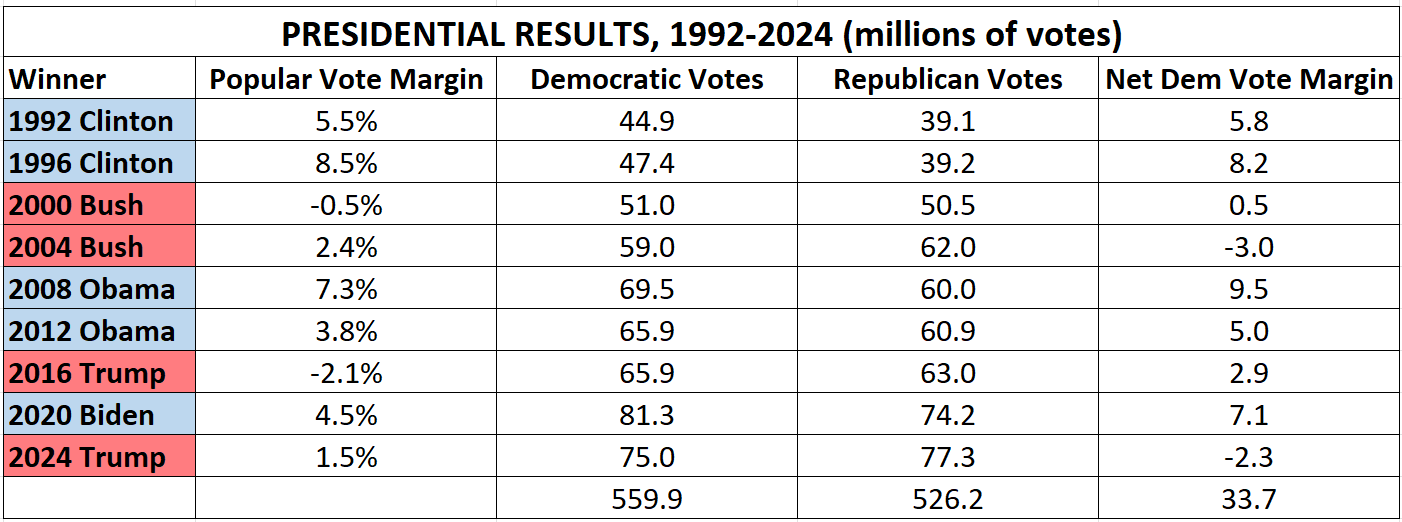
Thanks to the antiquated Electoral College, however, Bush and Trump each won once despite losing the popular vote.
Mix in Sen. Mitch McConnell’s refusal to confirm Obama’s 2016 nominee Merrick Garland, conservative Justice Anthony Kennedy’s strategic 2018 retirement, plus Ruth Bader Ginsburg’s untimely 2020 death, and conservatives enjoy a comfortable, 6-3 bench majority despite Democratic presidential dominance.
Building on their new majority
Liberals, Democrats, and concerned constitutional scholars who worry that conservatives might control the Court forever should be buoyed by last week’s results. A quick account of the current justices’ ages, plus some forward-looking Senate election handicapping, suggests that 2026 radically changed the Court calculus.
If vacancies are assumed to occur based on rough order of age, the retirements or deaths of Clarence Thomas (78), Samuel Alito (76), and Sonia Sotomayor (72) would create the next three Court openings.
If neither Thomas nor Alito leave the bench before 2028, and Democrats win the presidency that year while retaining their new Senate majority, Democrats could be in position to flip the Court from a 6-3 conservative majority to a 5-4 liberal edge. And if Sotomayor pulls a Kennedy-like strategic retirement, Democrats could replace an aging liberal with a much younger one to cement that five-member majority.
That said, let’s stipulate that Alaska’s Mary Peltola and Mississippi’s Scott Colom win, giving Democrats a 56-seat majority. How long might that Senate majority endure?
Looking at the 2028 Senate map, Democrats can set their sights on (at least) three Republican-held seats. In 2022, and despite a GOP-favorable Biden midterm cycle, North Carolina’s Ted Budd barely won with 50.5 percent and Wisconsin’s Ron Johnson narrowly won reelection with an almost identical 50.4 percent. (A nervous Johnson last week began to distance himself from Trump by denouncing the administration’s corruption.)
Then there’s Iowa Republican Chuck Grassley.

Following Tuesday’s tectonic Senate shift, the 93-year-old declared he would not retire to allow Republican Gov. Kim Reynolds to replace him before Democratic Governor-elect Rob Sand takes office. (Iowa’s governor appoints temporary successors to fill vacancies until a special election is held during the next general election.)
Even if Grassley keeps his word and resists White House pressure to resign, Father Time may deliver Democrats a chance to expand their majority before 2028 (apologies for the morbidity). Should Grassley simply retire at the end of his current term or decide to run again at age 95, Democrats in 2028 would either be vying for an open seat or running against a man seeking permission from Hawkeye voters to serve past age 100.
Democrats may also incur unforeseen vacancies between now and 2028. And the party next cycle must defend two difficult seats currently held by incumbents who won narrowly in 2022: Georgia’s Raphael Warnock needed a runoff to defeat scandal-plagued former football star Herschel Walker, and Nevada’s Catherine Cortez Masto eked out her win by fewer than 8,000 votes.
The good news is that Trump should again be a drag on the GOP in 2028. If he’s still in the White House but not on the ballot, Trump will be a senescent, lame-duck liability in the lead-up to November who provides declining motivation for the MAGA base to show up on election day.

Overall, if unexpected vacancies and tough-to-defend seats for both parties cancel out in 2028, the Democrats would keep their 54- to 56-seat majority for another two years.
Although it’s admittedly very early to speculate, the 2030 Senate map could be a bit tougher for Democrats. The party does not have many clear pickup chances and must defend two southwestern incumbents who won narrowly in 2024: Arizona’s Ruben Gallego (50.1 percent) and Nevada’s Jacky Rosen (47.9 percent). And if Democrats recapture the White House in 2028, midterm voter shifts tend to break against the presidential party.
Nevertheless, if Democrats head into 2030 with at least 54 and certainly 55 or 56 senators, they could afford to lose a few seats and still hold a narrower majority. The late votes being counted to determine the winners in Alaska and Mississippi could be the difference between Democrats holding the Senate for six, rather than four, years.
Courting success
A month ago, speculating about whether Democrats could build and retain a Senate majority for four or six years would have been dismissed as fantastical. But the party’s huge Senate sweep last week brought Democratic fantasies to life.
Seeking to curb the nakedly partisan abuses of the Roberts Court, a growing chorus of constitutional scholars, liberals, and Democrats — notably South Carolina Rep. Jim Clyburn and fellow members of the Congressional Black Caucus — have called for expanding the size of the Court by four justices. Others want stricter ethics rules to prevent justices like Alito and Thomas from enriching themselves, a proposal that sounds even better because it enraged both men.
Led by Sen. Cory Booker, others want to limit future Court terms to 18 years, with the appointment-and-confirmation process put on a biennial schedule so every president gets two appointees during a four-year term.

But for now, Democrats’ Senate capture should calm liberal worries a bit. If Chuck Schumer is as tough as his defenders claim, with his new majority he should treat Trump’s appointees during his final two years in office exactly how McConnell treated Obama’s during his final two years: By refusing to confirm any Trump Supreme Court appointee and almost every federal appeals court nominee.
The 2026 blue wave gave Democrats the votes to block Trump judges for the next two years and, should they recapture the White House in 2028, the power to start transforming the Supreme Court and the federal judiciary. Generational victories, after all, should beget generational consequences.
That’s it for today
We’ll be back with more tomorrow. If you appreciate today’s PN, please do your part to keep us free by signing up for a paid subscription.
Thanks for reading.