

This edition of PN is made possible by paid subscribers. Become one ⬇️
“I probably won all 50 states if we had an honest count,” President Trump said at an Oval Office event three weeks ago.
The lie that American elections are riddled with fraud has become a right-wing shibboleth, despite years of Republican-led investigations which only wind up proving how vanishingly rare it is.
But the election fraud myth undergirds two vital Republican projects: undermining faith in elections generally, and building support for “solutions” that will wind up disenfranchising millions of people, most of whom vote for Democrats.
Trump has been trying to ram these “solutions” through Congress since he got back into office, even blowing up the deal to renew the Foreign Intelligence Surveillance Act (FISA) by insisting that Republicans include his SAVE America Act, which includes a voter ID mandate and a national voter registry (and, bizarrely, “no transgender mutilization of our children”).
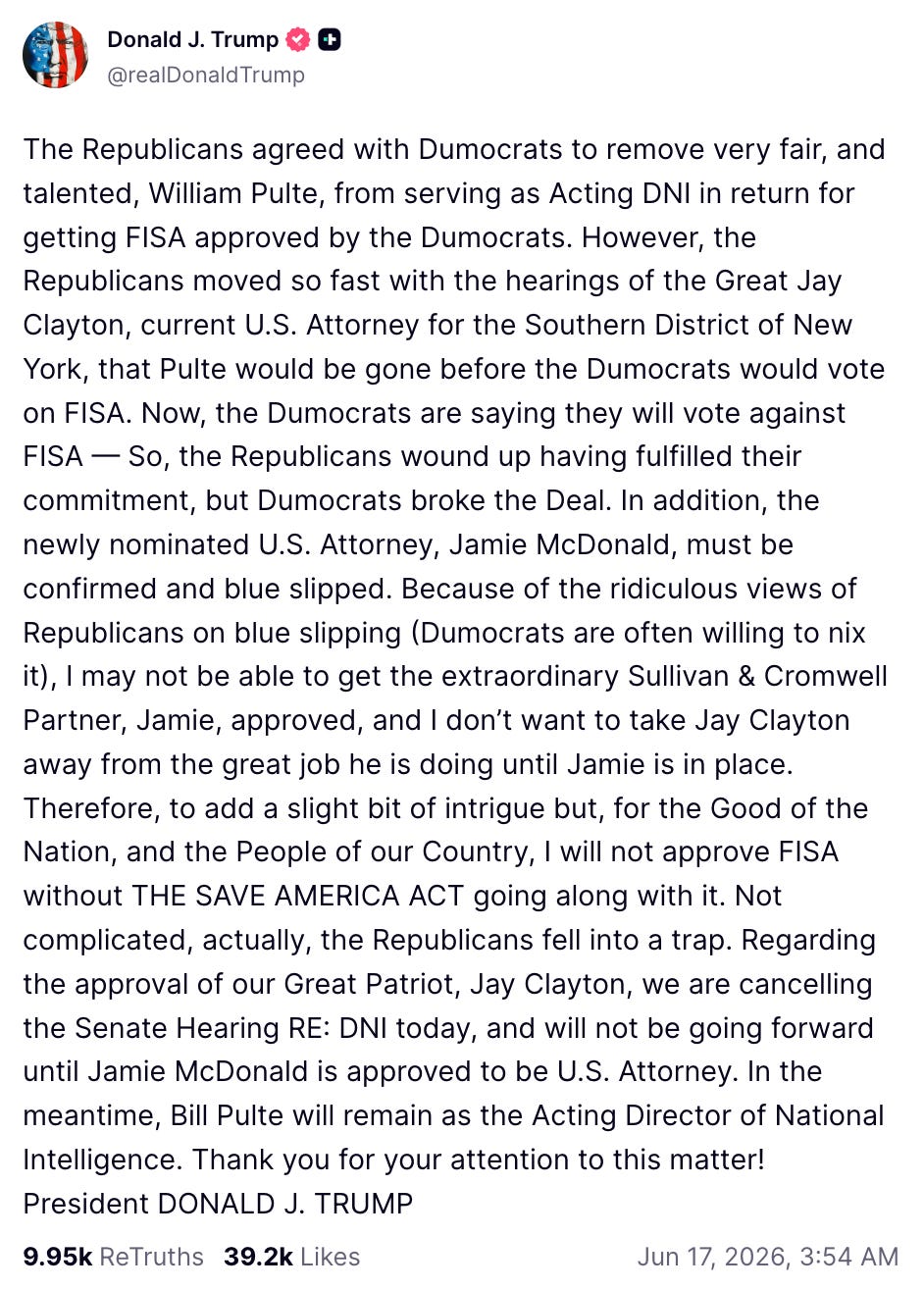
Congress could indeed enact these reforms. The Constitution’s Elections Clause states that “the Times, Places and Manner of holding Elections for Senators and Representatives, shall be prescribed in each State by the Legislature thereof; but the Congress may at any time by Law make or alter such Regulations.” But as Senate Majority Leader John Thune has admitted, even blowing up the filibuster wouldn’t get the SAVE America Act through, since it doesn’t have 50 votes.
And so Trump has been trying to will his disenfranchisement machine into existence by executive fiat.

In March 2025, he signed Executive Order 14,248, requiring documentary proof of citizenship to register to vote (which was immediately blocked) and directing DHS and DOJ to build a system to bulk-verify state voter rolls for citizenship status. A year later, when it became clear that the SAVE America Act was DOA, he signed Executive Order 14,399, instructing DHS to coordinate with the Social Security Administration to compile a national voter registry and ordering the Post Office to refuse to deliver mail-in ballots to anyone who isn’t on it.
Trump is using the entire executive branch to disenfranchise millions of voters — or at least he’s trying to. So far, the courts have largely blocked him.
Making the list
The first step in this plan was to compile a database of all registered voters. Toward that end, the Justice Department’s Civil Rights Division sent letters to election officials across the country demanding their states’ complete, unredacted voter rolls, including full names, addresses, driver’s license numbers, and Social Security numbers.
The letters invoked the Civil Rights Act of 1960, which requires local election officials to retain all documents received from voters and produce them to the DOJ on request. It’s a gross perversion of the statute, which was designed to prevent local registrars from throwing Black voters’ registrations in the trash, not to allow the federal government to seize and then cull state voter rolls. It also violates state electoral privacy laws, designed to protect the secrecy of the ballot
Many (but not all) red states complied anyway, handing over their residents’ data.
The Justice Department’s Civil Division sued 30 states and the District of Columbia for failing to turn over their complete voter rolls. So far, all nine courts to weigh in have told the DOJ to pound sand. Some judges excoriated the government for its craven exploitation of a law meant to protect voters. Some said that a voter roll is compiled by the registrar, and is thus not a document which “come into the possession” of election officials within the meaning of the 1960 statute. Some said that the DOJ had failed to articulate a reasonable purpose for its demand. None said that there was legal basis for the government’s demand.
Last week, Judge Stephanie Gallagher in Maryland spent just 10 pages disposing of the DOJ’s argument, much of which consisted of block quotes from other courts. The government has appealed these adverse rulings, but, as of now, the national voter database does not exist.
If you’ve got a problem, DOGE can make it worse
Meanwhile, behind the scenes, Trump had tasked Musk’s DOGE bros with hacking the Social Security database to set up the nationwide voter “verification” system, once again by perverting an extant program for a wholly unintended purpose.
The Systematic Alien Verification for Entitlements program (another SAVE!) was created by Congress in 1986 to allow nearly 4,000 federal and state agencies to search federal records to determine whether non-citizens were eligible for benefits. It wasn’t designed for bulk queries, and it explicitly did not cover US citizens. And yet, between April and August of last year, DHS, SSA, and DOGE overhauled SAVE into a centralized database linked to SSA’s master NUMIDENT file, which contains every Social Security number issued since 1936. They reprogrammed it to enable bulk uploads of entire voter rolls for mass citizenship screening and started dumping voter rolls in from cooperative red states.

If you don’t know anything about Social Security data, you might intuit that this is an excellent way to determine who is a citizen. And the DOGE kids definitely did not know anything about the dataset they were screwing around with — that’s why they breathlessly claimed to have found millions of dead centenarians receiving befits. Nope!
But people inside DHS and SSA did understand the problem, as evidenced by an internal “Privacy Threshold Analysis” produced by DHS last year which acknowledged “shortfalls in data accuracy” in SSA citizenship data that “could cause incomplete or false results.” That’s because non-citizens routinely secure SSNs, and they have no obligation to update SSA if and when they become citizens.
When Texas dumped records on its 18 million voters into SAVE, the system flagged 97 potential non-citizen voters in Travis County. But according to a brief filed by county officials, 65 of those voters had already presented documentary proof of citizenship, either when they registered to vote or when they got a state drivers license. An SSA Inspector General audit estimated that 3.3 million US citizens are listed as non-citizens in SSA’s own database, suggesting that at least one percent of voters might be flagged as ineligible and unable to cast a ballot if this plan is allowed to go into effect.
And compiling the information itself was a gross violation of the Privacy Act of 1974, which was enacted as a rebuke to proposals in the 1960s to create just such a centralized database aggregating information on individuals tied to SSNs. The law prevents the repurposing of an individual’s data for a new use without notice and 30 days of public comment. DHS and SSA published their notices months after the system was already running and made clear the changes would take effect immediately regardless of what commenters said.

And so on Monday Judge Sparkle Sooknanan in DC blocked DHS and SSA from using the SAVE system to screen voters for citizenship using SSN databases.
“They haphazardly combined and repurposed the private information of millions of Americans, including citizenship data that they knew to be unreliable. Since then, states have partnered with the federal government to access the database and are actively removing United States citizens from voter rolls based on inaccurate information,” she wrote. “All in all, the federal government has knowingly trampled on the privacy rights of American citizens in a manner that threatens the sacred right to vote.”
Going postal
The last leg of this cursed stool enlists the mailman to suppress the vote.
Trump’s second EO directs the United States Postal Service to initiate rulemaking to create a “Mail-In and Absentee Participation List” — constructed from stolen state voter rolls fed into the illegal SAVE database — and prohibit delivery of ballots to anyone who’s not on it.
Lawsuits followed within days. On May 28, Judge Carl Nichols denied a request for a preliminary injunction because the administration had done nothing yet to operationalize the EO. Although he left open the possibility of future challenges, he reasoned that the citizenship lists didn’t exist and USPS hadn’t issued a proposed rule, and thus the case wasn’t ripe. In fact, as NOTUS reported on May 14, White House officials had been meeting with DOJ Civil Rights Division chief Harmeet Dhillon, USPS CEO David Steiner, and Heather Honey — a DHS “election integrity” official whose prior research fueled Trump’s 2020 election challenges — to coordinate implementation of the order.
On June 2, just five days after Judge Nichols’s order, USPS published the proposed rule in the Federal Register. It would require states to register every mail ballot recipient through a new federal portal, with each envelope bearing a unique serialized barcode tied to the voter's name and address, effectively creating a federal registry of everyone who votes by mail. Ballots sent to voters not on the list would be returned undelivered.
The comment period closes July 2, and a final rule is due July 29. That would leave just three months for states to overhaul their ballot mail systems to ensure compliance by Election Day — something election administrators across the country have said cannot be done.
It’s not clear whether Judge Nichols will revise his stance in light of this new rule, but in Massachusetts, Judge Indira Talwani found that the issue is certainly ripe for court review, at least with respect to the November 3 election.
“With an ever-narrowing window of time in which review is appropriate and practicable, and where that review may well require timely involvement by the Court of Appeals or Supreme Court … the court finds that the legality of the EO as to the November 3, 2026 election (and earlier elections) is both ripe and fit for review,” she wrote last week.
That’s a strong signal that the judge intends to move expeditiously on the claims by the League of Women Voters and 23 states that the proposed rule violates the separation of powers, the Tenth Amendment, and the Voting Rights Act, while enlisting the Post Office to do something it’s not allowed to do by law.
So far, courts have managed to head off this plan for mass disenfranchisement. It seems almost certain that Judge Talwani will issue a preliminary injunction blocking the USPS rule change for mail-in ballots, likely ensuring that it cannot be put into effect for the midterms. But that won’t be the end of the matter. Trump and his cronies will fight tooth and nail to attack the right to vote by wrenching control of elections away from the states. Every single battle matters.
“The taking of democracy does not occur in one fell swoop,” California Judge David Carter wrote in January when he rebuffed the DOJ’s attempt to seize the state’s voter rolls. “It is chipped away piece-by-piece until there is nothing left.”
That’s it for today
We’ll be back with more tomorrow. If you appreciate today’s PN, please do your part to keep us free by signing up for a paid subscription.
Thanks for reading, and for your support.
He knows he will be held accountable at the ballot box. He’s doing everything he can to stack the odds in his favor. I grew up believing “cheaters never win”. WTF 🤬 Thanks to the numbskulls who are still drinking the koolaid, we have to add “unless you’re DJT”.
Thank you Liz. Let’s hope the judges do the right thing🤞🏼
I like to provide the following statement in regards to "vote by mail" because the features and benefits of such a system are often left out of the conversation.
Washington State, 100% vote by mail since 2011. (Among 8+ states):
No lost work. No standing in line. Vote from the comfort and security of your own home. Complete voter information providing candidate statements and “both sides” of a ballot issue for consideration sent weeks in advance. Multiple security features including proprietary barcoded envelopes and ballots along with signature verification. Completed, signed and sealed ballots mailed via USPS or placed in drop boxes prior to the election. Safe and secure. Well established record of vote security and integrity.
In a prior election, my signature was flagged for detected changes. Reasons were provided; signatures can change with age, time, writing style, etc. Send in or scan a current signature so voting in future elections will not be affected. I addressed my voter records on a state website account to provide a scan of a current signature. This verification proves that the system is providing accountability and voter integrity.