

PN is supported by paid subscribers. Become one ⬇️
A couple weeks ago, Adam Hamilton, pastor of the largest United Methodist church in the country, entered the Democratic Senate primary in Kansas to challenge Republican incumbent Roger Marshall.
Kansas is a deep red state; it hasn’t elected a Democratic senator in 94 years. Still, Hamilton is thought to be a strong contender. An early poll found him eight points behind Marshall, 54-46 — which are not bad initial numbers, considering Trump won the state in 2024 by 16 points. Another hopeful indicator is fundraising; Hamilton raised $1 million in his first week of campaigning — 92 percent from donors contributing $100 or less, and 70 percent from donors in Kansas.
Hamilton isn’t the only Democrat in Kansas who sees the race as winnable; there’s already a crowded primary field. That reflects Republican woes nationwide. President Donald Trump is under 37 percent in the Fiftyplusone aggregator and Democrats have benefitted from an average swing of 12.6 percent in special elections since 2024, according to The Downballot.
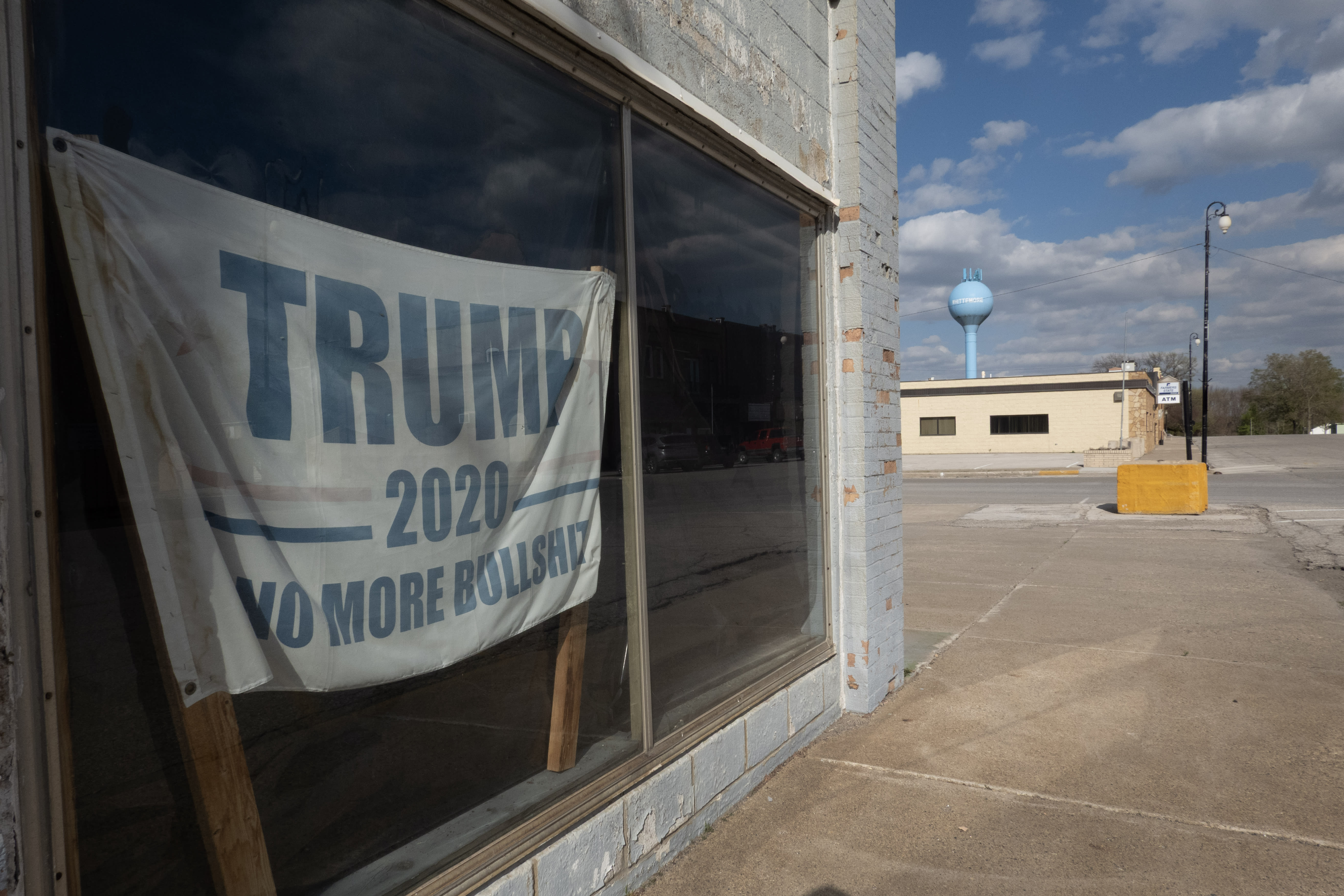
But Democratic hopes in Kansas, Nebraska, and Iowa also reflect regional conditions. Trump won rural voters by a massive 62-36 percent margin in 2024, in part on the strength of promises of federal aid that would usher in a “golden age” of farming.
But rural states in the Midwest and Plains which rely on farming have been especially hard hit by Trump’s reckless, billionaire-first policies. There’s a lot of discontent, and you can see it in polls and special election results which show Republican support collapsing in areas they have traditionally thought of as their base.
Trump takes farms
Farmers were already experiencing tough times in the 2020s. But Trump 2.0 has made everything worse, and his brutalization of farmers has been multipronged.
Trump’s first and most relentless attack on rural people has been his unilateral, fluctuating, exorbitant, and illegal tariffs. Trump admitted in September that farmers would be “hurt for a little while until the tariffs kick into their benefit.” And so they have been.
Trump’s trade war with China led that country to source corn and soybeans from more stable markets. As a result, agricultural imports from China dropped from a peak of $38 billion to only $8.4 billion in 2025 — a devastating decrease of almost 78 percent. In late 2025 Trump ratcheted back some tariffs, and China has increased its purchases in 2026. But the damage, and uncertainty, remain.

Trump has also levied high tariffs on steel, rubber, and manufactured machinery parts, which means that farmers’ costs are rising even as their sales plummet. The Hill reported that a new tractor which cost $190,000 in 2019 now retails for $330,000.
A second policy which has squeezed farmers is Trump’s xenophobic campaign of kidnapping and ethnic cleansing against immigrants. Farmers rely heavily on immigrant labor; the US Department of Agriculture reports that 70 percent of farmworkers were born overseas and 40 percent of them are undocumented. The Trump administration’s termination of some 30,000 work permits for immigrant farm laborers could by itself lead to a 14.5 percent increase in food, beverage, and tobacco prices as farmers struggle to recoup higher labor costs.
Finally, farmers are suffering because Trump launched a war of aggression in the Middle East and lost.
Now Iran controls the Strait of Hormuz and global fuel prices are skyrocketing. Fertilizer has spiked from $795 a ton in February (before the war) to $990 at the end of March. The diesel fuel which powers tractors has gone from $3.76 a gallon nationwide before the war to $5.51 a gallon. The New York Times this month reported on a Pennsylvania dairy farmer who had to sell the herd that has been in his family for generations thanks to the pointless war started by the president he voted for.
Trump has tried to offset these disasters with direct federal aid; in December he rolled out $12 billion in “bridge payments” intended to tide farmers over till the MAGA economic miracle does its miracle thing, whatever that may be.
Again, though, China alone imported $30 billion less in 2025 because of Trump, so farmers are still ending up far behind. And of course what Trump gives with one sweaty palm he grabs back with the other; his arbitrary freeze of federal funds has hurt farmers, and Republicans are busy cutting aid to rural communities from the budget bill now under consideration.
As you’d expect given these bleak conditions, the outlook for farmers is somewhere between bad and nightmarish. There were 315 farm bankruptcies in 2025, a 46 percent increase over 2024. More than a third of those (121) were in the Midwest, which experienced a 70 percent increase in bankruptcies from 2024 to 2025. Total farms dropped by 15,000 in 2025 — in line with yearly decreases since 2018.
That’s not indicative of a golden age. On the contrary, Kansas Sen. Jerry Moran told Politico that conditions facing Kansas farmers are “the most difficult that I’ve seen in my time as an elected official.” Moran first held elected office 44 years ago in 1982.
Betrayal
Politico notes that Republicans are worried about erosion among their rural base, and they are right to be.
Iowa has the highest net farm income in the country, at $14.7 billion. Almost 93 percent of Nebraska’s land is used for farmland. Agriculture is the largest employer in Kansas. In all of these states, when farming suffers everyone suffers. And when people suffer, they tend to blame the party in power.
That’s what’s been happening at contentious town halls in Iowa, Kansas, and Nebraska, as red state electeds confront outraged constituents. And that’s what’s been happening at the ballot box as well.

Since 2024, there have been major swings against the GOP in Midwest and plains states. Of six Iowa state legislative district elections in 2025, all swung to Democrats, most by 24-26 points — and two flipped from R to D. A blue seat in Oklahoma saw one of the biggest blowouts of the cycle in 2025, shifting left by 50 points — with another seat going left by 26 points earlier this year. In May 2025, Omaha elected its first Democratic mayor in a decade (and its first Black mayor ever).
Polls also look ominous for the GOP. Iowa voted for Trump by 13 points in 2024. But current polls for the open Senate seat show the two most likely Democratic nominees only a few points behind, or even ahead. In the Iowa governor’s race, Democrat Rob Sand actually has a healthy lead over his most likely Republican opponent. Similarly, Trump won Nebraska by 21 points in 2024, but polls show incumbent Sen. Pete Ricketts barely edging out independent/Democratic aligned challenger Dan Osborn.
Kansas hasn’t had any special elections recorded by The Downballot this cycle and polling is thin for both the Senate and governor’s race. But the signs aren’t difficult to read. Trump has put in place arbitrary, senseless policies that have devastated farmers. As a result, rural communities have lost faith in Trump and begun to realize, belatedly, that he hates them, as he hates anyone who fails to lick his boots as he kicks them in the face.
Partisanship, of course, is a powerful force; there’s no guarantee that Trump’s base will abandon him in large enough numbers to hand seats in Iowa, or Nebraska, or Kansas to Democrats. But if they don’t, they can look forward to more tariffs, more wars, more ethnic cleansing, and more misery.
The Senate, especially, gives rural voters a lot of power in the US. In November, those voters will have a chance to use that power to rebuke the man who has immiserated them. Hopefully they will do so.
That’s it for today
We’ll be back with more tomorrow. If you appreciate today’s PN, please do your part to keep us free by signing up for a paid subscription.
Thanks for reading, and for your support.
Bitter irony that Trump, who has never physically worked in his life, promises and then betrays farmers whose whole lives are physical labor.
And this doesn’t even mention the possibility of reducing tariffs on imported beef to lower costs for consumers here, which I assume would negatively affect US beef producers. I thought trump floated that idea (if I remember correctly) but I don’t know the outcome.