

Public Notice is proudly celebrating 5 years of independent journalism. Our coverage is possible thanks for paid subscribers. Become one ⬇️
Let’s make one thing very clear: in the hands of President Donald Trump and Attorney General Todd Blanche, the Department of Justice is a lawless shambles.
Functionally, it exists only to protect Trump and the GOP majority in the House and Senate, and Blanche is willing to greenlight pretty much anything to make that happen.
The lawsuits that the administration has brought against California and Alaska are straight-up election interference, pure and simple. We’re in genuinely uncharted territory here as we’ve never had a federal government go all in on trying to take over elections, Constitution be damned.

Because this is so unprecedented, it’s tough to say what the ultimate chances of success are, especially since every time the administration loses in the lower courts, Trump runs to the Supreme Court to beg for special treatment.
We got a real taste of weirdness over the weekend thanks to a rare Sunday oral argument at the Ninth Circuit Court of Appeals, where the administration pushed to get a ruling that it can somehow force California to segregate and not count mail-in ballots from tens of thousands of people that the administration says are not citizens. After an oral argument that very much did not go well for the administration, the Ninth Circuit ruled 2-1 on Monday that it would not immediately order California to set aside those ballots.
However, that’s nowhere near the end of the story for California. The appellate court order only sends the matter back down to the lower court. But the fact that the Ninth Circuit had to consider this in the first place is part and parcel of the DOJ’s absolute lawlessness these days.
So we have to talk about how ridiculous it was that the Ninth Circuit was even in the mix.
Fishing expeditions
On October 13, the administration sent Los Angeles County a random thumb drive with 20,000 names of alleged non-citizens and demanded California investigate all 20,000 within 48 hours.
If you want to know how secure and serious this effort was, know this: The thumb drive came with a little blue Post-it note containing the password. Needless to say, this is not how the government typically shares sensitive voter information. Indeed, Los Angeles County’s head of elections, Dean Logan, declined to plug a random thumb drive into secure election computers, saying it “would conflict with established data privacy and information security protocols.”
Ultimately, California reviewed a sample of 200 voters from the list. More than 100 had never had ballots mailed to them, 71.2 percent had never voted in past elections, and 38.9 percent were born in the United States. But hey, that’s no big deal, according to Deputy Attorney General Trent McCotter, who acknowledged that sure, the list might have errors and “there may be some names on there who it turns out ultimately are citizens.” McCotter’s additional remarks did not exactly engender confidence either: “We’re not perfect and that’s why we’ve asked California to cooperate with us. These are the ones where we’re kind of the most confident that they are noncitizens.”
Oh, well as long as you’re “kind of the most confident,” things are probably fine. Surely things in California won’t be like the administration’s efforts to hunt down non-citizen voters in Nevada, where the administration claimed it had found 16,000 registered non-citizens, then dropped that number to 185 — quite a decrease. (Nevada investigated those 185 and found they were all citizens.)
When California declined to mass-disenfranchise 20,000 voters because Trent McCotter was “kind of the most confident,” the administration sued the state on October 15.
Federal law bars states from mass-purging voters from rolls during the “quiet period,” 90 days before a federal election. That should really end the whole lawsuit right there, but the DOJ has done this cute little trick where it says that it isn’t asking California to remove 20,000 people from the voter rolls, just not to count their ballots until the administration decides, somehow, which of those 20,000 people are citizens.
That is, of course, a distinction without a difference. Canceling someone’s ballot has the same effect as canceling their registration — it nullifies their ability to have their vote counted.
The DOJ’s entire case rests on the claim that the federal statute banning noncitizen voting gives the attorney general authority to tell states which ballots can be counted, and that this somehow overrides the National Voter Registration Act’s ban on purging voters 90 days before an election.
After filing this clearly illegal lawsuit, the administration filed a motion for a temporary restraining order to bar California from counting those ballots. Somehow, because of all the quality lawyering at the DOJ, they asked for a TRO on both October 19 and October 21, because, sure, why not. Both times, they asked the lower court to rule by November 3. The lower court set a speedy schedule, with a hearing on October 27.
Then things got even stupider.

Late on October 21, the administration filed what it called a “Request for Expedited Ruling on TRO,” and told the lower court it now wanted a ruling by noon on October 22, roughly 15 hours later. Then, when the lower court did not do that, because that is not really a thing, the DOJ ran to the Ninth Circuit that same day, saying that by not ruling on its request for an expedited ruling, the lower court “constructively denied” their motion, so they got to go to the appellate court and ask it to immediately require California to not count the 20,000 ballots.
Like much of the DOJ’s practice, “constructive denial” is a real doctrine, but the DOJ’s use of it here is distinctly unreal. Briefly, if a lower court doesn’t rule on a motion for an extended time and leaves the parties in limbo, a party can ask the appellate court for relief. However, that’s typically a looooong time, as in months and months.
But the DOJ felt 15 hours was plenty, thanks to a ruling in A.A.R.P. v. United States. In that case, the federal government told immigrant detainees that they would be deported “today or tomorrow.”
This is, of course, a genuine emergency, and when the lower court didn’t decide the matter in 14 hours and 28 minutes, the plaintiffs appealed to the Fifth Circuit and to the Supreme Court.
As we learned when the administration deported hundreds of men to El Salvador’s notorious CECOT prison, it was perfectly fine defying an order from Judge James Boasberg requiring it to turn the planes around. So, the plaintiffs in the A.A.R.P. case argued they faced an immediate and irreparable harm. The Supreme Court agreed it had jurisdiction because the lower court had constructively denied the motion.

In the California case, of course, there was no emergency whatsoever, as the majority of the Ninth Circuit panel told the administration. Any emergency here was entirely self-made, as the DOJ could have brought its suit against California months ago. Next, asking for relief by November 3 and then changing that demand on the fly also doesn’t count as an emergency. Finally, where the A.A.R.P. detainees would have been removed from the country for good, making it impossible for them to appeal, California isn’t going anywhere, and the administration can appeal a ruling in the normal course of things.
In any event, Monday’s ruling doesn’t put the matter to bed. The Ninth Circuit declined to exercise jurisdiction and rule on the case, but the case is still with the lower court, and the administration’s motion for a TRO still exists. Additionally, of course, the administration will likely ask the Supreme Court to step in, and who can say what would happen there.
That brings us to the lawsuit in Alaska, where the justification might be even shabbier.
Vibes-based litigation
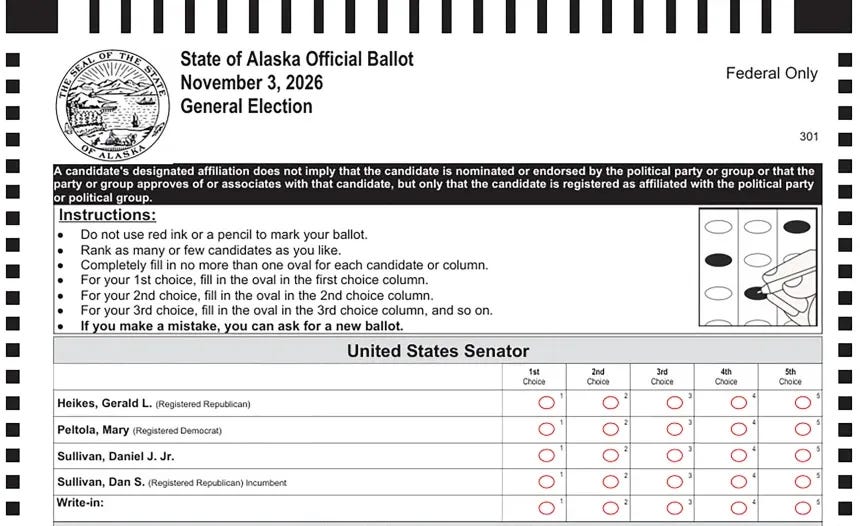
In Alaska, the administration is furious that Dan J. Sullivan, unaffiliated with any party, is on the ballot alongside the incumbent Republican, Sen. Dan Sullivan.
You can see the problem, of course, but the Alaska Supreme Court, which has jurisdiction over state ballot issues, already ruled on this and held that both Sullivans would stay on the ballot. So, Trump ordered up a lawsuit against Alaska, because we’re not even pretending any longer that he doesn’t control the DOJ.
The DOJ contends that voters will be confused by the two Sullivans and has asked the federal court to block certification of the election — but only if Mary Peltola wins. If that case, the administration wants an investigation into whether people were confused enough by the two Dan Sullivans that the GOP incumbent should just win anyway.
The only law the DOJ cites as giving it authority to do this is the preamble to the NVRA, which says one purpose of the law is “to protect the integrity of the electoral process.” But that law is about voter registration, not about what appears on ballots, and trying to bootstrap a vague statement of purpose from a preamble into a reason for the DOJ to dictate how ballots are counted is absurd.
If you’re wondering how on earth anyone would “investigate” the intentions of voters, keep wondering. The DOJ didn’t bother to explain how that would work, because it really wouldn’t.
The presence of two Dan Sullivans on the ballot is arguably far less confusing in Alaska than it might be elsewhere, because Alaska uses ranked-choice voting. A candidate can only win if they receive a majority — 50 percent+1 — of total votes cast. If, after the first round of counting, no candidate gets that majority, the candidate with the fewest votes is eliminated. The second choice on those ballots then goes to the remaining candidates, and counting continues in rounds until a candidate gets a majority.
If a confused voter who intended to vote for incumbent Sullivan as their first choice accidentally ranked the other Sullivan first, such an error is almost certain not to matter. That’s because the other Dan Sullivan is likely to receive far fewer votes than both the incumbent Dan Sullivan and his Democratic challenger, Peltola. In the primary, Incumbent Dan won 68,726 votes, while Random Dan got 4,107. Anyone who mistakes the order of their Dans would therefore have their Random Dan vote distributed to Incumbent Dan.
The state has also gone to significant lengths to reduce confusion. Incumbent Dan is listed on the ballot as “Sullivan, Dan S. (Registered Republican) Incumbent.” Random Dan is listed as “Sullivan, Daniel J. Jr.” and has no party affiliation. And despite Trump declaring that “a lot of people don’t know what incumbent means,” they generally do.
Normalizing malfeasance
Both of these lawsuits are laughable, but the purpose of them isn’t really to win. Instead, as Steve Vladeck explains, the goal is to normalize preemptive election interference: “Its whole point is to have the theories and the filings in place — and the specter of mischief in the air — before the counting starts so that the results can be attacked if, but only if, they don’t come out the ‘right’ way.”
If there were any doubt about that, Trump dispelled it with his Monday Truth Social post about Minnesota’s Senate race:
Let’s all get behind Michele Tafoya in Minnesota. She’s running a great race. Don’t allow them to play with the Votes after the race is over. The Federal Government will be watching closely. The only way she can lose is if they cheat by playing games with the Ballots as they come in. We can’t allow that to happen, because I won Minnesota three times but they didn’t give me the Victories, and Minnesota hasn’t been “won” since 1972, when Richard Nixon claimed the trophy.
So, in Alaska, if Mary Peltola wins, her victory is inherently suspect and must be investigated. And in Minnesota, if Peggy Flanagan bests Michele Tafoya, her victory is inherently suspect because Trump has declared that Tafoya can’t lose, period, unless Democrats cheat.
And this is the long, stupid shadow of the 2020 election. Elections where Trump — or any other Republican — wins are fine, but elections where Republicans lose are corrupt. The only solution, of course, is to let the DOJ intervene both before and after any elections that Trump has fixated on.
Trump may be deluded enough that he genuinely thinks these lawsuits are legitimate, but Todd Blanche and every attorney who signed off on these disgraceful filings know otherwise. And someday, they should suffer the consequences of their actions. For now, however, we’ll settle for both of these ridiculous lawsuits being tossed out.
That’s it for today
We’ll be back with more tomorrow. If you appreciate today’s PN, please do your part to keep us free by signing up for a paid subscription.
Thanks for reading.
I'm thinking that the legallly qualified people who supported these ridiculously flimsy charges out to be up for some sort of disciplinary action by the professional legal bodies. But I'm no lawyer.
It seems pretty plain that the election wave is such that no amount of screaming and obsfucating is going to seem credible to anyone but the hardened members of the Trump cult. But given how central democracy is to what the US is supposed to be about, this frontal assault on the workings and necessary public acceptance of the democratic process is tantamount to treason. These people only 'love America' as long as they are in charge. They are no patriots and should be told so.
PN always does great work but this is especially helpful. Thanks folks.