


This special Saturday edition of the newsletter is made possible by paid subscribers. Become one 👇
It’s small peanuts in comparison with the Trump regime’s brutal occupation of the Twin Cities and threats to obliterate NATO by “taking” Greenland, but it’s worth examining how the president’s authoritarianism has even extended to public golf courses in Washington DC.
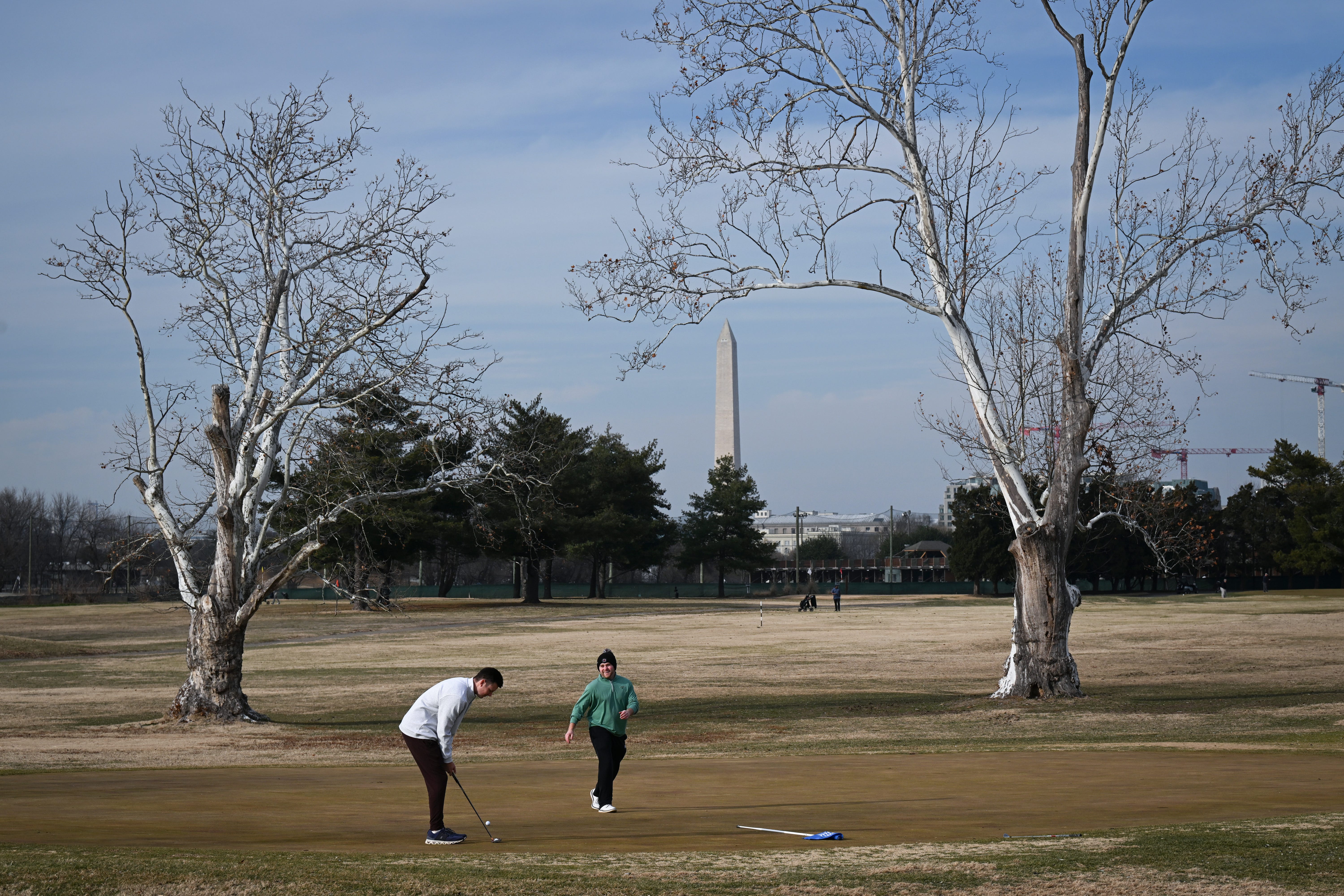
The administration recently took the step of unilaterally cancelling a 50-year lease it had previously negotiated with the operators of three public golf courses in DC. The announcement, made December 31., leaves the largely volunteer, non-profit course managers of the courses, the National Links Trust (NLT), in limbo over its ambitious, privately-funded renovation plans for the trio of properties.
This raises questions about the future day-to-day operations of golf at the three popular, affordable golf courses: East Potomac, Langston Park and Rock Creek Park. It also portends the possibility of Trump himself stepping in to redirect the future of public golf in DC, possibly converting it to a gaudy model of costly, championship-oriented golf under aegis of his own corporate entity, Trump Golf.

One of Trump’s favorite golf architects, Tom Fazio, told Public Notice he had lunch with Trump in the Oval Office “around Thanksgiving,” before he made an initial evaluation of East Potomac. The 36-hole property sides along the Potomac River, near the Tidal Basin.
“It’s a little early yet,” he said. “There has been no specific discussion of programming possibilities. But the potential is good.”
Fazio added that he and his staff would be returning this month to take a closer look at the site.
Nice golf course you have there …
For a guy who purports to love golf so much, Donald Trump sure disdains everyday public golfers. That’s the only conclusion one can draw from the latest episode of the Trump White House trying to muscle in on everyday American culture.
Apparently it has not been enough to propose plans for a monumental new arch near the Reflecting Pool, tear down historic office buildings whose design he finds objectionable, impose his name (illegally) on the Kennedy Center after strong-arming his way onto the board, or tearing down the East Wing of the White House to replace it with a monstrous banquet hall – not to mention announcing the creation of a new class of naval destroyers bearing – what else? – his name.

Now, Trump is positioning himself to steer the management of these popular daily-fee courses in DC into something much more upscale than their current incarnation as low-priced, accessible everyday public venues.
Trump has lately been calling for an entirely different approach to the sport in the city, one geared toward attracting major golf events and requiring hefty green fees. No surprise that the course redesigns for such a vision would take on an aesthetic more akin to gold-plated sensibility than to the scruffy, old-school style that has been embraced by the NLT and for which three big-name golf architects have already volunteered their services.
When it comes to affordable golf, DC has been woefully under-served for many years. Private club members and political power brokers have the run of a dozen private clubs in and around the city. But the 700,000 DC residents and tens of thousands of visitors enjoy only three facilities open to the public: East Potomac, Langston, and Rock Creek Park.
Despite its reputation as a game dominated by wealthy elites at private clubs, golf is overwhelmingly a public recreation. According to data from the National Golf Foundation, 70 percent of the country’s 16,000 golf courses and 75 percent of all rounds played in the US occur in the public domain. That includes daily fee, pay-as-you-go facilities, whether privately owned, municipally controlled or affiliated with a resort hotel. The average green fee per round is $40-$50 — hardly an extravagance. Golf is still a public good here in the US, as it is in Scotland, where the most famous course in the world, at St. Andrews, is also a municipal, daily-fee entity.
These three public golf courses were especially important to the largely Black population of DC — a demographic that had been historically excluded from the game at both private and public courses throughout the country. With Black golfers banned from membership in the PGA of America until 1961, the United Golfers Association was actually founded in DC back in 1925 as an organized response to racial barriers in the sport.
Five years into the new leasing agreements negotiated between the National Parks Service and the NLT — and approved by the Department of Interior during the first Trump administration — golf has been booming at these DC courses and renovation plans were imminent.

When demolition of the East Wing of the White House took place last fall to make way for a new banquet hall, the White House convinced East Potomac Golf Course to take the soil, threatening to revoke its lease if it refused. Even after the NLT accepted shipments of the material, the Trump administration filed notice on October 29 of a breach of contract, thereby opening the door to seizing control of the golf property and taking over day-to-day operations. No details or documentation of specific violations were cited, as is required by the contract. Trump then threatened to impose an entirely different — though yet unspecified — plan for the long-term character of East Potomac and the other two courses.
After news of the potential violation became public in a December 12 article in the Wall Street Journal, the NLT issued a conciliatory statement contesting claims of a contract violation.
“National Links Trust appreciates the President’s interest in the DC golf courses and looks forward to the opportunity to partner with the administration to improve these historically significant facilities. We respectfully disagree with the characterization that we are in default of our lease.”
Trump, of course, is no newcomer to golf course operations. His eponymous corporate golf entity lists a portfolio of sixteen golf properties, 11 in the US and the others in Scotland, Ireland, United Arab Emirates, and Indonesia. They include private, public, and resort courses, and all share one common trait: they’re extremely expensive to join and play. Tee times at Doral in Miami, for example, start at $235. At Turnberry-Ailsa Course in Scotland, mid-season rates run £1,000 per golfer.
Moreover, Trump and his properties are also closely allied with the insurgent world golf tour called LIV, sponsored by the infamous Saudi Public Investment Fund, a sovereign wealth entity with bottomless resources that’s trying to buy international credibility by spending hundreds of millions of dollars on star players like Phil Mickelson, Bryson DeChambeau, and Jon Rahm.
Trump’s golf properties in New Jersey, Virginia, and Miami are regularly on the LIV tournament rota. Trump has made no effort to hide his affection for brutal tyrants like the Saudi leader, Crown Prince Mohammed bin Salman. MBS, as he is known, has endorsed the broad objectives of LIV. More ominously, he is also widely believed to be the mastermind behind the slaying of Washington Post columnist Jamal Khashoggi, whose writings had been critical of the Saudi regime.

What precise plans Trump has for DC’s three public courses is yet to be determined. But we must take seriously his public statements about renovating East Potomac GC in such a way that it becomes suitable for championship golf, including a prestigious international Ryder Cup. If such a plan comes to fruition, it would require reducing the 36-hole property into a single 18-hole layout to allow room for tournament infrastructure, spectator stands, media, and merchandise tents.
At this moment there’s no doubt that the agreed-upon terms for NLT’s management of DC golf are now in peril. Until recently the NLT was mobilizing through a petition drive as well as leveraging social media to galvanize support for the original restoration plans. The goal was to develop public pressure against Trump’s incursion upon NLTs’ efforts to revive affordable, accessible golf in DC.
The wider political context is also important here, given Trump’s penchant for crony capitalism.
A nonstop assault on public goods
Commentators in recent months have come to calling Trump’s authoritarian-inclined politics “patrimonial” in nature. The term comes down to us from the German sociologist Max Weber.
Just over a century ago, Weber alerted Europeans to an ancient form of rule that he saw as resurfacing, one in which the space between the government and the leader was diminishing, if not nonexistent. Patrimonialism (sometimes called Sultanism) is a client-based form of rule in which the regime, and sometimes a single individual, secures obeisance by rewarding loyal vassals, often family members to whom power is usually ultimately passed.
Patrimonial leaders are known to be contemptuous and distrustful of ordinary people (subjects, not citizens as such), so they must eke out what legitimacy they can by appearing to be heir to a long tradition of norms and customs that scarcely anyone would question. Because in such a regime the leader and the political entity are one, questioning the leader means calling into question the nation.
Patrimonialism is essentially despotic in nature. In return for services, clients and retainers must be courted and their loyalty sustained through the allocation of land, and the chance to feed at the master’s table. This style of rule usually hallows itself through charismatic displays of awe and grandeur. Competence and investments in provisions that will generate huge returns far into the future are not hallmarks of patrimonial systems. Saudi Arabia’s MBS, Hungary’s Orban, and Turkey’s Erdogan are contemporary models.

What’s more, patrimonial leaders struggle to manage the economy because their business practices are highly irrational and erratic. They’re incredibly undisciplined, but often they can afford to be — several Middle Eastern countries are essentially patrimonial regimes, but rich as they are in natural resources means they can get away with considerable waste, fraud, and high levels of public corruption. That’s exactly how LIV operates: staying in business despite racking up huge losses because its political goals of “sportswashing” outweigh its poor performance in terms of not-for profit investments.
Most noteworthy about Trump’s rule at present is his singular talent for grabbing headlines, for ribbon-cuttings and weekly, sometimes daily announcements in cultural spheres such as those we are highlighting here. His administration is singularly skilled in “flooding the zone,” feeding the insatiable appetite of media in public spectacles of frenzied zeal, no matter the depth of the venal and the vain. It only works as long as rewards and honors are forthcoming to those who fall in line and endorse and subsidize the effort.
It is in this expanded political context, of the unpredictable grab for attention, headlines, and submission to arbitrary rule, that we need to understand Trump’s efforts to seize control over public golf in the nation’s capital. It constitutes a purely arbitrary and vindictive assault on a public good, one enjoyed by minorities in a city which he has long castigated as corrupt, crime-ridden, and worthy of military occupation despite the refusal of city leaders to accept that characterization.
The implications of this latest land grab are profound, not least for those seeking to provide an affordable public recreation to DC residents. The withdrawal of opportunities for public recreation goes hand in hand with Trump’s larger program of dismantling public services and core components of the welfare state – consistent, then, with the fate of affordable healthcare.
That he can do so here in the context of a sport to which he claims competence and experience makes the effort no less reprehensible. It also suggests the urgent need to resist it, as NLT has been scrambling to do — though its exact legal strategy going forward now has yet to be revealed.
What is clear is that this is not just about golf. It threatens to become yet another example of the arbitrary seizure and enclosure of public spaces for private control and reward.
That it for this week
If you enjoy this edition of PN, please support our work by becoming a paid subscriber.
Thanks for reading, and have a great weekend.
I was just waiting for the word "Black" to appear. A golf course that the Black and minority citizens of D.C. enjoy? Sacrilege! Golf is the sport of rich, white men and it gives Trump joy to snatch that recreation away from the people that he wants to drive out of "his" city and "his" country. Look for the ICE goons to be very, very busy on those courses if the management won't bend the knee to Trump.
And, how much taxpayer money is going to be used in this grift?