

PN is supported by paid subscribers. Become one ⬇️
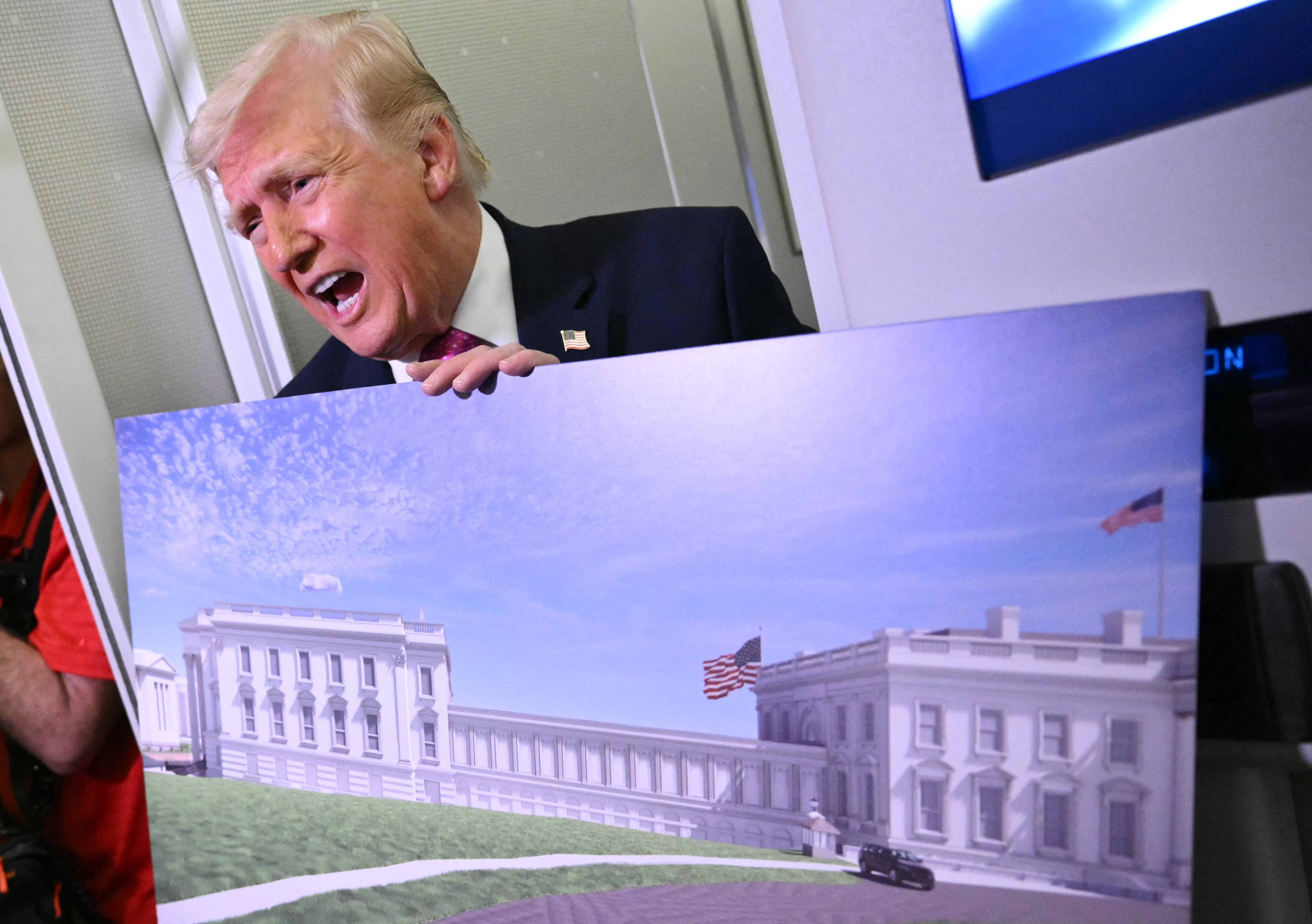
A federal judge just told President Trump he has to stop building his tacky, enormous ballroom until he gets congressional approval. Unsurprisingly, Trump immediately said he would keep building it anyway, trying to squeeze his precious new obsession through a national security-sized exception in Judge Richard Leon’s ruling.
Leon, a 76-year-old George W. Bush appointee, wrote a banger of an opinion granting the preliminary injunction requested by the plaintiff, the National Trust for Historic Preservation in the United States. The ruling makes crystal clear that the administration’s own arguments compelled the outcome here.
Yes, Donald Trump, you played yourself.
Leon gave administration officials every opportunity to cite some legal authority that allowed Trump to demolish the East Wing and build a 90,000-square-foot ballroom in its place, no pesky Congress needed, and they couldn’t. But to understand why Trump lost this week, we have to unpack why he hadn’t lost already.
“No statute comes close to giving the President the authority he claims”
Immediately after filing their lawsuit last December, the Trust moved for a temporary restraining order. Judge Leon denied it, saying the Trust had not shown it would suffer “irreparable harm” that warranted immediate relief. Then, in February, Leon denied the Trust’s motion for a preliminary injunction, saying neither of their legal theories offered them a path to relief.
The Trust initially argued that Trump violated the Administrative Procedure Act by failing to submit plans to review boards and by failing to prepare an environmental assessment. Leon’s February ruling, however, explained that the Office of Executive Residence (EXR), which the administration said was the entity managing the East Wing project, is not an agency for purposes of the APA.
So, no luck for the Trust there, and in part that was because the administration is adept at a sort of hypertechnical slipperiness that makes it impossible to pin down who to sue or how.

The Trust initially sued multiple entities that are indeed agencies and would, in a normal world, have something to do with the construction of a giant ballroom on federal government land, like the National Park Service, the Department of the Interior, and the General Services Administration. But the administration sidestepped this by saying that none of those agencies were responsible — only the EXR. Though the Trust then amended its complaint to include the EXR as a defendant, that couldn’t save a claim under the APA, because the APA applies only to agencies. So that neat little trick worked.
Next, the Trust amended their initial complaint to say that well, if the White House and the EXR and the president are the ones responsible, that’s a violation of the separation of powers. Under the Property Clause of the Constitution, only Congress has the power “to dispose of and make all needful Rules and Regulations respecting the Territory or other Property belonging to the United States.” Then, the administration shifted again, saying it was not claiming Trump had any constitutional authority to build the ballroom, but rather that he was relying on several federal statutes.
Judge Leon is no fool. There’s nothing, legally speaking, that can stop the administration from playing this sort of whack-a-mole game, but that doesn’t mean he has to go along with it. Hence his delicately noting, in the February order denying the Trust’s request for a preliminary injunction, that “the President’s source of legal authority to construct the ballroom was not apparent before the National Trust brought its motion.”
But since the administration has now disclaimed any constitutional authority, the Trust couldn’t prevail on its constitutional claim. So, Judge Leon really had no choice but to deny the preliminary injunction. He did, though, explain that the Trust could amend its complaint to bring what is called an ultra vires claim, alleging that Trump’s actions well exceeded his authority under the statutes he was now invoking as justification.
And here’s where Trump’s too-clever-by-half argument was his downfall. Yes, he notched a temporary win with the whole “not an agency, not the constitution” shell game, but by arguing that specific statutes authorized the ballroom, he was always eventually going to have to show how, exactly, those statutes did that.
So, after the Trust amended their complaint yet again to say that the three statutes the administration relied upon did not actually authorize Trump to build an enormous ballroom without congressional approval, they then brought a new motion for a preliminary injunction.
Third time’s the charm, and it wasn’t even close, per Judge Leon: “I have concluded that the National Trust is likely to succeed on the merits because no statute comes close to giving the President the authority he claims to have.”
To get to that conclusion, Judge Leon gave a masterclass in how — and how not — to interpret statutes.
“I’m allowed to continue building”
First, Trump claimed that 3 U.S.C. § 105(d)(1) lets him build anything, really, without going to Congress. That statute authorizes — but does not require — Congress to appropriate, each fiscal year, “such sums as may be necessary for the care, maintenance, repair, alteration, refurnishing, improvement, air-conditioning, heating, and lighting (including electric power and fixtures) of the Executive Residence at the White House.”
In 2024, Congress appropriated almost $2.5 million for the “repair, alteration, and improvement of the Executive Residence at the White House pursuant to 3 U.S.C. 105(d) … to remain available until expended, for required maintenance, resolution of safety and health issues, and continued preventative maintenance.” Trump argued that the terms “alteration” and “improvement” allowed him to “modify” the White House and “make it better,” including building a 90,000-square-foot ballroom. Leon called this “a brazen interpretation, indeed!” — and he’s not wrong.
There are specific rules, called canons of construction, that courts must use when interpreting statutes. Suffice it to say that arbitrarily plucking random words out of a statute and ignoring everything else is pretty much the exact opposite of how those rules work. A term that’s in dispute here, like “alteration,” must be interpreted in the context of the neighboring words in the statute. So, since “alteration” is surrounded by words like “refurnishing” and “air-conditioning,” reading it consistent with those terms, as Leon put it, “all strongly suggest minor ‘alteration[s]’ and ‘improvement[s],’ not wholesale demolition and reconstruction.”
Leon’s got more: “Under Defendants’ reading, virtually any change to the White House could be framed as an ‘alteration’ or ‘improvement.’ Indeed, some might even view tearing down the White House and building a modern skyscraper in its place as an ‘improvement.’”
Don’t give Trump any ideas.

Leon also didn’t buy the administration’s argument that because Trump is using private funds, 3 U.S.C. 105(d) means he can go buck wild and build anything. Indeed, he (accurately) called the whole funding scheme a “Rube Goldberg contraption.”
That’s because nothing about the funding actually matters for purposes of whether this statute can serve as authorization for Trump to build the ballroom without congressional approval. Or, as Leon put it: “Defendants cannot evade the limitations of 105(d)(1) and the 2024 appropriations act through a series of unrelated statutes that say nothing about the President, the White House, or the construction of a ballroom.”
There’s no permission slip buried somewhere in that statute. It’s simply about Congress appropriating money for the White House to do things like fix the air conditioning. But Trump was urging the court to read it as broadly as possible and stretch it beyond all rational meaning as a way to say it covers the ballroom.
But when it came to 40 U.S.C 8106, which says “a building or structure shall not be erected on any reservation, park, or public grounds of the Federal Government in the District of Columbia without express authority of Congress,” Trump prefer a much narrower reading, or perhaps simply that the statute could be magically disregarded somehow.
Buckle up, because the administration tried everything here.

First, they said, well, this is just general authority to build and isn’t about a specific building. Judge Leon batted that away, saying it’s “beside the point because Congress has not provided any authorization to Defendants. Without question, Congress has not specifically authorized the ballroom construction!”
The administration then said that the statute shouldn’t stop Trump from building whatever he wants because it should not be read to limit him, absent a clear statement in the statute from Congress. But their own past arguments tripped them up here as well. Judge Leon wrote that the clear statement rule “makes sense when Congress is legislating in an area where the President exercises overlapping constitutional authority.”
Next, the administration tried to say that the National Park Service has actually built “countless structures on national parkland” without congressional approval, and therefore, the court should basically pretend that the statute doesn’t exist. First, said Judge Leon, that’s not how interpreting statutes works. The court has to apply a statute as it reads, not go spelunking about to see how the statute has been used elsewhere. Oh, and also it turns out a lot of the “countless structures” the administration said were built without authorization actually were. Big surprise there.
Finally, the administration said that Section 8106 doesn’t apply to the White House because there have been White House alterations done without approval since that statute was passed. Well, not really, says Judge Leon. Congress authorized both the 1933 West Wing Expansion and the 1942 expansion through general appropriations. The smaller projects Trump pointed to, like President Ford putting in a pool in 1975 or his own installation of a tennis pavilion in 2019, were, Leon noted, much most modest, not challenged in court, not visible to the public, and for the president’s use. So, not remotely similar to a 90,000-square-foot ballroom.
After saying that no agency had any role in the project, to get out from under those pesky APA claims the Trust raised earlier, the administration then doubled back, saying that the National Park Service — most definitely an agency — has construction authority and therefore the court should deny the Trust’s request for a preliminary injunction.
Imagine being on the federal bench for decades and having to put up with this sort of garbage. Judge Leon’s exasperation here is palpable: “Indeed, it is difficult to understand how Defendants can rely on NPS’s construction authority while claiming that NPS ‘had (and has) no role in directing’ the ballroom project.” The administration tried to say that NPS “contracted” with EXR for the construction, but guess what? A contract means that NPS still has some role, so Judge Leon ruled that the Trust would therefore likely now succeed on the same type of APA claim they previously failed under, because there’s an agency involved after all.

The Trust also had to show it would suffer irreparable harm if construction wasn’t enjoined. In its complaint, the Trust alleged it would suffer aesthetic harm if the ballroom were built. In an argument that most lawyers would walk into the sea before making, the administration argued that because no one will actually see the big ugly ballroom for months, there is no imminent aesthetic harm. You can hear Judge Leon’s sigh through the page: “Defendants cannot seriously argue that Hoagland [a Trust member] has no claim for imminent aesthetic harm until the completed building is fully visible.”
When granting a preliminary injunction, judges must “balance” the harms, weighing the impact of the injunction on both parties. Here, the Trust — and the entire country — face harm when Trump changes the White House into the Trump House with no authority. And as far as harm to the government? Per Judge Leon, “the Government cannot suffer harm from an injunction that merely ends an unlawful practice.”
Trump can’t prevail by saying that, having started a wholly illegal thing, he will be harmed if he can’t finish the wholly illegal thing. But that’s pretty much what the administration is going for, because of course the ballroom is a matter of national security, the administration’s favorite fig leaf. This was vague when the administration first raised it, and most of the filings about the supposed national security aspects have been done ex parte, so only the judge gets to see it.
But a few days before Leon issued his ruling, Trump went and blabbed about how the ballroom is actually a “shed” that will cover a massive military complex being built underneath it and will therefore have things like bulletproof glass to protect the complex from drones and “any other things.”
Leon’s preliminary injunction excluded “construction necessary to ensure the safety and security of the White House,” so now Trump’s argument is that he needs the ballroom for safety and thus the order means “I’m allowed to continue building as necessary.”
Here are your exciting new ballroom safety features: “The roof is drone-proof. We have secure air-handling systems. You know, bad things happen in the air if you have bad people. We have bio-defense all over. We have secure telecommunications and communications all over. We have bomb shelters that we’re building. We have a hospital and very major medical facilities that we’re building.”
There’s a hospital now?
This nonsense means that the Trust has already had to go back to court, asking Judge Leon to clarify the scope of his injunction and pointing out that “the President’s belief appears to be that because various Ballroom features, if built, would be relevant to safety and security like ‘bulletproof and ballistic proof’ glass and a ‘drone-proof roof,’ the Court’s order allows Ballroom construction to proceed unabated now.”
The administration has already appealed the order to the DC Circuit and will no doubt eventually race to the Supreme Court to howl about the injustice of not letting Trump turn the People’s House into his own house, a constitutional crisis that must be addressed immediately.
Except Judge Leon’s order doesn’t stop Trump from building the ballroom. It just stops him until he gets congressional approval. “It is not too late for Congress to authorize the continued construction of the ballroom project. The President may at any time go to Congress to obtain express authority to construct a ballroom and to do so with private funds.”
It isn’t clear why Trump doesn’t just go ask Congress, given how pliable his Republican majorities are. After all, they’re letting him do a whole illegal war, so getting them to hold a quick little vote on allowing donor money to be used on his ugly ballroom does not seem like a reach.
It may simply be Trump’s bedrock belief that no other branch can constrain him, so he’s not required even to ask. It could be that Trump knows the votes aren’t there. Or it may even be that such a vote might bring to light more of what is going on with the construction, like the surprise hospital, and Trump does not want that scrutiny.
It remains to be seen whether Congress or the Supreme Court will bail Trump out, or if he’ll just keep building his ballroom anyway. Regardless, when a Democratic president gets in office, the first order of business needs to be to tear it all down to the studs. No trace of this monument to ego should remain.
That’s it for today
We’ll be back this afternoon with a new episode of Nir & Rupar and then with a special Saturday edition of the newsletter as well. If you appreciate today’s PN, please do your part to keep us free by signing up for a paid subscription.
Thanks for reading and for your support.
That last sentence over and over again. Tearing down his monstrosities, erasing his name and face from public edifices, and stripping out all his gold gewgaws will be a cathartic effort for all Americans!
A hospital??? Who will permanently staff the hospital? Who will pay for the staff, medicines and expensive medical devices as well as upgrades and service to those devices? What about those medicines? They do expire. And, ultimately, who will be allowed to go to that hospital? What a ridiculously absurd claim to make.