

This edition of PN is made possible by paid subscribers. Become one ⬇️
The Trump regime is trying to usher in a “Golden Age in Science” where scientific research is run like a Trump family business, artificial intelligence is all that matters, profit is everything, and expertise is for chumps.
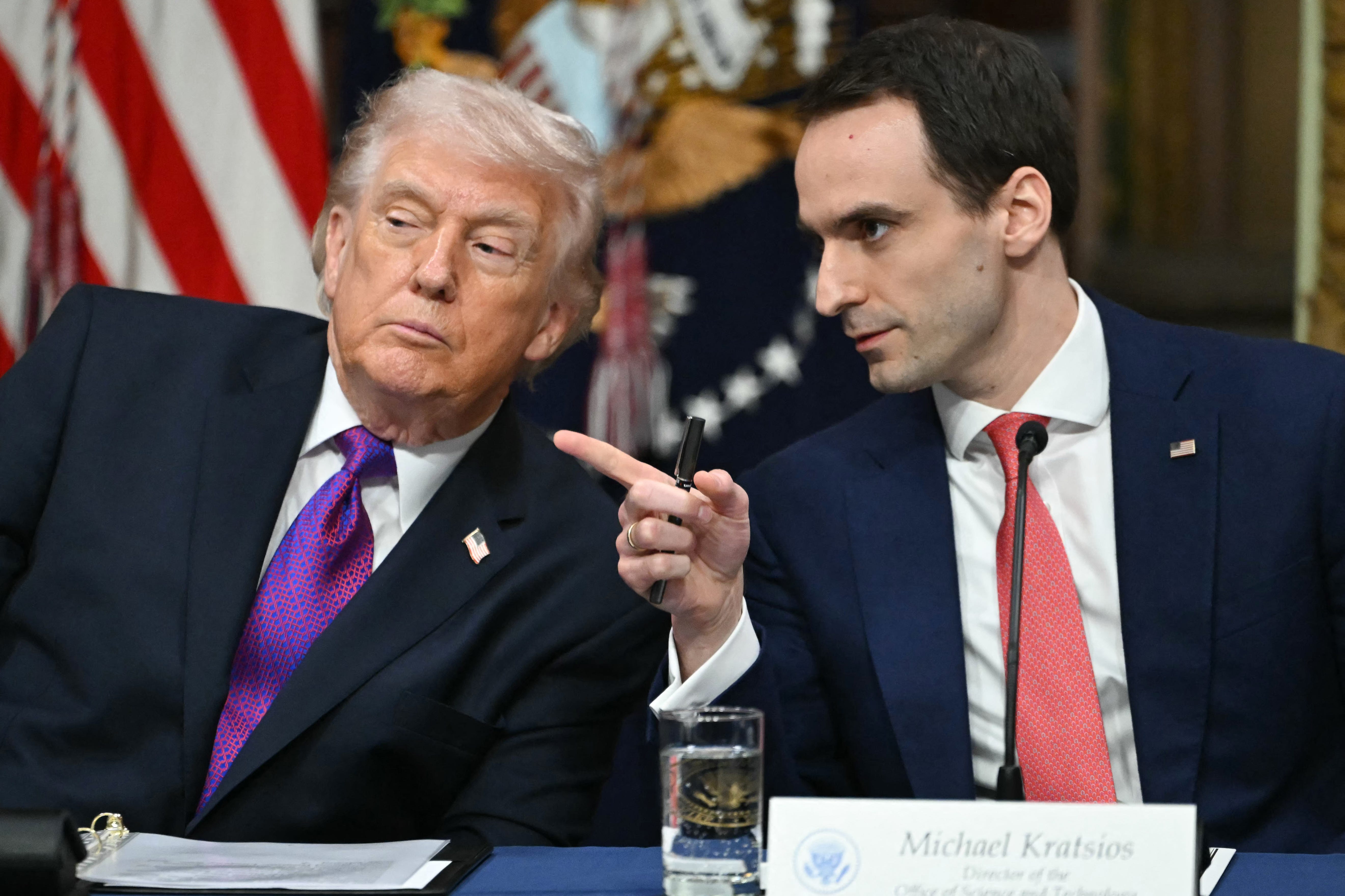
Or at least that’s the vision emerging from a new 123-page “Report to the President” from Michael Kratsios, the Director of the White House Office of Science and Technology Policy.
In a normal administration, you could probably skip over learning about a science policy document — but this is no normal administration, and this is no normal science policy document. Instead, it’s Trump’s attempt to end the actual golden age of science that was kicked off in 1945 with the publication of '“The Endless Frontier” by Vannevar Bush.

Bush, at President Franklin Delano Roosevelt’s request, laid out a vision of federal support for science that centered on funding universities to do basic research, saying that as long as those institutions were “vigorous and healthy and their scientists are free to pursue the truth wherever it may lead, there will be a flow of new scientific knowledge to those who can apply it to practical problems in Government, in industry, or elsewhere.”
Kratsios’s report is supposed to be the successor to Bush’s, and even apes the format, but this isn’t really a document about science policy. It’s one about ending science research as we know it in favor of shoveling cash at big tech companies.
While it might be temping to wave this away as an aspirational policy document, Trump has already begun to shift billions in research funds to AI projects and has taken a hatchet to science funding across the board. He’s teed up the shift Kratsios proposes here, and since neither Congress nor the Supreme Court seem inclined to stop him from doing whatever he wants with taxpayer money, it isn’t doomering or hyperbole to say we are staring down the barrel of a world where the only “science” the government intends to support is for-profit tech and defense advancements.
Science for dummies
Part of how you can tell this isn’t a document about science is that you are immediately faced with an absolute wall of business-speak of the worst sort. Did you know we must “tightly couple our science and technology enterprises to ensure that groundbreaking ideas invented in the United States are rapidly prototyped, tested, manufactured, and scaled domestically”? You do now!
That tone isn’t surprising, because Kratsios has no background in science or research. He has a bachelor’s in political science and spent most of his career working for Peter Thiel at Thiel Capital. After a stint in the first Trump administration as Chief Technology Officer, where he also did not do any science, Kratsios was tasked in 2020 with overseeing the Pentagon’s research budget for a brief time, a position that, as the Wall Street Journal put it, “carries a great deal of power in terms of dictating investment allocations.”
He spent the Biden years at Scale AI as “head of strategy,” which you will also note is neither a science nor a research job. But Scale AI has contracts with the Department of Defense and, as the Washington Post wrote in 2023, “has been aggressively pitching itself as the company that will help the US military in its existential battle with China.”
And now you have the necessary background for our new golden age, which is going to be a golden age of taking money away from scientists and universities and giving it to companies like Scale AI.
In a genuinely galling move, Katsios spends a lot of time slamming universities because of “administrative burdens on researchers” and the “well-documented inefficiencies” in academia, the message being that those damn universities waste the time of amazing researchers with paperwork.
Except it’s the administration that is attempting to impose inefficient, unnecessary burdens on those researchers with a proposed Office of Management and Budget rule that would require senior political appointees to approve every science grant and ensure it aligns with Trump’s personal priorities. Researchers would also have to seek prior government approval to attend conferences or publicize their research. And political appointees could terminate any grant at any time if they feel like it.

But when it comes to AI, we’re going to “restore permissionless innovation.” The report proposes to give lucky ducky innovators a pile of cash up front for grants lasting five years or longer, saying “awards should be fully-funded in year one, with all resources earmarked upfront, to minimize administrative burdens and reduce pressure for researchers to generate intermediate results to secure continued funding.”
Yeah, wouldn’t want to have to make the Very Special Tech Bros show results or get money parceled out year by year like the plebes at universities.
The report also proposes that we should have “fast grants” with “simplified applications requiring just a few pages of writing” because that is definitely how science works, just writing a bit off the dome and getting some cash.

Oh, and we should have prizes and challenges, where multiple teams compete. The proposed prizes include incentives like “advance procurement commitments,” which means the federal government agrees to buy whatever is being developed. There’s also “regulatory fast-tracking,” making sure all those great AI thingies don’t have to wait too long to be unleashed on a market.
These aren’t incentives to do science. These are incentives to develop things with tax dollars that you can then sell to the government for more tax dollars.
In the suggestion that might be the most unhinged, the most very opposite of how both government and research work, our new age will include “golden tickets.” That’s where an individual reviewer in an agency — yes, just one person — can “recommend unconventional proposals that may not pass consensus-driven review panels” because somehow this will “surface valuable ideas too divisive for committees and attract higher quality reviewers by empowering them to exercise independent scientific judgment.”
Yes, that’s saying that a random person in an agency should be able to shovel money at some idea even if it can’t pass a review panel, and that the opportunity to do so will attract better employees because apparently all the best minds in science are chomping at the bit to be allowed to unilaterally fund AI research based on their personal vibes.
But that isn’t at all how actual science works, and actual scientists aren’t unhappy about review panels. They work collaboratively, not siloed in some secret race to create the next AI chatbot. A 2020 study by the National Bureau of Economic Research examined whether peer review panels succeed in helping agencies predict which research ideas will best advance science. Peer review was better at finding “diamond in the rough” applicants than a single government program official.
How about that.
Trump always wants a taste
It’s painfully clear that what Katsios is trying to do here is turn the whole of government science research and funding into the sort of “move fast and break things” paradigm that is the hallmark of big tech. That method works to line the pockets of tech executives, but it isn’t science.
There’s a reason the government funds different kinds of research than private tech companies do. What Katsios either fails to understand or deliberately ignores is that the federal government is the main funder of basic research precisely because it can take a long time for it to bear fruit and is not intended to be profitable as such.
“Basic” here does not mean rudimentary or simple, but rather research that is designed to advance scientific knowledge instead of achieving a specific outcome or product. Big tech companies don’t widely fund that sort of research, because it doesn’t make them money. Industry dollars account for only about 20 percent of basic research funding, while the government contributes around 60 percent.
Big tech companies and startups do, however, rely on and benefit from that basic research. A 2019 study found that 35 percent of all patents obtained by venture-backed startups from 1976 to 2016 cited federally supported research. Basic research funded by the NIH contributed to every single drug the FDA approved from 2010 to 2016.

Unlike inventing the next ChatGPT, actual science is slow and iterative. Government funding of research that, on its face, would not appear to lead to any big new invention is actually what underpins those big new inventions.
If the government hadn’t funded research into desert lizard venom, we wouldn’t know about semaglutide, and we wouldn’t have Ozempic. If research scientists hadn’t studied how bees optimize nectar foraging within a colony, we wouldn’t have the algorithm that assigns internet traffic across computer servers.
The report assiduously ignores that a symbiotic, profitable relationship between the federal government, universities, and private companies already exists. Each federal research dollar generates about $1.50 to $3.00 in long-term economic benefits. The $36 billion the government awarded in NIH research funding in fiscal year 2025 generated $94 billion in new economic activity.
Trump’s proposed new golden age is intended to strip those billions from universities, resulting in the dismantling of departments and the shuttering of labs. But Katsios has a plan for that: Universities should just become trade schools to churn out no-show STEM degrees!
“Require universities and community colleges to embed practical technical training and externships into STEM curricula. Let hands-on experience and industry credentials count toward degrees.”
It’s quite the feat to, on the one hand, strip schools of funding for scientific research while simultaneously demanding to control what is taught and, oh, also, colleges need to give degrees to employees at big tech companies just for being employees at big tech companies.
The new golden age would also exacerbate the brain drain Trump’s policies have already caused. Nature found that in the first quarter of 2025, US scientists submitted 32 percent more job applications abroad than in 2024. A March 2025 poll by Nature of roughly 1,600 scientists found that over 1,200 said they were considering leaving the country. Europe is investing $565 million to make it a “magnet for researchers” and provide funding for scientists who relocate.
The new golden age is also about embedding Trump’s xenophobia into the fabric of American science. The report complains of an “over-reliance on foreign students” that “creates a security challenge our institutions are ill-equipped to address” and that a “reliance on foreign talent sidelines American students.”
This is, to put it mildly, nonsense. International students pay far higher tuition and often receive no financial aid. Their tuition dollars are what make it possible for American students to get financial aid.
In the 2023-2024 school year alone, international students contributed $43.8 billion to the US economy and supported over 378,000 jobs. Those 1.1 million international students accounted for only six percent of the total number of students in higher education that year, but were such an economic engine that for every three international students, one job was created or supported.
It’s impossible not to wonder whether part of Trump’s loathing for universities and their leading role in scientific research is that there is no way for him to corrupt the process and make money off it in the same way he can by giving millions and billions to Silicon Valley types who, in turn, give him millions in cash. There’s no way for his children to invest in universities that the government then gives no-bid contracts to, fattening the family’s bottom line, which is pretty much the Trump sons’ current venture capital practice.
Trump and Katsios’s view of science is narrow, cramped, and wrong. We’re not in a crisis, we’re not a failed state. We’ve been a science superpower for decades, and the only thing that threatens that is Donald Trump.
Tech bros are already living high off the hog in this administration. They don’t need any more of our tax dollars. Hopefully this new golden age never comes to pass.
That’s it for today
We’ll be back with more tomorrow. If you appreciate today’s PN, please do your part to keep us free by signing up for a paid subscription.
Thanks for reading, and for your support.
Biden had a sensible approach, which of course Trump had to dismantle instantly. ARPA-H and various AI programs. Golden tickets and political priorities are almost surely an invitiation to corruption.
Meanwhile, as massive money flows into AI in the private sector, surely Musk and Thiel and Bezos and Altman and the like can fund any and all such applied research. At the very least, they could pay some taxes before tapping into federal funding for their benefit.
Please keep talking about this.
Great piece! Thanks for the clear explanation of Trump’s research policy. If Trump does run scientific research like one of his businesses, we are guaranteed two things: corruption and bankruptcy.