

This special Saturday edition of PN is supported by paid subscribers. Become one ⬇️
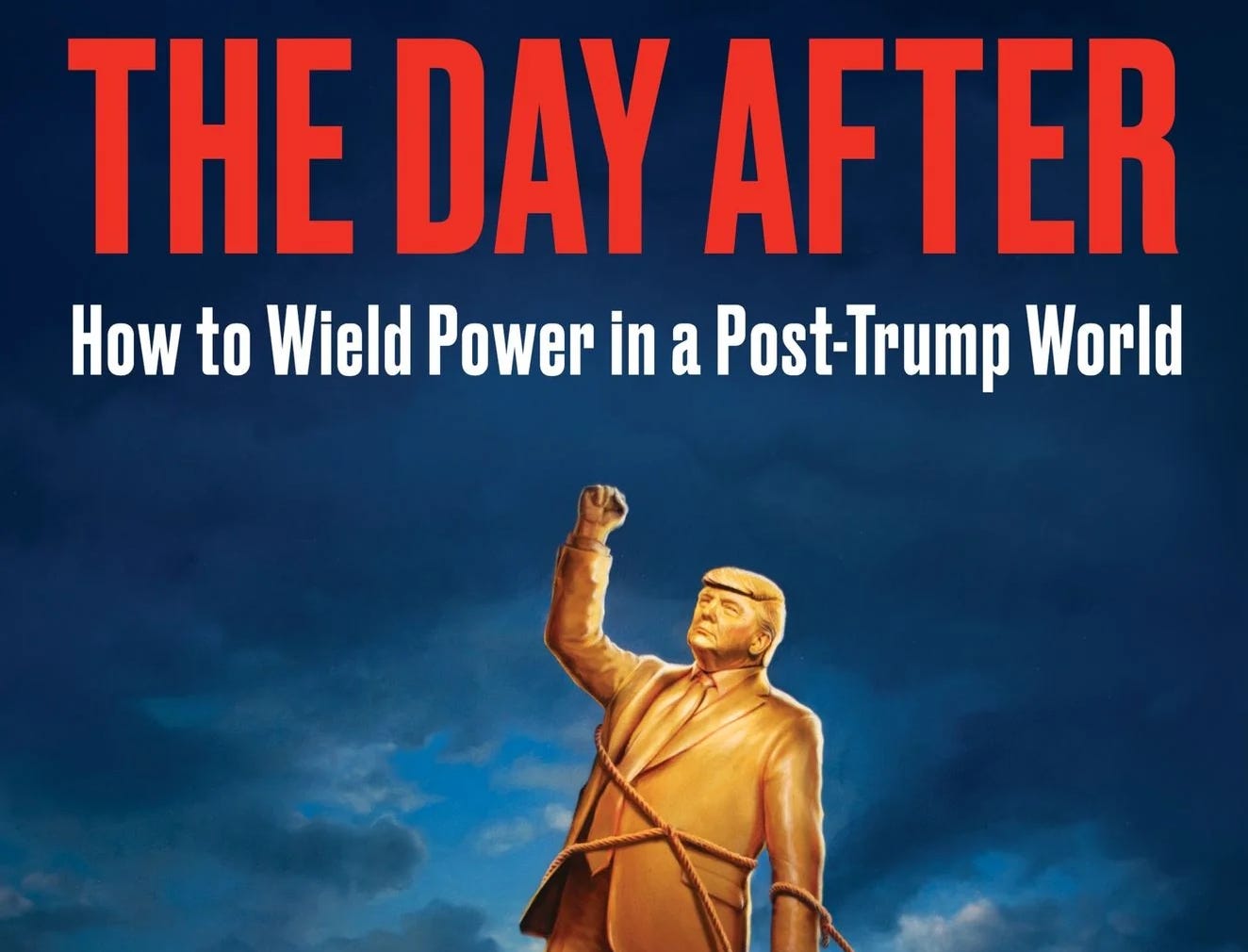
As a weekend bonus, I connected this week with my friend Brian Tyler Cohen to discuss his new and highly recommended book, “The Day After: How to Wield Power in a Post-Trump World.”
Brian needs no introduction to readers of this newsletter. But suffice it to say that on top of being one of the most influential left-wing creators on YouTube and TikTok, he’s a fantastic author. “The Day After” not only makes an argument about the need for Democrats to govern more forcefully the next time they have a chance, but also provides a deeply researched account of the political failures that led to the disaster of November 2024 and the party being locked out of power.
We chatted on Wednesday when Brian was fresh off a flight to New York from DC ahead of an event he had that night with Don Lemon. In addition to his book, we got into his inclusion on the White House’s “media offenders list,” talked about which Democrats he thinks are standing out right now, and much more.
Without further ado, here’s the Q&A.
Aaron Rupar
We’ll get to the book, but I wanted to ask you first about being included in the White House’s “Media Offenders List.” What “offense” did you allegedly commit, and did it resulted in an increase in harassment?
Brian Tyler Cohen
I think the specific offense was some banal post about the Park Service, which certainly didn’t warrant inclusion on any “media offenders” list.


But alas, I guess they have a low threshold for what they view as dishonesty from the left, and no threshold for dishonesty from the White House itself.
In terms of fallout, yes, I saw an uptick in harassment. It was nothing that dissuaded me from doing the work I do, but the point of course is the harassment itself. The Trump administration knew that would be the consequence and used a tool of the federal government as a cudgel against a political foe.
But the interesting thing from my part is that after seeing how law firms and universities and tech companies and legacy media outlets have all capitulated to Trump when they’ve been in his crosshairs, I wanted to make sure I used this moment to not do what they’ve done even if it would’ve been easier and frankly safer for me to have just quieted down. Capitulation begets more capitulation and cowardice begets more cowardice.
So I wanted to use the opportunity to show that the gut reaction doesn’t have to be cowardice. I wore it as a badge of honor and talked about it every day. I amplified it. I even put it on t-shirts. I embraced it to show this administration that they weren’t going to be successful in trying to quell me into submission or silence.
In the aftermath of that, so many other creators saw it and said, “I want inclusion on this list, how do I get onto it?” Interestingly, they still haven’t added anybody else to it. I think that’s because it backfired, and that’s the beauty of independent media.
All these big companies and rich executives need something from the federal government. They need approvals for mergers or acquisitions or whatever it may be. But independent media has no reason to kowtow or pander to these people. And so in a way it put on full display why independent media is so important in this moment.
Aaron Rupar
We know that if there’s one thing Trump is good at, it’s the “Streisand effect” of accidentally bringing attention to things he wants people to ignore.
But let’s talk about your new book. At one point, you write that Biden and Harris “weren't wrong about Donald Trump and his MAGA mob; they were wrong about the voters.” What did you mean by that?
Brian Tyler Cohen
In large part, Trump and Republicans ran against the system, and the reflexive response by Democrats was that if Trump is tearing it all down, we have to be the de facto defenders of the status quo and our institutions. But there was no appetite for that in the country.
These are institutions that don’t work for the vast majority of people. I mean, you’ve heard the statistic that 40 percent of Americans can’t afford a $400 emergency. But I think it’s instructive more broadly because Democrats’ blind deference to institutions is in large part what holds us back from really getting stuff done. Trump doesn’t let any institution stand in his way. If he wants to do something, he’ll do it — courts be damned, other branches of government be damned, judges be damned, attorneys be damned.
Meanwhile, Democrats will let the smallest obstacle prevent us from delivering. So in this moment, we can learn from the fact that these institutions are not as sacrosanct as we’ve been led to believe. We have to be okay tearing them down if it means it helps us deliver for people on all of the things that we claim to support, like healthcare, voting rights, climate, and on and on.
Aaron Rupar
Another case you make in the book is for Democrats to tap into frustrations that people have. You write in the epilogue about how voters are deeply unhappy with the status quo and “the Trumpian revolution.”
As we head toward a critical midterm cycle, are you satisfied that Democrats are internalizing some of these lessons and are perhaps more willing now to do what Trump did and campaign against the whole system, especially since he and his party control the entire federal government?
Brian Tyler Cohen
I think Democrats are understanding where voters are at. Whether they act on it remains to be seen.
The whole point of this book is to push them in that direction. We won’t know what they’ll do until they’re in a position of power, but my warning to them is you’ve already got a very disaffected and disillusioned electorate, which is what pushed a broad swath of Americans to Trump and Republicans in 2024. Now you’ve got an even more disillusioned electorate because Trump outright refuses to deliver on his promises.
Voters are disillusioned with the right and the left. And so we have a rare second bite of the apple here where we can either deliver for these people or risk losing them forever. And if that’s the case, if we have just a whole generation of Americans who are disaffected with politics, those are the conditions where autocracy really thrives.
Aaron Rupar
How do you make sense of the fact that while Democrats have had a very impressive string of electoral victories since November 2024, the party still polls so poorly when surveyed in isolation?
Brian Tyler Cohen
Democrats have been able to coast off anti-Trump sentiment, but this is going to be the last election where he remains in office. We need a longer term strategy. If we want to make sure we can have a durable coalition, we have to have a plan beyond “Trump is bad.”
Aaron Rupar
Of course, to get to the “day after” when Democrats are able to wield power again, they need to win elections first. And as soon as these midterms come and go, we’ll be talking about the 2028 presidential primary.
The last time there was a serious Democratic presidential primary back in 2019 and ‘20, candidates fixated a lot on plans and policies, sometimes to their detriment — I’m thinking of Kamala Harris’s comments about trans inmates that were all over Trump ads in 2024. If Democrats internalize some of the lessons from your book, what do you think the broad contours of a successful presidential campaign will look like two years from now?
Brian Tyler Cohen
We don’t even need to talk theoretically. I think Mamdani and Ossoff are examples of Democrats who are doing it really well right now.
Mamdani during his campaign stayed focused on his message of delivering for people despite the best efforts of reporters to bait him with the usual politics bullshit, and he’s governing that way too. Ossoff doesn’t get distracted from his message of amplifying the corruption of this administration. It’s a lesson that I think Bernie Sanders imparted on this new generation of politicians — building up credibility by being relentlessly on message so people know what you’re about.
Even if you don’t agree with Bernie, there’s no doubt that he has credibility. So I think these politicians who refuse to allow themselves to fall into a lot of the culture war bullshit that has really driven campaigns in the past are offering a great blueprint.
Aaron Rupar
In terms of the “day after,” given how polarized the country is and Republican efforts to rig elections in a variety of ways, it’s unlikely that Democrats will have anything but a narrow trifecta in 2029 if they’re lucky enough to have one at all. You talked earlier about how one of the lessons of Trump is that it’s possible to just do things and ask questions later. I don’t think we’d necessarily want to endorse a Democratic president taking that approach, but what would effective and durable governance look like under these conditions?
Brian Tyler Cohen
It certainly wouldn’t look like trying to curry favor or compromise with a Republican Party that doesn’t reciprocate and has frankly never reciprocated. Practically, it’s about eliminating the filibuster and starting to pass the legislation that Democrats claim to have supported for years and years and years. We need a new Freedom to Vote Act, Voting Rights Act, an increase in the minimum wage, and real, durable climate legislation. Frankly, I think the time for Medicare for All has come as well. The notion that we’re the wealthiest country in the world and don’t have universal healthcare for our citizens is crazy.
Aaron Rupar
Lastly, I’m curious about what inspired you to write this book. Obviously, putting something like this together, with all the research you did, is a Herculean task on top of all the day-to-day work you do. I know it’s not your first book, so you have experience, but given the timing, I’m wondering if it was a way to process the 2024 election results or how off the rails the first year of Trump 2.0 was, or some combination thereof.
Brian Tyler Cohen
I think it’s more the former. I’m fortunate enough to be in a position where I have access to a lot of these politicians and host interviews with them almost on a daily basis on my channels. And so if I can be helpful from my position, especially in a moment where we do feel a little bit rudderless and the media landscape is rapidly changing, then I feel like I need to do my part.
Look, I can see very plainly that there is a hunger for Democrats to not be feckless, not be the party of strongly worded letters. And if I can be one of a whole litany of voices demanding they start to embrace a more aggressive mentality, a willingness to fight, then I think I have an obligation given my position in this ecosystem to say it.
That’s it for this week
We’ll be back with more Monday. If you appreciate today’s PN, please do your part to keep us free by signing up for a paid subscription.
Thanks for reading, and for your support. Have a great weekend.
Great interview. And I will buy the book. In an earlier post, Aaron mentioned a person who canceled his subscription because he was exhausted by all of the coverage. We are all exhausted, but this is the time to suppoer independent media while we still can. Sometimes, I'm mentally and emotionally unable to read all the posts I subscribe to, so I don't read that day. But I continue to subscribe so that they have the resources they need.
"given how polarized the country is"
I just listened to an interview with HCR, & the interviewer asked her about this. & her response was that the PEOPLE aren't that polarized. for ex, & I've seen this before, probably back in 2016, she pointed out that ~80% of Americans want something like universal healthcare. There's a whole list of policies/programs that a large majority of Americans want. (& it's not Project 2025). But politicians haven't been delivering them.